
Online conversations move fast. Messages appear every second, and people often jump in and out of chats quickly. In the middle of a conversation, you might suddenly see someone type “AFK.”
If you have ever wondered what it means, you are not alone.
Many people search for “AFK mean in text” because the abbreviation appears everywhere. It shows up in gaming chats, WhatsApp groups, Instagram messages, and even work platforms like Slack or Discord.
At first glance, it may look confusing. Some people assume it is an emotion, a code, or even a typo.
In reality, AFK is one of the oldest and most widely used internet expressions. Understanding it helps you follow conversations more easily and communicate naturally online.
Let’s break down the meaning, origin, emotional tone, and real-life usage of AFK in everyday digital conversations.
AFK – Quick Meaning
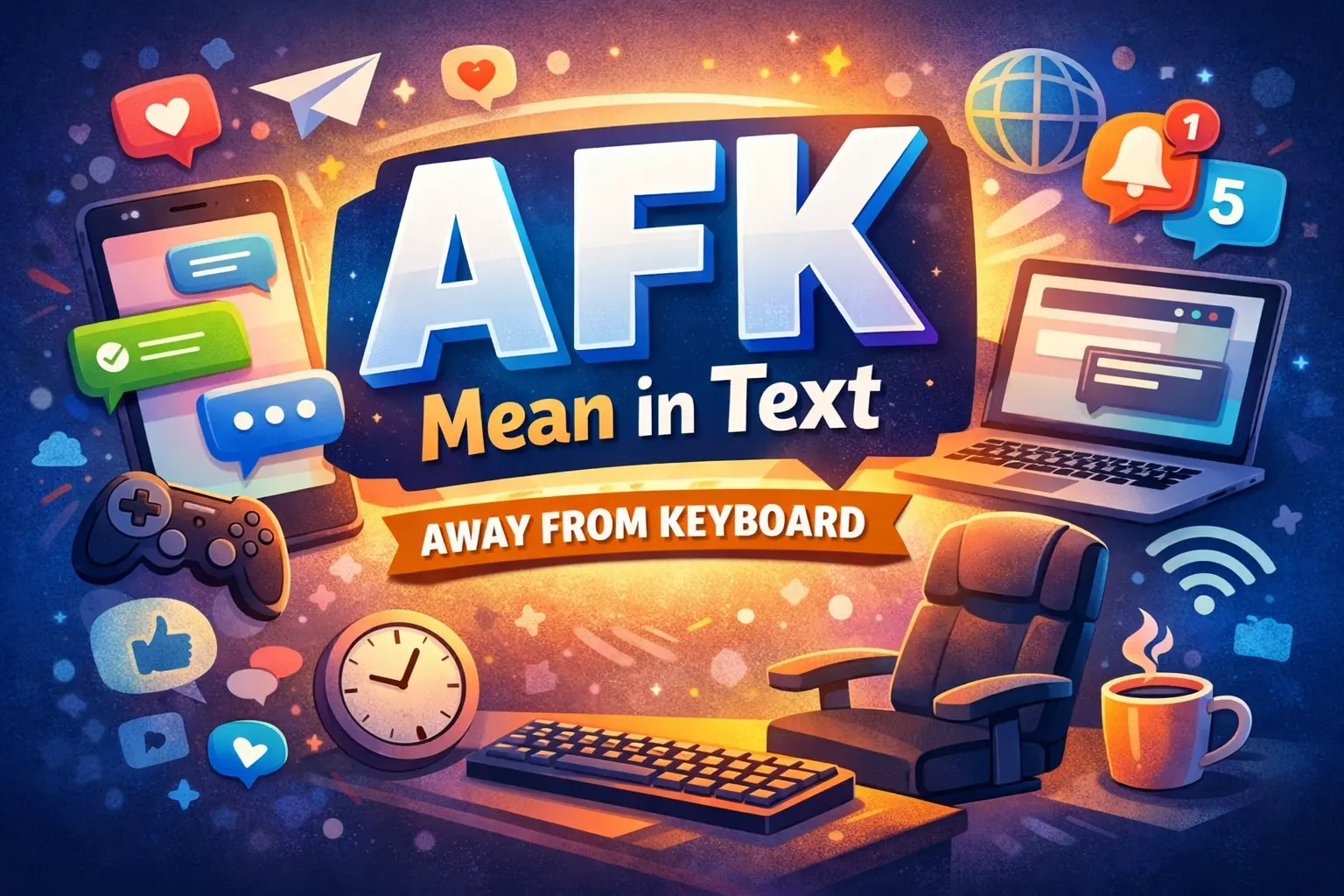
AFK stands for “Away From Keyboard.”
It is used when someone wants to tell others they are temporarily stepping away from their device or chat.
People often type it quickly to avoid leaving others wondering why they stopped replying.
Simple Definition
AFK means the person is not actively present in the conversation right now.
Common Situations
People use AFK when they:
- Step away from their computer or phone
- Pause a conversation for a moment
- Leave a game temporarily
- Take a quick break from chatting
Quick Examples
“Hold on guys, AFK for 5 minutes.”
“Dinner time. AFK.”
“AFK brb.”
Even though it originally referred to keyboards, today it simply means “I’m stepping away for a bit.”
Origin & Background
The phrase AFK began in early internet culture during the late 1990s and early 2000s.
At that time, most online communication happened on desktop computers through platforms like chat rooms, internet forums, and early messaging programs.
People literally sat at a keyboard while chatting.
So when someone needed to step away, they typed “AFK.”
It was a quick way to let others know they were still part of the conversation but temporarily unavailable.
Early Gaming Culture
AFK became extremely popular in online gaming communities.
In multiplayer games, teamwork and timing matter. If a player suddenly stops moving, teammates need to know why.
Typing “AFK” informed everyone that the player had stepped away.
Social Media Expansion
As smartphones replaced desktop computers, the meaning expanded.
Today, people still say AFK even when they are not using a keyboard at all.
It now simply means:
“I’m not here right now.”
Cultural Evolution
Over time, AFK became part of everyday internet language.
It appears in:
- Gaming chats
- Discord servers
- WhatsApp groups
- Twitch streams
- Instagram messages
Despite being decades old, AFK remains one of the most recognized internet abbreviations.
Real-Life Conversations
Seeing AFK in real conversations makes its meaning much clearer.
Here are realistic examples from different platforms.
WhatsApp Conversation
Person A:
“Did you finish the assignment?”
Person B:
“Almost. Need to check one thing.”
Person B:
“AFK for 10 mins, mom calling.”
Person A:
“No worries.”
Instagram DM
Person A:
“Wait did you see that new reel?”
Person B:
“Yes 😂”
Person B:
“AFK, my food just arrived.”
Person A:
“Send pics later!”
TikTok Comments
Person A:
“This stream is chaotic 😂”
Person B:
“Streamer went AFK again lol”
Person C:
“He always does that.”
Text Message
Person A:
“Are you still there?”
Person B:
“Sorry AFK. Was driving.”
Person A:
“Got it.”
These small interactions show how AFK prevents confusion in conversations.
Emotional & Psychological Meaning
Even though AFK looks simple, it carries subtle emotional meaning.
When someone says AFK, they are showing respect for the conversation.
Instead of disappearing silently, they let others know they will be away.
This small gesture maintains trust and smooth communication.
What AFK Often Communicates
It may signal:
- Politeness
- Transparency
- Temporary pause
- Continued interest in the conversation
A Personal-Style Scenario
Imagine chatting with a close friend late at night.
The conversation is meaningful, and suddenly they stop responding. Minutes pass. Then you see a message:
“AFK, had to help my sister with something.”
That simple message instantly removes uncertainty. You know they did not ignore you.
This is why AFK remains powerful in digital communication.
It reassures people.
Usage in Different Contexts
The meaning of AFK stays the same, but its tone can change depending on where it is used.
Social Media
On platforms like Discord, Twitch, or gaming chats, AFK is extremely common.
Example:
“AFK for a minute, grabbing coffee.”
People use it casually without explanation.
Friends and Relationships
Among friends, AFK often sounds relaxed and natural.
Example:
“AFK, my phone is dying.”
It feels friendly and informal.
Work or Professional Settings
In professional chats, AFK can still appear but usually with more context.
Example:
“AFK for lunch, back at 1 PM.”
Here, it communicates availability clearly.
Casual vs Serious Tone
AFK is generally casual.
However, adding details makes it sound more responsible.
Example:
“AFK for a meeting.”
When NOT to Use It
Even though AFK is common, there are situations where it may feel inappropriate.
Formal Communication
In highly formal emails or business reports, abbreviations like AFK may look unprofessional.
Instead, write:
“I will be away from my desk.”
Sensitive Conversations
If someone is sharing something emotional, suddenly typing AFK can feel dismissive.
A more thoughtful message would help.
Example:
“Give me a moment, I’ll respond shortly.”
Important Work Discussions
In serious meetings or urgent team chats, clarity is better than slang.
Common Misunderstandings
Many people misinterpret AFK when they first see it.
Thinking It Means “Offline”
AFK does not always mean someone left the internet.
It only means they are temporarily away.
Assuming It Means Ignoring
Sometimes people think AFK is an excuse to avoid replying.
But most of the time it simply means a short break.
Confusing It With Other Slang
Some people mix it up with expressions like BRB or GTG.
Each has slightly different timing and intention.
Comparison Table
| Expression | Meaning | When Used |
|---|---|---|
| AFK | Away from keyboard | Temporarily stepping away |
| BRB | Be right back | Very short break |
| GTG | Got to go | Leaving conversation |
| Offline | Not connected | Not using internet |
| Busy | Occupied | Unable to talk |
Key Insight
AFK specifically signals temporary absence, while many other expressions imply leaving entirely.
That subtle difference keeps conversations flowing naturally.
Variations / Types
Here are common variations related to AFK.
1. AFK BRB
Away briefly and will return soon.
2. AFK 5 Min
Indicates a short break.
3. AFK Dinner
Stepping away to eat.
4. AFK Phone Call
Leaving chat for a call.
5. AFK Bathroom Break
Used humorously among friends.
6. AFK Work
Busy with tasks.
7. AFK Family Time
Stepping away to spend time offline.
8. AFK Study Mode
Focusing on schoolwork.
9. AFK Real Life
Playful way of saying real life responsibilities came up.
10. AFK Internet Issues
Temporary technical problems.
How to Respond When Someone Uses It
Responses depend on your tone and relationship.
Casual Replies
“No problem.”
“Alright.”
“See you in a bit.”
Funny Replies
“Don’t get lost.”
“Bring snacks when you return.”
“AFK but thinking of us? 😂”
Mature Replies
“Take your time.”
“Message when you’re back.”
Respectful Replies
“Got it. I’ll wait.”
“No rush.”
Regional & Cultural Usage
Internet slang spreads across cultures, but usage patterns vary.
Western Culture
In North America and Europe, AFK is extremely common in gaming and workplace chats.
People understand it instantly.
Asian Culture
In countries like South Korea and Japan, gaming communities widely use AFK.
However, some messaging apps may use local equivalents.
Middle Eastern Culture
Among younger internet users, AFK appears frequently in gaming and Discord groups.
Older users may prefer full sentences.
Global Internet Usage
AFK has become part of universal online language.
Even people with different native languages recognize it.
Generational Differences
Gen Z tends to combine AFK with other slang.
Example:
“AFK lol.”
Millennials usually use it more straightforwardly.
Example:
“AFK for lunch.”
Is It Safe for Kids?
Yes. AFK is completely safe for kids.
It does not contain offensive language or inappropriate meaning.
Parents may even appreciate it because it teaches children to communicate clearly when stepping away from online activities.
FAQs
What does AFK mean in text?
AFK means “Away From Keyboard.” It tells others that someone is temporarily stepping away from a conversation or device.
Is AFK only used in gaming?
No. While it started in gaming culture, AFK now appears in texting, social media chats, and workplace messaging.
How long does AFK usually mean?
It typically means a short break, ranging from a few minutes to about an hour.
What is the difference between AFK and BRB?
AFK means someone stepped away, while BRB suggests they will return very quickly.
Can AFK be used on phones?
Yes. Even though phones do not have keyboards in the traditional sense, people still use AFK to mean they stepped away.
Is AFK rude?
Not at all. In fact, it is often polite because it lets others know why someone stopped replying.
Do professionals use AFK?
Sometimes, especially in team chats like Slack or Discord. In very formal situations, full sentences are preferred.
Conclusion
Digital conversations are fast and sometimes unpredictable. People step away, multitask, and return to chats throughout the day.
That is where AFK plays an important role.
It is a small phrase with a clear purpose. Instead of leaving others confused, it signals that someone is temporarily unavailable but still part of the conversation.
Over the years, AFK has evolved from early internet chat rooms into a global communication habit used across games, social media, and messaging apps.
Understanding this simple abbreviation helps you navigate modern online conversations with confidence.
Next time you see AFK in a text, you will know exactly what it means and how to respond naturally.