

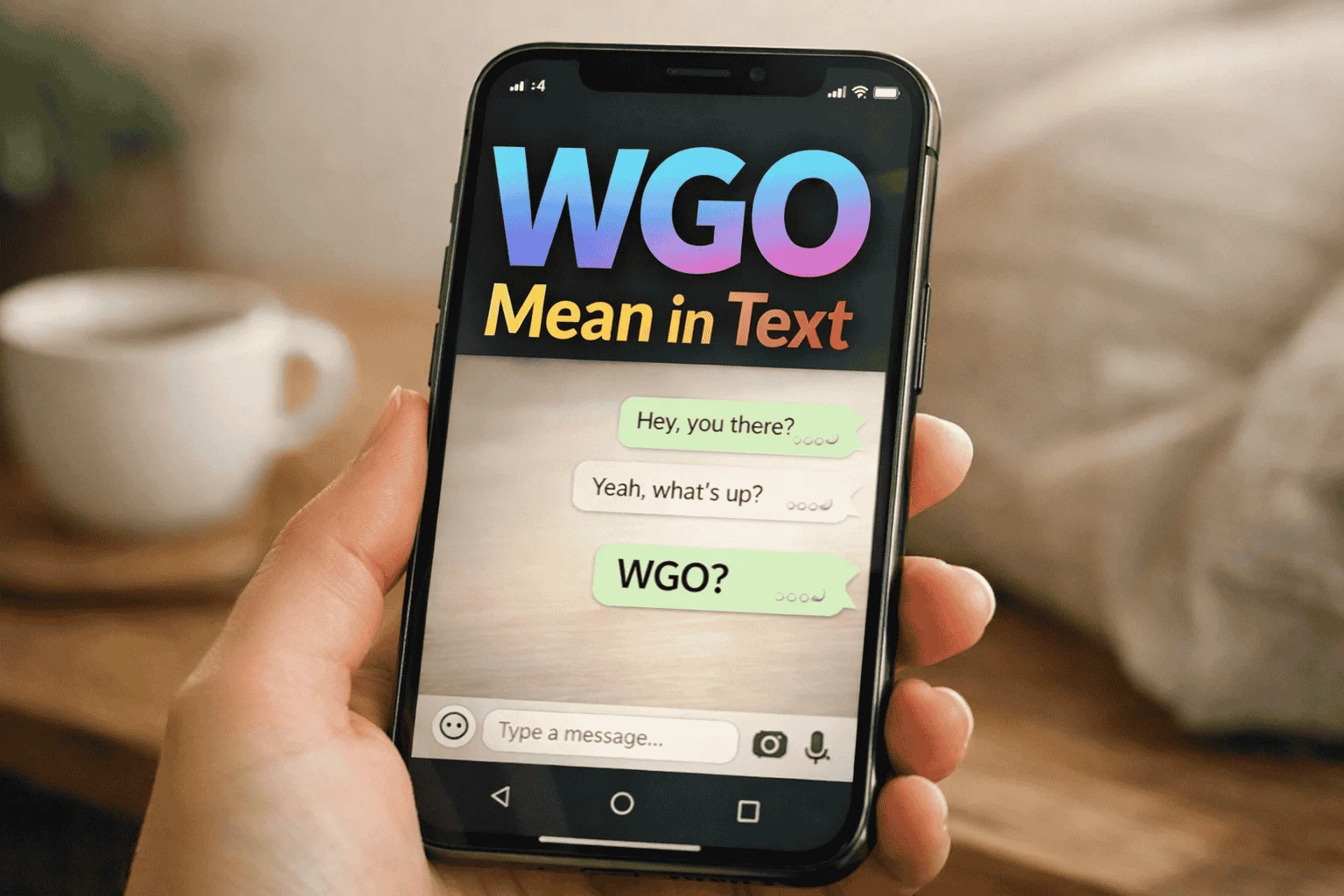
If you’ve ever received a quick message saying “wgo”, you probably paused for a second. Is it a typo? A code? A slang phrase you somehow missed?
You’re not alone. Many people search “wgo mean in text” because this tiny abbreviation shows up in chats, comments, and DMs—but its meaning isn’t always obvious.
In modern texting culture, short forms evolve fast. Some fade away; others quietly become part of everyday digital conversation. WGO sits in that in-between space: familiar to some, confusing to others.
This article clears that confusion completely. You’ll learn what wgo really means, where it came from, how people actually use it, and when you should (or shouldn’t) reply with it.
WGO – Quick Meaning
WGO in text usually means:
- “What’s going on?”
- A casual way to ask what someone is doing
- A check-in message to start conversation
It’s similar to:
- “What’s up?”
- “What’s happening?”
- “What are you doing?”
Examples:
“Hey, wgo tonight?”
“Wgo? Haven’t heard from you all day.”
“Bored… wgo?”
In most contexts, it’s simply a relaxed social opener.
Origin & Background
WGO emerged from the natural compression of texting language. As messaging shifted from SMS to instant chat apps, people began shortening common phrases to save time and typing effort.
“What’s going on” → WGO
Unlike older abbreviations (like BRB or LOL), WGO never had a formal rise. It spread quietly through:
- Online gaming chats
- Snapchat and Instagram DMs
- Teen texting culture
- Informal friend groups
Its growth reflects a broader trend: modern messaging favors speed + tone over grammar. People want quick emotional signals rather than full sentences.
Today, WGO lives mainly in casual digital spaces rather than mainstream written language.
Real-Life Conversations
Person A: Hey, you disappeared yesterday 😭
Person B: I know, sorry! Family stuff
Person A: Oh okay… wgo now?
Instagram DM
Person A: You in the city tonight?
Person B: Yeah
Person A: Bet. Wgo later?
TikTok Comments
User 1: This song hits different at night
User 2: fr
User 3: Same mood rn
User 4: wgo in everyone’s life lately 😭
Text Message
Person A: Haven’t talked in forever
Person B: I know… life got messy
Person A: Same here
Person B: Wgo this weekend?
These examples show how WGO acts as a bridge into conversation, not the main message itself.
Emotional & Psychological Meaning
At its core, WGO expresses curiosity and connection.
It signals:
- Interest
- Checking in
- Social openness
- Casual attention
People use it when they want to reconnect without sounding intense. It’s softer than direct questions like “What are you doing?” and warmer than silence.
Psychologically, WGO works because it feels:
- Low pressure
- Friendly
- Non-intrusive
Personal-style scenario:
You think about a friend you haven’t spoken to in weeks. You don’t want to ask something heavy like “Are you okay?” So you send:
“Hey… wgo?”
It opens the door gently.
Usage in Different Contexts
Social Media
WGO appears in:
- Comments
- DMs
- Story replies
Example:
“Wgo tonight? Everyone out?”
It’s used to engage socially.
Friends & Relationships
Common between:
- Close friends
- Casual friends
- Romantic interests
Tone: relaxed and familiar.
Example:
“Wgo? Miss you.”
Work / Professional Settings
Rare and usually inappropriate.
Example (not ideal):
“Wgo with the project?”
Better:
“What’s the current status?”
Casual vs Serious Tone
Casual:
“Wgo later?”
Serious:
Not suitable for emotional or important conversations.
You wouldn’t write:
“Wgo with your health results?”
When NOT to Use It
Avoid WGO in:
- Formal communication
- Professional emails
- Serious discussions
- Sensitive topics
- Authority relationships (boss, teacher)
Why? Because it can sound careless or immature in serious contexts.
Also avoid with:
- Older generations unfamiliar with slang
- Cross-cultural formal settings
Common Misunderstandings
1. Thinking it means something negative
Some assume WGO = drama or conflict.
It usually doesn’t.
2. Confusing tone
Without context, it can feel:
- Curious
- Flirty
- Bored
- Concerned
Tone depends on relationship.
3. Literal interpretation
People sometimes think it asks for full explanation.
Often it just means “What’s up?”
Comparison Table
| Expression | Meaning | Tone | Use Case |
|---|---|---|---|
| WGO | What’s going on | Casual | Friends/chat |
| WYD | What you doing | Casual | Active conversation |
| SUP | What’s up | Very casual | Greeting |
| HRU | How are you | Neutral | Check-in |
| LMK | Let me know | Practical | Requests |
| NM | Not much | Response | Reply |
Key Insight:
WGO sits between curiosity and greeting—it’s more engaged than “sup” but less direct than “wyd.”
Variations / Types
- WGO?
Basic check-in. - Wgo tonight
Plans inquiry. - Wgo later
Future interaction. - Wgo rn
“What’s happening right now.” - So wgo
Continuation question. - Hey wgo
Friendly opener. - Wgo with you
Personal check-in. - Wgo this weekend
Social planning. - Wgo here
Group context. - Wgo lately
Life update inquiry.
How to Respond When Someone Uses It
Casual Replies
- “Nothing much, you?”
- “Just chilling”
- “At home rn”
- “Working 😭”
Funny Replies
- “Existential crisis”
- “Same chaos as usual”
- “Trying to be productive”
- “Absolutely nothing productive”
Mature Replies
- “Just catching up on work”
- “Taking it easy today”
- “Planning the week”
- “Relaxing after a long day”
Respectful Replies
- “Not much right now”
- “Just resting”
- “All good here”
- “Quiet evening”
Regional & Cultural Usage
Western Culture
Common among:
- Teens
- Young adults
- Online communities
Tone: casual social check-in.
Asian Culture
Less common in native texting.
More used by English-speaking youth online.
Often replaced by:
“What doing?” or local slang.
Middle Eastern Culture
Used mainly in:
- English chats
- Gaming communities
- Social media youth culture
Not common in formal Arabic texting.
Global Internet Usage
WGO appears in:
- Discord
- TikTok
- Snapchat
It functions as a universal casual opener.
Generational Differences
Gen Z:
Comfortable, normal slang.
Millennials:
Understand but use less.
Older generations:
Often unfamiliar.
Is It Safe for Kids?
Yes.
WGO is harmless slang meaning “What’s going on.”
However, parents should still teach:
- Context awareness
- Audience awareness
- Formal vs casual language
It’s safe socially, not academically.
FAQs
What does WGO stand for in text?
It stands for “What’s going on.”
Is WGO the same as WYD?
Similar, but WGO asks about general situation; WYD asks current activity.
Is WGO rude?
No. It’s casual and friendly.
Can I use WGO at work?
Not recommended. Too informal.
Is WGO flirting?
It can be, depending on context.
Why do people use WGO?
To start conversation quickly and casually.
Is WGO outdated?
No. It’s still used in informal chats.
Conclusion
WGO is one of those small digital phrases that quietly carries human connection. It’s simple, relaxed, and socially warm—an easy way to check in without pressure.
Understanding what wgo mean in text helps you read tone correctly and respond naturally. It also shows how modern communication values speed, emotion, and familiarity over formal grammar.
Used in the right context, WGO feels friendly and approachable.
Used in the wrong one, it can feel careless.
So next time someone sends “wgo?”, you’ll know exactly what they mean—and how to answer with confidence.