
In the fast-paced world of texting, social media, and instant messaging, you’ve probably seen someone type “ASAP” and paused to wonder, “What does that really mean?” While it seems straightforward, this little acronym carries more than just urgency. People search for it because its meaning can feel context-dependent, sometimes polite, sometimes demanding. Understanding “ASAP” helps prevent misunderstandings, especially in casual chats, professional emails, or social media exchanges.
By the end of this guide, you’ll know not only the literal definition but also the cultural nuances, emotional undertones, and practical ways to respond. Whether you’re a student, professional, or casual texter, this article gives you the complete picture.
ASAP – Quick Meaning
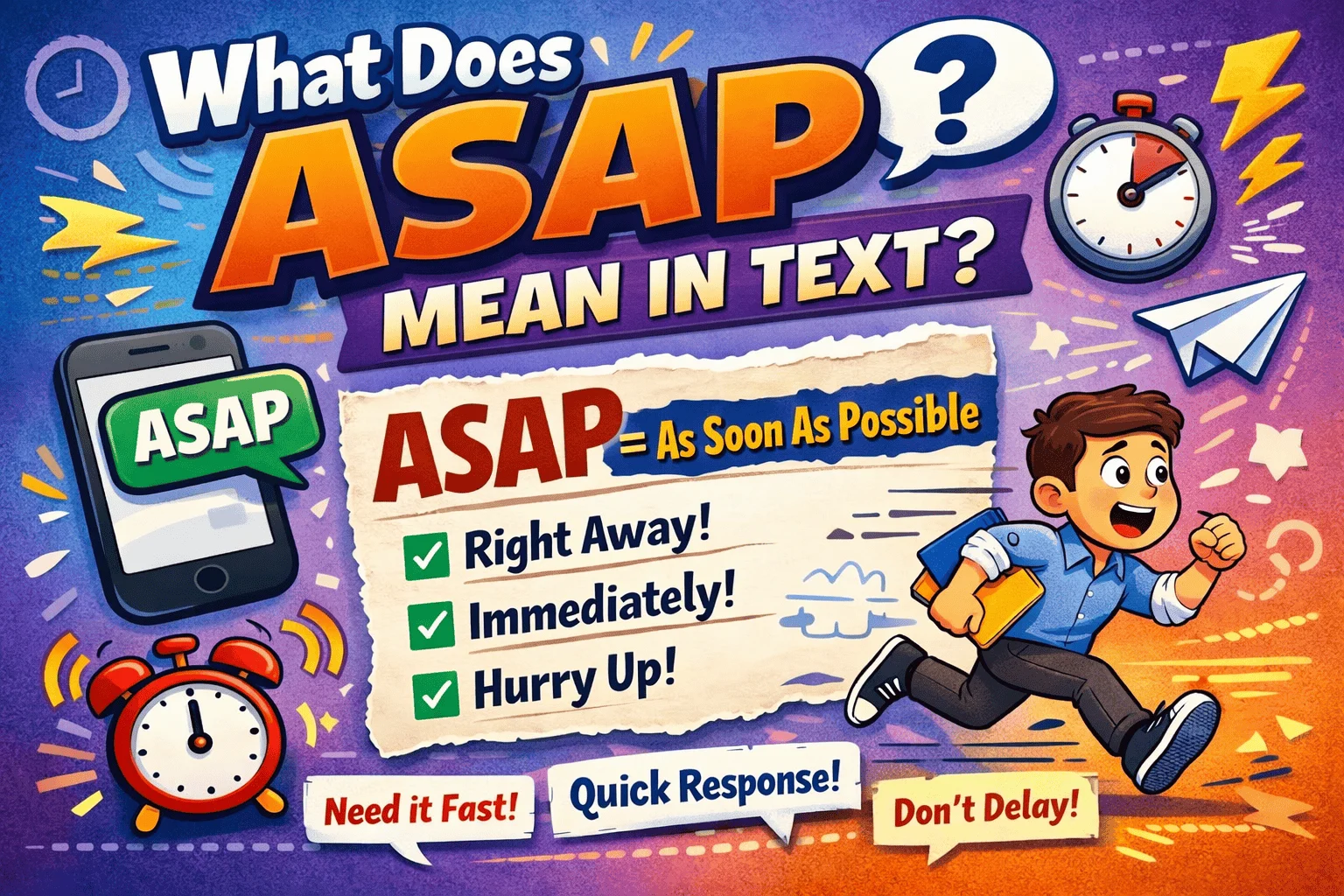
ASAP stands for “As Soon As Possible.”
It is used to indicate urgency, a need for prompt action, or sometimes mild impatience.
Key points:
- Expresses speed: You want something done quickly.
- Can be formal or casual, depending on context.
- Often appears in both professional and personal messaging.
Examples in text:
- “Can you send me the report ASAP?”
- “I need your reply ASAP, it’s important.”
- “Meet me at the café ASAP, I’m already here.”
At its core, ASAP is about time sensitivity—but how it’s perceived depends on tone and context.
Origin & Background
ASAP’s roots trace back to military and professional environments where concise communication mattered. Its first documented uses appeared in the mid-20th century in memos and official correspondence. The military used it to convey urgency efficiently without lengthy explanations.
With the rise of texting, emails, and social media, ASAP transitioned from formal to informal contexts. Platforms like WhatsApp, Instagram, and TikTok amplified its usage among younger generations. The original “urgent” meaning remained, but modern users often add layers of emotion: excitement, frustration, or playful urgency.
Interestingly, social media also shaped a softer side of ASAP. When paired with emojis or casual phrasing, it can read less demanding and more friendly. For example, “Send me the pic ASAP 😅” communicates urgency without harshness.
Real-Life Conversations
WhatsApp:
Person A: Hey, did you finish the slides?
Person B: Almost! Sending them ASAP.
Instagram DMs:
Person A: Can you share the link to that video?
Person B: Yep, ASAP! 😎
TikTok comments:
User 1: When’s the next video dropping?
User 2: ASAP, stay tuned!
Text message:
Person A: Can you pick up groceries on your way home?
Person B: Sure, ASAP.
These examples show that ASAP is flexible—it can be polite, urgent, or even playful depending on the relationship and tone.
Emotional & Psychological Meaning
ASAP isn’t just about speed. It conveys emotions and attitudes that reveal modern communication habits:
- Urgency – You need action quickly.
- Mild pressure – It can subtly push someone without being confrontational.
- Responsibility signaling – Shows accountability (“I’ll act immediately”).
Scenario: You’re coordinating a surprise party. Your friend texts, “Can you grab the cake ASAP?” It’s not criticism—it’s excitement and shared responsibility. Understanding this emotional nuance can prevent tension.
ASAP reflects how we value efficiency and responsiveness today. People interpret it not just literally, but emotionally, based on context, punctuation, and even emojis.
Usage in Different Contexts
Social media: Often paired with playful emojis to create urgency without offense.
Friends & relationships: Casual, friendly, sometimes teasing.
Work / professional settings: Polite urgency—can be formal in emails or memos.
Casual vs serious tone: Adding “please” softens it; uppercase may feel stronger (“ASAP” vs “asap”).
Understanding context ensures your message is received as intended.
When NOT to Use It
- Formal legal or official documents – Too informal.
- Sensitive conversations – Might feel demanding.
- Cross-cultural settings – Some cultures interpret urgency as rudeness.
Using ASAP indiscriminately can create tension, so consider tone, relationship, and medium.
Common Misunderstandings
- Literal vs figurative: People may interpret it as an emergency when it’s just convenience.
- Tone confusion: “ASAP” can read bossy if not paired with polite language.
- Assumed availability: Doesn’t mean the recipient can act instantly; context matters.
Comparison Table
| Expression | Meaning | Tone | Use Case |
|---|---|---|---|
| ASAP | As Soon As Possible | Urgent | Work, personal |
| Stat | Immediately (medical origin) | Very urgent | Hospitals, emergencies |
| When you can | Flexible timing | Casual | Friends, social chat |
| PRN | As needed (medical) | Neutral | Healthcare |
| At your convenience | Polite, non-urgent | Formal | Business emails |
Key Insight: ASAP sits in the middle—it conveys urgency without the extremity of medical or emergency terms, making it versatile for both personal and professional use.
Variations / Types of ASAP
- ASAP – Standard “as soon as possible.”
- ASAP! – Adds urgency or excitement.
- asap pls – Polite and casual.
- asap lol – Playful or joking tone.
- ASAP 😅 – Urgent yet lighthearted.
- ASAP thx – Polite and appreciative.
- ASAP fam – Friendly, among peers.
- ASAP rn – Emphasizes immediacy (“right now”).
- ASAP bro – Casual, often male peer usage.
- ASAP q – Quick shorthand for instant action.
These variations show the adaptability of ASAP across tone, relationship, and platform.
How to Respond When Someone Uses It
- Casual reply: “On it!”
- Funny reply: “I’m teleporting there ASAP 😎”
- Mature reply: “Got it, will do ASAP.”
- Respectful reply: “Understood, I’ll take care of it ASAP.”
Matching tone and urgency helps maintain clarity and relationships.
Regional & Cultural Usage
- Western culture: Seen as standard and efficient, often polite.
- Asian culture: Can be considered slightly direct or impolite in formal settings.
- Middle Eastern culture: Urgency appreciated in business, but tone sensitivity matters.
- Global internet usage: Widely understood, but emojis and capitalization shift meaning.
- Generational differences: Gen Z tends to pair ASAP with emojis or playful tone, Millennials often use it more literally or professionally.
Is It Safe for Kids?
Yes, ASAP is generally safe, but context matters. Kids should learn when urgency is appropriate, like asking a parent for help, versus informal peer conversations. Teaching tone awareness prevents miscommunication.
FAQs
1. Can ASAP be used in emails?
Yes, especially in professional contexts, but add “please” for politeness.
2. Does ASAP sound rude?
It can if overused or capitalized without softening words.
3. Is ASAP the same as “urgent”?
Similar, but ASAP is slightly softer and versatile.
4. Can I text ASAP to a friend?
Absolutely, especially in casual or playful contexts.
5. What is the difference between ASAP and STAT?
STAT is medical-level immediate; ASAP is practical urgency, not life-or-death.
6. How do emojis affect ASAP?
Emojis soften the urgency, making it playful or friendly.
7. Should I always respond immediately to ASAP?
Not necessarily. Context and feasibility matter.
Conclusion
ASAP is more than just a three-letter acronym. It embodies urgency, emotional nuance, and modern communication habits. By understanding its meaning, context, and tone, you can confidently use it in personal chats, social media, and professional messages. Next time you see “ASAP,” you’ll know exactly what it implies—and how to respond thoughtfully.