

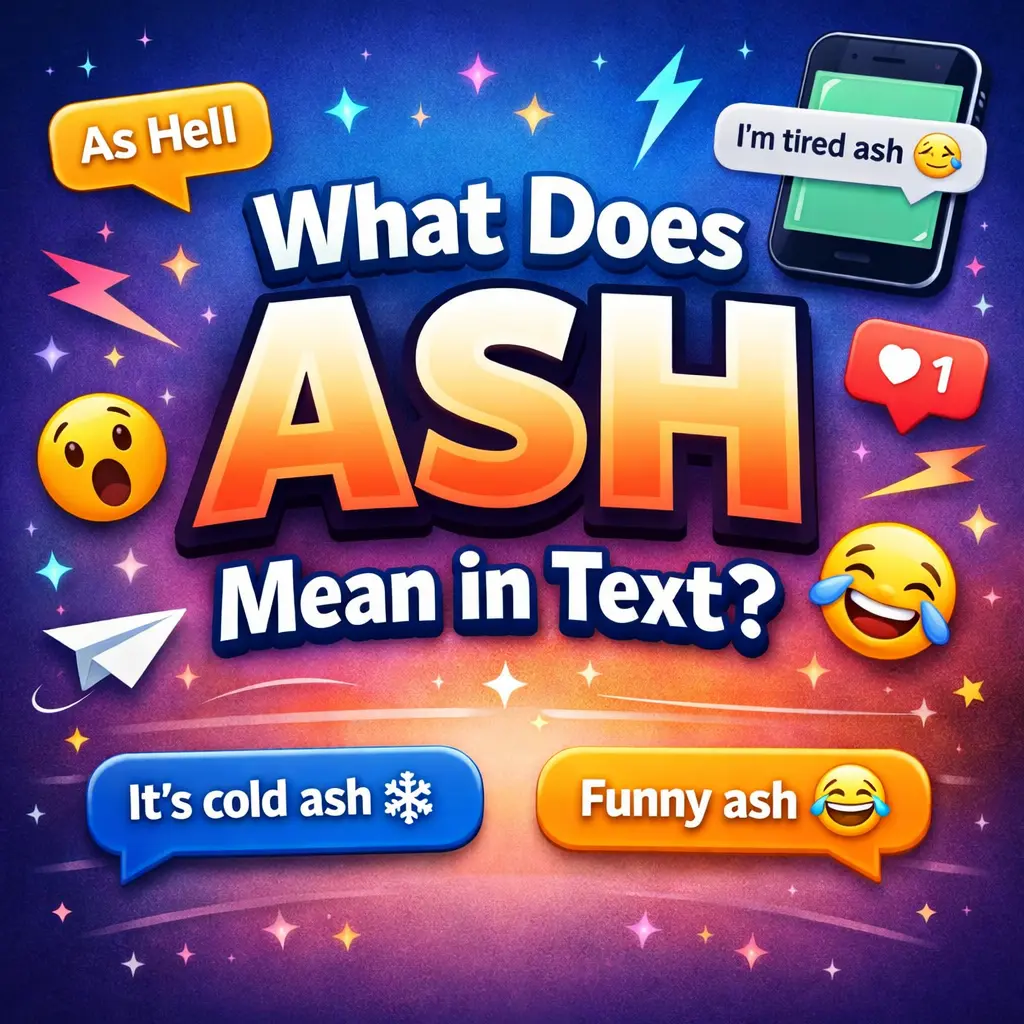
If you’ve recently seen someone reply with “ash” in a text, comment, or message, you might have paused for a moment and wondered what it actually means. At first glance, it looks like the word related to fire or smoke. But in texting language, “ash” has a completely different meaning.
Modern digital conversations move fast. People shorten words, drop letters, and invent slang that spreads quickly through social media. Because of this, many everyday words take on new meanings that can confuse anyone who isn’t familiar with the latest texting trends.
That is exactly why many people search for “what does ash mean in text.” They may have seen it in a message from a friend, a TikTok comment, or an Instagram DM and want to understand the tone behind it.
The good news is that the meaning is actually simple once you see how it’s used in real conversations. In this guide, you’ll learn:
- The true meaning of “ash” in texting
- Where the slang came from
- Real conversation examples
- Emotional and psychological reasons people use it
- Situations where you should or should not use it
By the end, you will recognize the word instantly and feel confident using it in casual online conversations.
“ASH” – Quick Meaning
In texting slang, “ash” usually means “as hell.”
It is a shortened and stylized version of the phrase “as hell,” which people use to intensify a statement or emphasize something strongly.
Simple definition
ASH = “As Hell”
It adds strong emphasis to an emotion, opinion, or situation.
Example meanings
- “I’m tired ash.”
Meaning: I’m extremely tired. - “That movie was funny ash.”
Meaning: The movie was very funny. - “It’s cold ash outside.”
Meaning: It’s extremely cold.
In short, “ash” acts like an amplifier. It makes whatever comes before it feel stronger or more intense.
Origin & Background
The slang “ash” developed from casual spoken language, especially in younger communities where phrases are shortened for speed and style.
Originally, people would say:
“That’s funny as hell.”
Over time, in fast digital communication, the phrase started changing.
First it became:
“funny as hell” → “funny asl”
Then another variation appeared:
“funny ash”
This version spread quickly because it sounds natural when spoken out loud and feels playful in text.
Cultural influence
Several factors helped the slang spread:
1. Social media culture
Platforms like TikTok, Instagram, and Snapchat encourage fast, expressive communication. Short slang terms work perfectly in comments and captions.
2. Youth language creativity
Younger users constantly experiment with language. Words are shortened, reshaped, and remixed to feel fresh.
3. Sound similarity
When spoken casually, “as hell” can sound like “ash.” This made the spelling feel natural online.
Evolution of the slang
The timeline roughly looks like this:
- “As hell” (original phrase)
- “ASL” or “asl” (text abbreviation)
- “Ash” (modern slang spelling)
Today, “ash” is widely used in informal texting, especially among Gen Z and active social media users.
Real-Life Conversations
To really understand slang, it helps to see it used in real messages. Below are some realistic examples from common online conversations.
WhatsApp Conversation
Person A:
I stayed up all night finishing that show.
Person B:
Same 😭 I’m tired ash today.
Person A:
Coffee is the only thing saving me.
Instagram DM
Person A:
Did you see that video I sent?
Person B:
Yeah 😂 it was funny ash.
Person A:
I watched it like five times.
TikTok Comments
User 1:
This prank had me crying.
User 2:
Fr it’s funny ash 😂
User 3:
I can’t stop laughing.
Text Message
Person A:
It’s cold outside.
Person B:
Cold ash. I’m not leaving the house today.
Person A:
Same honestly.
These examples show how “ash” naturally fits at the end of a sentence to strengthen the feeling being expressed.
Emotional & Psychological Meaning
Slang is not just about shortening words. It also reflects how people emotionally connect through language.
When someone uses “ash,” they are usually expressing a strong emotion or reaction.
It can show:
- excitement
- frustration
- humor
- exaggeration
- relatability
In many ways, slang helps make digital conversations feel more human and expressive.
Why people use it
There are a few psychological reasons behind it.
1. It adds personality
Typing “I’m tired ash” feels more expressive than simply saying “I’m tired.”
2. It signals informality
Using slang tells the other person the conversation is relaxed and friendly.
3. It builds social belonging
People naturally adopt the language used by their social circles. When friends use a slang word, others start using it too.
A real-life style scenario
Imagine a college student texting their friend after a long day of classes.
They could say:
“I’m very tired today.”
But instead they write:
“I’m tired ash.”
The second message feels more relatable, emotional, and authentic, which is why slang like this continues to spread online.
Usage in Different Contexts
Although “ash” is common online, it does not belong in every situation.
Understanding context helps avoid awkward misunderstandings.
Social Media
This is where “ash” appears most often.
Examples:
- TikTok comments
- Instagram captions
- Snapchat messages
- YouTube replies
It adds humor and emphasis in casual digital conversations.
Friends and Relationships
Among friends, it is perfectly normal.
Examples:
- “I’m bored ash.”
- “That restaurant was good ash.”
- “I’m hungry ash right now.”
In relationships, it can even add playful tone.
Example:
“I miss you ash.”
Work or Professional Settings
It is not appropriate for professional communication.
Avoid using it in:
- emails
- work chats
- business messages
- school assignments
Professional language should remain clear and formal.
Casual vs Serious Tone
“ASH” works best in light and casual conversations.
It does not fit serious discussions like:
- serious arguments
- formal debates
- professional communication
Think of it as friendly slang, not standard language.
When NOT to Use It
Even harmless slang can create confusion in the wrong context.
Avoid using “ash” in these situations.
Professional environments
Example to avoid:
“I’m busy ash today.”
In professional communication, this can appear careless or unprofessional.
Conversations with older audiences
Not everyone understands modern texting slang.
Older readers might interpret it literally or become confused.
Sensitive conversations
If someone is sharing serious news or emotional struggles, slang may appear dismissive.
For example:
“I’m stressed ash” could seem insensitive if someone else is discussing something serious.
Common Misunderstandings
Many people misunderstand “ash” the first time they see it.
Here are a few common confusions.
Thinking it means literal ash
Some people believe the word refers to ashes or fire residue. In texting slang, it has nothing to do with that meaning.
Confusing it with “ASL”
Another slang abbreviation is “asl,” which also means “as hell.”
Both serve similar purposes, but they look different.
Tone confusion
Because slang exaggerates emotions, it may sound stronger than intended.
For example:
“I’m tired ash”
The speaker might simply mean they are very tired, not extremely exhausted.
Comparison Table
| Expression | Meaning | Tone | Example |
|---|---|---|---|
| ash | as hell | casual slang | I’m hungry ash |
| asl | as hell | texting abbreviation | It’s funny asl |
| very | strong emphasis | neutral | I’m very tired |
| extremely | strong emphasis | formal | extremely cold |
| super | casual emphasis | friendly | super tired |
Key Insight
While all these expressions emphasize intensity, “ash” is the most informal. It belongs in relaxed conversations with friends rather than formal communication.
Variations / Types
Slang often evolves into multiple variations. Here are common forms related to “ash.”
1. ASL
Short for “as hell.” Another popular texting version.
2. Funny ash
Used when something is extremely funny.
3. Tired ash
Means extremely tired.
4. Cold ash
Used to emphasize very cold weather.
5. Hungry ash
Expresses strong hunger.
6. Bored ash
Used when someone feels very bored.
7. Late ash
Means extremely late.
8. Loud ash
Describes something very loud.
9. Busy ash
Indicates someone is extremely busy.
10. Slow ash
Often used jokingly to say something is very slow.
How to Respond When Someone Uses It
If someone sends a message using “ash,” you can respond in many ways depending on the tone.
Casual Replies
- “Same honestly.”
- “I feel that.”
- “Me too.”
Funny Replies
- “Then go take a nap 😂”
- “Drink coffee asap.”
- “Mood.”
Mature Replies
- “Sounds like you had a long day.”
- “You should get some rest.”
Respectful Replies
- “Hope things get easier.”
- “Take care of yourself.”
Matching the tone keeps the conversation natural.
Regional & Cultural Usage
Slang spreads differently across cultures and regions.
Western Culture
In the United States and parts of Europe, texting slang evolves quickly. Words like “ash” are common among younger social media users.
Asian Culture
In many Asian countries, English slang appears mainly in online communities and among young people who follow global internet culture.
Middle Eastern Culture
English slang is sometimes used in mixed-language texting, especially among bilingual users on social platforms.
Global Internet Usage
Because of TikTok, YouTube, and memes, slang now spreads internationally within weeks.
A phrase used in one country can become global almost instantly.
Generational Differences
Gen Z
- Uses slang like “ash” frequently
- Comfortable experimenting with language
Millennials
- Understand some slang
- Use it less often in daily communication
Older generations tend to prefer clearer and more traditional language.
Is It Safe for Kids?
Generally, “ash” is harmless slang.
It simply replaces the phrase “as hell.”
However, parents and educators may still prefer encouraging clearer language in academic or formal communication.
In casual conversation between friends, it is usually safe and widely understood.
FAQs
What does “ash” mean in texting?
In texting slang, “ash” means “as hell,” used to emphasize a feeling or statement strongly.
Is “ash” the same as “asl”?
Yes, both are slang variations of “as hell.” They are used to intensify a statement.
Is “ash” rude?
Not necessarily. It is casual slang. However, it may be inappropriate in professional settings.
Do people still use “ash” online?
Yes. It appears frequently in social media comments, messages, and informal chats.
Can I use “ash” in formal writing?
No. It should only be used in casual conversations or friendly texting.
Why do people shorten “as hell” to “ash”?
People shorten phrases online to type faster and make messages feel more expressive.
Conclusion
Language on the internet changes quickly, and slang like “ash” is a perfect example of how communication evolves in the digital age.
At its core, the meaning is simple. “Ash” is just a shortened way of saying “as hell,” used to emphasize something strongly.
You will mostly see it in casual conversations between friends, in social media comments, and in relaxed text messages. It adds personality, humor, and emotion to everyday digital communication.
Like most slang, context matters. It works best in friendly settings and should be avoided in professional environments or serious discussions.
Once you understand how it works, the word becomes easy to recognize and even easier to use. The next time someone says they are “tired ash” or something is “funny ash,” you will instantly know exactly what they mean.
And who knows. You might even find yourself using it in your own messages.