

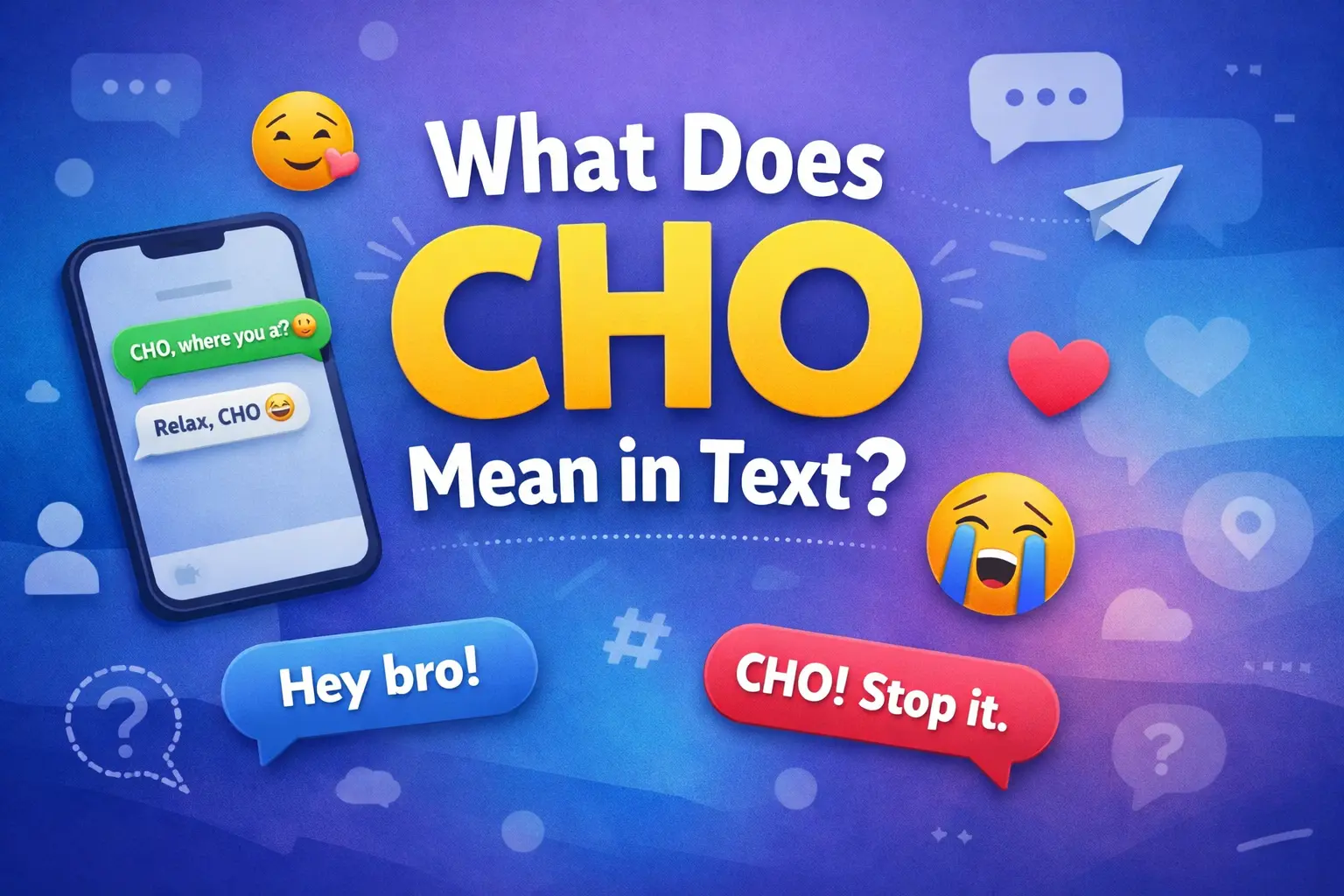
If you’ve come across “CHO” in a message and paused for a second, you’re not alone.
It’s one of those short text expressions that looks simple but can feel confusing depending on the context. Is it slang? Is it a typo? Or does it carry a deeper meaning?
People search for “what does CHO mean in text” because it doesn’t have just one universal definition. Its meaning shifts based on tone, culture, and even the relationship between the people chatting.
In this guide, I’ll break it down in a way that actually makes sense. You’ll see what it means, where it came from, how people really use it, and how to respond without overthinking.
CHO – Quick Meaning
In texting, “CHO” usually means “you” or “your”, often used in a playful, casual, or dialect-based way.
Common meanings:
- A slang variation of “you”
- A shortened or stylized form of speech
- Sometimes used for humor or emphasis
Example messages:
- “What you doing, cho?”
- “Cho funny 😂”
- “I told cho already!”
The tone is usually relaxed, friendly, and informal.
Origin & Background
“CHO” isn’t a new invention. It comes from spoken language patterns, especially where words are shortened or blended in casual speech.
In some dialects, especially in parts of the United States and Caribbean-influenced slang, “you” can sound like “cho” or “chu” when spoken quickly.
Over time, this natural speech pattern moved into texting.
Social media played a huge role here. Platforms like TikTok and Instagram made it normal to write how you speak, not how grammar rules say you should write.
That’s why you now see:
- “chu” instead of “you”
- “cho” instead of “your” or “you”
It’s less about correctness and more about personality.
Real-Life Conversations
WhatsApp Chat
Person A: Where you at?
Person B: I told cho I’m on the way 😭
Person A: You always late
Instagram DMs
Person A: That outfit is fire
Person B: Cho always hyping me up 😂
TikTok Comments
User 1: This dance is hard
User 2: Nah cho just gotta practice more
Text Messages
Person A: Did you finish the assignment?
Person B: Bro why cho stressing me 😩
These examples show how “CHO” fits naturally into relaxed, everyday conversations.
Emotional & Psychological Meaning
“CHO” is more than just a word. It reflects how people want to sound when they text.
It often expresses:
- Closeness
- Comfort
- Playfulness
- Informality
When someone uses “CHO,” they’re not trying to be formal. They’re signaling that the conversation is easygoing and personal.
Why people use it:
- To sound more natural and less robotic
- To match how they speak in real life
- To create a friendly or humorous tone
A real-life scenario
Imagine a close friend texting you:
“I told cho not to worry.”
It feels warmer than “I told you not to worry.”
It carries a sense of familiarity, like they’re right there talking to you.
That’s the emotional layer behind it.
Usage in Different Contexts
Social Media
On platforms like TikTok or Instagram, “CHO” is used to sound trendy and relatable.
Example:
“Cho really thought that was a good idea 😭”
Friends & Relationships
Among friends, it feels natural and fun.
Example:
“Cho better not forget my birthday 🎂”
Work / Professional Settings
Avoid using it.
It can look unprofessional or confusing, especially in emails or formal chats.
Casual vs Serious Tone
- Casual: Works perfectly
- Serious: May feel out of place or unclear
Tone matters more than the word itself.
When NOT to Use It
Even though it’s fun, there are situations where “CHO” doesn’t fit.
Avoid using it:
- In professional emails
- When talking to someone you don’t know well
- In serious or sensitive conversations
- With people unfamiliar with slang
Why?
It can:
- Sound unclear
- Be misunderstood
- Come across as careless
Sometimes, simple and clear communication is better.
Common Misunderstandings
1. Thinking it’s a typo
Some people assume “CHO” is a mistake. It’s not. It’s intentional slang.
2. Confusing tone
Without context, it can sound:
- Rude
- Sarcastic
- Or playful
Tone depends on the relationship.
3. Literal confusion
Not everyone knows it means “you,” so they might not understand the sentence at all.
Comparison Table
| Expression | Meaning | Tone | Usage |
|---|---|---|---|
| CHO | You / Your | Playful, casual | Friends, social media |
| You | Standard form | Neutral | Everywhere |
| Chu | You (slang variation) | Cute, informal | Close friends |
| Ya | You (shortened) | Casual | Texting |
| You all / Y’all | Group form | Friendly | Regional usage |
| Sir/Ma’am | Formal address | Respectful | Professional |
Key Insight
“CHO” stands out because it reflects personality more than meaning. It’s less about what you say and more about how you say it.
Variations / Types
Here are common variations you might see:
- Chu – Another slang for “you”
- Cho self – Refers to “yourself”
- Cho fault – Means “your fault”
- Cho problem – Blaming in a playful way
- Cho turn – “Your turn” in games or chats
- Cho idea – Suggesting ownership
- Cho vibe – Referring to someone’s energy
- Cho people – Talking about someone’s group
- Cho business – Saying something is your responsibility
- Cho side – Taking someone’s side
Each version keeps the same casual tone but adapts to context.
How to Respond When Someone Uses It
Casual Replies
- “What you mean 😂”
- “Not me this time”
- “You funny fr”
Funny Replies
- “Don’t blame me, that’s cho problem 😭”
- “Cho wild for that”
- “I’m innocent!”
Mature Replies
- “Alright, I understand what you mean.”
- “Let’s keep it clear though.”
Respectful Replies
- “Got it, thanks for explaining.”
- “I see your point.”
Match the tone of the conversation. That’s the key.
Regional & Cultural Usage
Western Culture
Common in casual slang, especially among younger users.
Asian Culture
Less common, but used by those influenced by global internet trends.
Middle Eastern Culture
Not widely traditional, but increasingly used in online conversations.
Global Internet Usage
Thanks to social media, “CHO” is spreading across different cultures.
Generational Differences
- Gen Z: Uses it naturally and frequently
- Millennials: Understand it but may use it less
Language online is shaped by younger users, and this is a good example.
Is It Safe for Kids?
Yes, “CHO” is generally safe.
It’s not offensive or inappropriate. It’s simply informal slang.
However, kids should understand when to use it and when to switch to proper language, especially in school or formal settings.
FAQs
1. Does CHO always mean “you”?
Most of the time, yes. Context can slightly change how it feels.
2. Is CHO rude?
Not usually. It depends on tone and relationship.
3. Can I use CHO in formal writing?
No. Stick to standard English in professional situations.
4. Is CHO popular?
It’s moderately popular, especially in casual online spaces.
5. What’s the difference between CHO and CHU?
Both mean “you,” but “chu” often feels softer or cuter.
6. Why do people use CHO instead of “you”?
To sound more natural, playful, or expressive.
Conclusion
“CHO” is a small word with a big personality.
At its core, it simply means “you.” But the way it’s used tells a deeper story about how modern communication works. People want to sound real, relaxed, and emotionally connected, even in text.
Understanding slang like this isn’t just about decoding words. It’s about understanding tone, relationships, and culture.
Once you get the feel for it, you won’t just recognize “CHO.” You’ll know exactly when to use it and when to keep things simple.