
If you have come across the term “epy” in a message or comment and felt confused, you are not alone. Modern digital communication is full of abbreviations, slang, and shortcuts that evolve quickly across platforms like WhatsApp, Instagram, TikTok, and Snapchat. Words like this often carry meanings that depend heavily on context, tone, and even the relationship between the people using them.
The phrase “epy” is not a standard dictionary word. Instead, it is an informal expression that appears in casual texting environments. People search for its meaning because it can be unclear whether it is a typo, slang, or a coded expression used in a specific community.
Understanding what “epy” means helps avoid misinterpretation in conversations. It also gives insight into how language continues to evolve in digital spaces, where speed, emotion, and brevity often matter more than formal grammar.
This guide breaks down everything you need to know about “epy,” including its meaning, usage, variations, cultural context, and how to respond when someone uses it in conversation.
“EPY” – Quick Meaning
In most cases, “epy” is not a standardized acronym with a fixed definition. It is often:
- A typo or misspelling of another word
- A shorthand used in informal texting
- A personal or context-specific expression
Depending on the conversation, it may resemble or be intended as:
- “hey” typed quickly on a keyboard
- “yep” written incorrectly
- A playful or stylized way of expressing agreement or attention
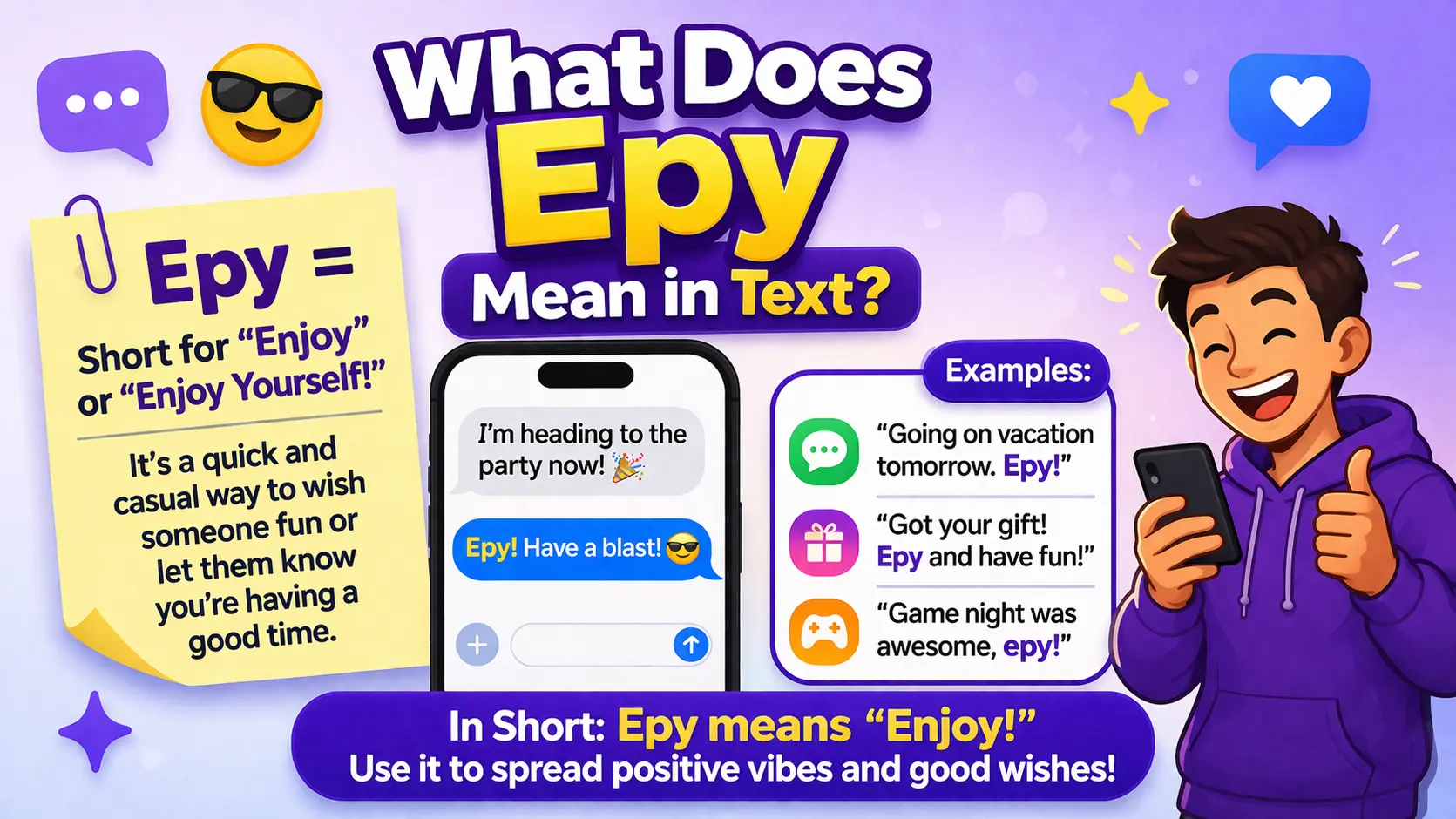
Example usages:
- “Epy, are you there?”
- “Epy, that sounds good.”
- “Epy 😂 I didn’t expect that.”
In many cases, the meaning is derived from the surrounding conversation rather than the word itself.
Origin & Background
Unlike widely recognized internet slang, “epy” does not have a clearly documented origin. It likely emerged organically through typing habits, especially on mobile keyboards where autocorrect, speed typing, and thumb typing can lead to unintended letter combinations.
Several factors contributed to its appearance:
- Fast-paced texting culture
- Autocorrect variations on mobile devices
- Informal communication among close friends
- Creative or playful spelling habits
Social media platforms have also played a role in spreading unconventional text patterns. Users often experiment with short, unique expressions to stand out or communicate casually.
Over time, such terms become recognizable within certain friend groups or online communities, even if they are not universally defined.
Real-Life Conversations
Here are some realistic examples showing how “epy” might appear in everyday communication:
WhatsApp Conversation:
Person A: Epy, are you coming to the meetup?
Person B: Yes, I’ll be there in 10 minutes.
Instagram DM:
Person A: Epy 😂 that post was hilarious
Person B: Glad you liked it!
TikTok Comment Thread:
Person A: Epy, this video is so relatable
Person B: I know right, it happens all the time
Text Message:
Person A: Epy, did you finish the assignment?
Person B: Almost done, just reviewing it now
These examples show that “epy” is often used as a casual opener or attention-grabber rather than a formal expression with a strict meaning.
Emotional & Psychological Meaning
“Epy” often reflects a tone rather than a literal definition. In communication psychology, such expressions serve as conversational fillers that help establish connection, friendliness, or informality.
People use it because:
- It feels casual and relaxed
- It reduces formality in conversation
- It can signal familiarity or closeness
- It adds a playful or human touch to texting
In many cases, the emotional intent behind “epy” matters more than the word itself.
Example scenario:
A person texts “epy” to a friend before asking a question. The intention is not just to greet, but to soften the message and make it feel less abrupt. It creates a friendly tone that makes the conversation more comfortable.
This reflects how modern communication blends emotion with brevity, especially in fast-paced digital environments.
Usage in Different Contexts
Social Media
On platforms like Instagram or TikTok, “epy” may appear in comments as a casual acknowledgment or reaction. It can express agreement, surprise, or attention.
Friends & Relationships
Among friends, it often acts as a relaxed greeting or conversational starter. It suggests familiarity and comfort between individuals.
Work or Professional Settings
In professional communication, using “epy” is generally not appropriate. It may appear unprofessional or confusing unless used within a very informal internal chat where such language is accepted.
Casual vs Serious Tone
- Casual tone: Acceptable and often used freely
- Serious tone: Can be misunderstood or appear unclear
- Formal tone: Not recommended
Understanding the context ensures that the message is interpreted correctly.
When NOT to Use It
There are situations where using “epy” may not be suitable:
- Formal emails or business communication
- Academic writing or professional reports
- Conversations with people unfamiliar with slang
- Sensitive or serious discussions
In these cases, clarity is more important than brevity. Using standard language helps avoid confusion or misinterpretation.
Cultural sensitivity also matters. Not everyone is familiar with informal texting abbreviations, so using them with strangers may lead to misunderstanding.
Common Misunderstandings
Many people misinterpret “epy” because:
- They assume it is a formal acronym
- They think it has a universally accepted definition
- They confuse it with similar sounding slang words
Another common misunderstanding is treating it as intentional slang when it may simply be a typo.
Tone confusion is also common. Without context, “epy” can seem vague or incomplete. However, in real conversations, surrounding messages usually clarify its meaning.
It is important to interpret it as part of a full message rather than in isolation.
Comparison Table
| Term | Meaning | Usage Context | Tone |
|---|---|---|---|
| epy | Informal / unclear slang | Casual texting | Friendly, casual |
| hey | Greeting | General conversation | Neutral, friendly |
| yep | Agreement | Informal replies | Casual, confirming |
| yo | Attention-grabbing greeting | Slang conversations | Very casual |
| hello | Formal greeting | Professional or polite use | Formal |
Key Insight:
“Epy” is not a standardized term like “hey” or “yep.” Its meaning depends entirely on context, and it often functions as a casual conversational placeholder rather than a defined expression.
Variations / Types
Here are related or similar expressions often used in texting:
- Hey
A common greeting used to start conversations. - Yo
A casual way to get someone’s attention. - Yep
Informal confirmation or agreement. - Yup
A variation of “yep” with the same meaning. - Sup
Short form of “what’s up.” - Hi
A simple and neutral greeting. - Hello
A more formal greeting. - Eh
A filler expression indicating hesitation or indifference. - Hmm
Used to express thinking or uncertainty. - Ok / Okay
Acknowledgment or agreement.
Each of these serves a communicative purpose similar to how “epy” may function in informal exchanges.
How to Respond When Someone Uses It
Casual Replies
- “Hey, what’s up?”
- “Yes, tell me 😊”
- “I’m here, go ahead”
Funny Replies
- “Epy? Did you just invent a new word 😂”
- “I’ll pretend I understood that 😄”
- “New slang unlocked?”
Mature Replies
- “Hi, how can I help?”
- “Yes, please continue”
- “I’m listening”
Respectful Replies
- “Hello, what would you like to discuss?”
- “Sure, go ahead and share”
- “I’m here if you need anything”
Choosing the right response depends on your relationship with the sender and the tone of the conversation.
Regional & Cultural Usage
Western Culture
Informal slang and abbreviations are widely accepted in casual texting. Words like “epy” may be interpreted as typos or playful expressions.
Asian Culture
In many Asian contexts, clarity and respect are emphasized. Informal slang may be used among friends but avoided in formal communication.
Middle Eastern Culture
Communication often balances formality and friendliness. Slang is common among younger users but less used in professional settings.
Global Internet Usage
On global platforms, slang evolves quickly. Meanings can vary by community, and users often adapt terms based on trends rather than strict definitions.
Generational Differences
- Gen Z: More comfortable with slang, abbreviations, and evolving expressions
- Millennials: Familiar with texting shorthand but may prefer clearer wording
These differences influence how “epy” is perceived and used across audiences.
Is It Safe for Kids?
“Epy” itself is not harmful or offensive. It is generally safe for kids to see and use in casual communication.
However, guidance is important because:
- Children may misinterpret unclear slang
- They should learn when formal language is required
- Understanding context helps avoid confusion
Overall, it is harmless, but awareness of proper usage is beneficial.
FAQs
1. What does epy mean in texting?
It is usually an informal or unclear expression, often a typo or casual shorthand used in messaging.
2. Is epy an acronym?
No widely accepted acronym exists. Its meaning depends on context.
3. Is epy a slang word?
It can be considered informal slang, but it is not standardized.
4. Can I use epy in formal messages?
No, it is better to avoid it in professional or formal communication.
5. Why do people use epy?
People use it for casual expression, quick typing, or as a conversational filler.
6. Is epy offensive?
No, it is not offensive. It is neutral in tone.
7. How should I interpret epy in a message?
Look at the surrounding context to understand whether it is a greeting, typo, or informal expression.
Conclusion
“Epy” is a modern example of how digital communication evolves through informal usage, typing habits, and social interaction. While it does not have a fixed dictionary definition, it is commonly used as a casual expression, often functioning as a greeting, attention marker, or typo depending on context.
Understanding such terms helps improve communication clarity and reduces the chances of misinterpretation in everyday conversations. As texting language continues to evolve, flexibility and awareness remain key.
Using expressions like “epy” is perfectly fine in relaxed environments, especially among friends. However, knowing when to use standard language ensures your message is always understood clearly in more formal situations.