

If you have ever received a message that simply says “FIR?” or “fir” in a chat, you might have paused for a moment wondering what it actually means. In the fast-moving world of digital conversations, short abbreviations appear constantly, and not all of them are obvious.
People search for “what does FIR mean in text” because the term can carry multiple meanings depending on context. In some cases it is casual slang. In others it refers to something more formal. Without context, the meaning can feel confusing.
Texting culture thrives on speed and simplicity. Instead of typing full sentences, people shorten words or phrases to communicate quickly. FIR is one of those expressions that pops up in chats, comments, and messages across different platforms.
In this guide, we will explore what FIR means in texting, how people actually use it in conversations, and why it sometimes causes misunderstandings. By the end, you will understand not only the meaning but also the tone, context, and cultural nuance behind it.
FIR – Quick Meaning
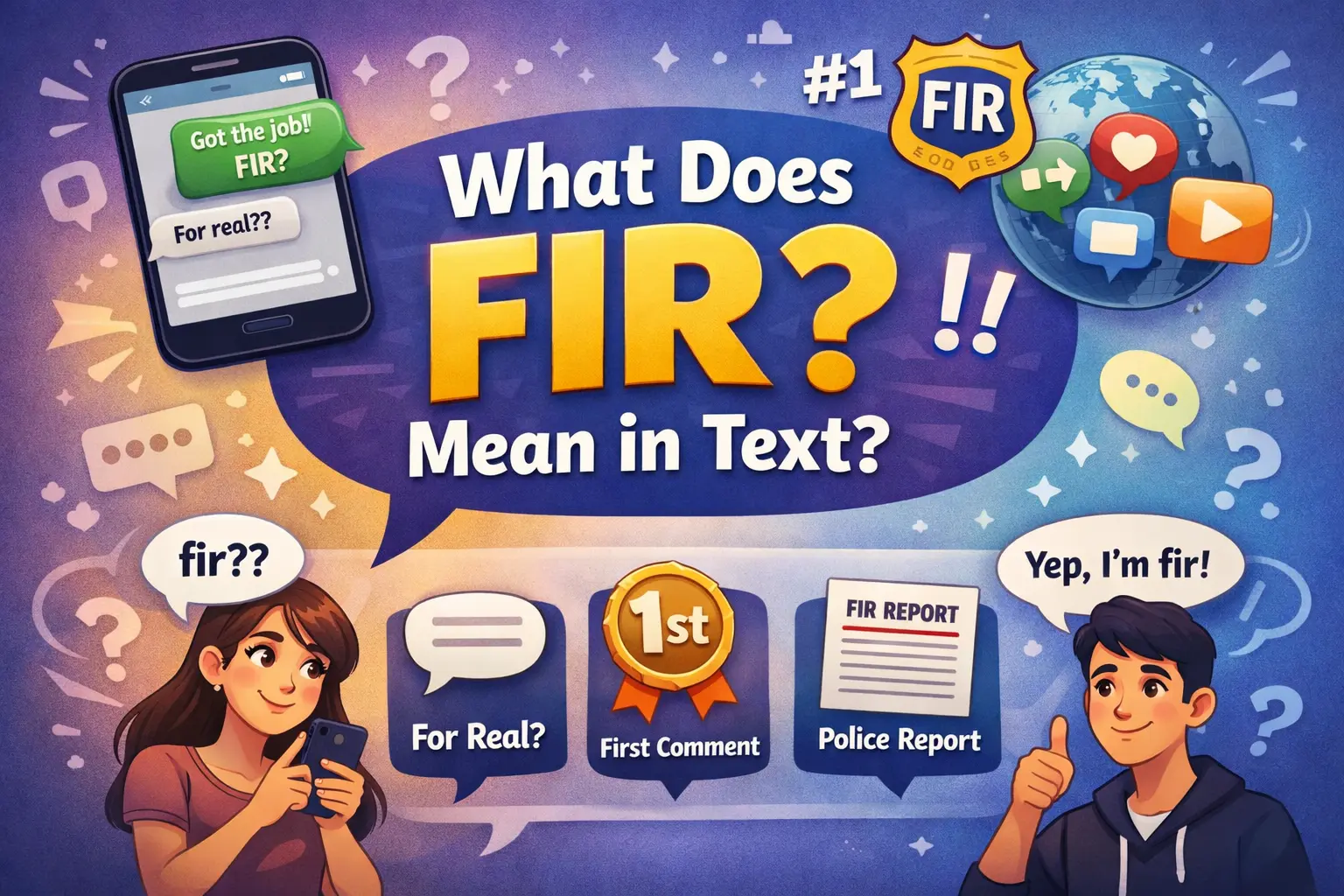
In texting, FIR can mean different things depending on the situation. The most common interpretations include:
1. “For Real”
A shortened way of asking if something is serious or genuine.
2. Typing shortcut for “first”
Sometimes used in comments or gaming chats.
3. A reference to “First Information Report”
Used mainly in legal or regional contexts, especially in South Asian discussions.
Simple Examples
“You got the job? fir??”
Meaning: For real?
“fir comment!”
Meaning: First comment.
“He filed an fir yesterday.”
Meaning: First Information Report in legal terms.
Context determines which meaning is intended.
Origin & Background
The abbreviation FIR did not emerge from a single internet trend. Instead, its usage developed through multiple digital cultures.
Early texting culture
In early SMS messaging, character limits encouraged people to shorten words. Abbreviations like LOL, BRB, and OMG became standard. FIR appeared in some communities as a quick version of “for real.”
Social media influence
As platforms like Instagram, TikTok, and Twitter grew, people started commenting rapidly on posts. In comment sections, users often typed “fir” to claim the first comment on a new post or video.
This behavior became especially common among younger internet users who compete playfully to be the first to comment.
Regional context
In countries like India and Pakistan, FIR already had an established meaning: First Information Report, a legal document filed with the police. Because of this, the abbreviation carries a completely different tone in certain conversations.
Evolution of meaning
Today, the meaning of FIR depends entirely on the situation. It can signal excitement, disbelief, or simply internet playfulness.
This flexibility is what makes texting language both creative and confusing.
Real Life Conversations
Understanding slang becomes much easier when you see it used naturally. Here are realistic examples from everyday digital conversations.
WhatsApp Conversation
Person A:
I just met the singer from that band I love!
Person B:
fir??? you’re serious??
Person A:
Yes! I even took a picture.
Here, fir means “for real?”
Instagram DM
Person A:
Guess what. I finally passed my driving test.
Person B:
fir! that’s amazing.
In this case, fir expresses excitement and confirmation.
TikTok Comments
User 1:
fir
User 2:
No way you were first 😂
User 3:
Second gang here.
Here, fir is a shortcut for first in the comment section.
Text Message
Person A:
My neighbor filed an fir after the accident.
Person B:
That makes sense. It was serious.
In this context, FIR refers to the legal report filed with police.
Emotional & Psychological Meaning
Beyond its literal meaning, FIR can reveal subtle emotions in digital communication.
When used as “for real,” it often expresses:
- Surprise
- Excitement
- Curiosity
- Mild disbelief
In fast chats, people rarely type full reactions like “Are you serious?” Instead, they send a short expression like fir?? which carries the same emotional energy.
Why people use it
Short words reduce typing effort and match the fast pace of modern messaging. They also feel more casual and friendly.
A relatable scenario
Imagine a friend texting you late at night:
“Guess what. I got accepted into my dream university.”
Your immediate reaction might simply be:
“fir?? that’s huge!”
The short response captures genuine excitement without slowing down the conversation.
This is exactly why abbreviations like FIR survive in texting culture.
Usage in Different Contexts
The meaning of FIR shifts depending on where it appears.
Social Media
On platforms like TikTok or Instagram, fir usually means first comment.
Example:
“fir!! love this video.”
It is playful and competitive rather than serious.
Friends and Relationships
Among friends, fir often means for real.
Example:
“fir? you’re moving to another city?”
This expresses curiosity and surprise.
Work or Professional Settings
In professional conversations, FIR is rarely used as slang. If it appears, it usually refers to the legal term First Information Report.
Because of this, using “fir” casually in work chats may confuse people.
Casual vs Serious Tone
Casual tone
“fir?? that’s mistaken”
Serious tone
“He submitted the FIR to the police.”
Tone changes everything.
When NOT to Use It
Even harmless abbreviations can create confusion if used in the wrong situation.
Professional emails
Avoid slang abbreviations like fir in professional communication. They can appear informal or unclear.
Legal conversations
If discussing law or crime, writing fir casually could create misunderstanding. It may look like you are referring to the legal report.
Formal discussions
Academic writing, presentations, and official documents should avoid texting abbreviations.
Sensitive conversations
When discussing serious topics, full sentences are clearer and more respectful.
Common Misunderstandings
Because FIR has multiple meanings, people often misinterpret it.
Confusion between slang and legal meaning
Someone might write:
“Did you file fir?”
Without context, readers may not know whether it means “for real?” or a police report.
Tone misunderstanding
Text messages lack voice tone. A simple “fir?” might sound supportive to one person but sarcastic to another.
Typing mistakes
Sometimes fir is simply a typo for “for.”
Example:
“I did it fir you.”
This can lead to unnecessary confusion.
Comparison Table
| Expression | Meaning | Tone |
|---|---|---|
| FIR | For real / First / Legal report | Depends on context |
| FR | For real | Casual |
| OMG | Oh my God | Surprise |
| TBH | To be honest | Honest opinion |
| FYI | For your information | Informative |
| JK | Just kidding | Playful |
Key Insight
The key to understanding FIR in text is context. Unlike many abbreviations with a single meaning, FIR shifts depending on the conversation. Paying attention to the surrounding message helps decode the intention quickly.
Variations and Related Forms
Here are common variations or related expressions used in texting.
1. FR
Short for for real. Very common in casual chats.
2. FRFR
Means for real, for real. Emphasizes seriousness.
3. FIR??
Used to show disbelief or surprise.
4. FIR!
Expresses excitement or confirmation.
5. First
The full word used in comment competitions.
6. 1st
Another way to claim first comment online.
7. No cap
Modern slang meaning I’m being honest.
8. Legit
Means something is genuine or true.
9. Dead serious
A stronger version of “for real.”
10. Seriously?
The full phrase behind many short reactions like fir.
How to Respond When Someone Uses It
Your response depends on tone and context.
Casual Replies
- “Yeah, totally.”
- “Yep, it’s true.”
- “100%.”
Funny Replies
- “I swear on pizza.”
- “Yes, the universe confirmed it.”
- “I wouldn’t lie about this!”
Mature Replies
- “Yes, I’m serious about it.”
- “It’s actually happening.”
Respectful Replies
- “Yes, that is correct.”
- “I can confirm it.”
Choosing the right reply keeps the conversation smooth and natural.
Regional & Cultural Usage
Texting language is shaped by culture and location.
Western Culture
In Western online spaces, FR is more common than FIR for “for real.” FIR is rarely used in that sense.
Asian Culture
In South Asian countries, FIR strongly connects to the legal police report meaning. Because of this, people often interpret it differently.
Middle Eastern Culture
Usage varies widely. Some communities adopt global slang, while others avoid abbreviations altogether.
Global Internet Culture
On international platforms like TikTok or gaming communities, fir occasionally appears as first comment slang.
Generational Differences
Gen Z
More likely to use short slang forms quickly.
Millennials
Understand them but may prefer clearer phrases like “for real.”
Older generations may find the abbreviation confusing without context.
Is It Safe for Kids?
Yes, FIR in texting is generally harmless.
When used as slang, it simply expresses curiosity or excitement. However, parents should still guide children about online communication.
Teaching kids to understand context is important because abbreviations can carry different meanings depending on the situation.
Frequently Asked Questions
1. What does FIR mean in texting?
It usually means “for real” or sometimes “first.” In legal discussions, it refers to First Information Report.
2. Is FIR slang?
Yes, when used in casual chats as a short form of for real, it functions as slang.
3. Why do people type FIR instead of full words?
Short forms make texting faster and more casual, especially during quick conversations.
4. Is FIR commonly used on social media?
It appears occasionally in comments, especially when someone wants to claim the first comment on a post.
5. Does FIR mean something different in law?
Yes. In legal systems in South Asia, FIR means First Information Report, which is an official police document.
6. Is FIR the same as FR?
Not exactly. FR is a more common abbreviation for for real.
7. Should I use FIR in professional messages?
It is better to avoid it in professional settings because it may confuse readers.
Conclusion
The abbreviation FIR in text may look simple, but its meaning depends heavily on context. In casual conversations it often expresses surprise or curiosity as a short form of “for real.” On social media, it can also mean first comment, while in legal discussions it refers to First Information Report.
This variety shows how dynamic digital language has become. A few letters can carry multiple meanings depending on who is speaking and where the conversation is happening.
The best way to understand abbreviations like FIR is to look at the surrounding message and the tone of the conversation. Once you become familiar with these patterns, decoding texting slang becomes much easier.
With this knowledge, you can now read, understand, and even use FIR confidently in the right situations.