
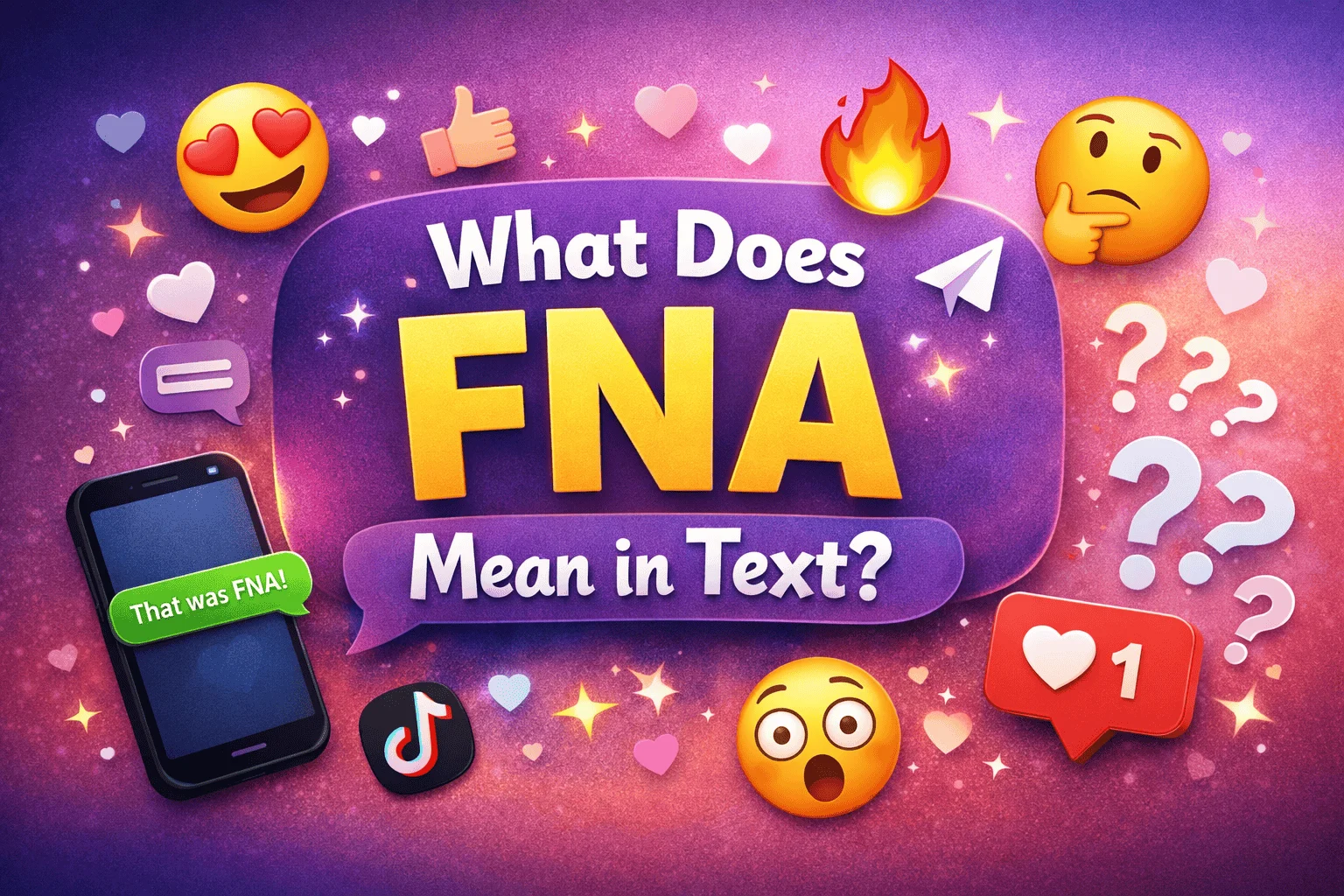
If you’ve recently seen “FNA” in a message and paused for a second, you’re not alone.
Text slang moves fast. What feels obvious to one person can be confusing to someone else. That’s exactly why people search for what does FNA mean in text — they want clarity without guessing the wrong tone.
The truth is, FNA is a flexible slang term. Its meaning depends heavily on context, the relationship between people, and even the mood of the conversation.
In this guide, you’ll get a clear, real-world understanding of FNA. Not just the definition, but how people actually use it, what emotions it carries, and when it can go wrong.
What Does FNA Mean in Text – Quick Meaning
FNA most commonly stands for:
- “F*ing Amazing”** (positive, excited tone)
- Sometimes used as “For No Apparent reason” (less common)
Simple Examples
- “That movie was FNA 🔥”
- “You just disappeared FNA, what happened?”
- “This food is FNA, I need more 😭”
In most modern chats, especially among younger users, FNA expresses strong excitement or admiration.
Origin & Background
FNA doesn’t come from a formal dictionary or a single viral moment. It evolved naturally from internet slang culture.
It follows a familiar pattern. People shorten phrases to save time and add emotional punch. Just like “OMG” or “WTF,” FNA compresses a strong reaction into three letters.
Cultural Influence
- Social media platforms like TikTok and Instagram helped spread it
- Meme culture favors short, punchy expressions
- Younger users prefer expressive abbreviations that feel personal
How It Evolved
At first, phrases like “f***ing amazing” were typed fully. Over time, they became abbreviated for speed and subtlety.
Now, FNA works as a quick emotional signal rather than a literal phrase.
Real-Life Conversations
Here’s how FNA actually appears in real chats.
WhatsApp Chat
Person A: Bro I just tried that new burger place
Person B: And?
Person A: FNA. No joke, best thing I’ve had all week
Instagram DMs
Person A: Your vacation pics 😍
Person B: Haha thanks
Person A: That beach looks FNA honestly
TikTok Comments
User1: The editing on this video is reckless
User2: Right?? FNA 🔥🔥
Text Messages
Person A: Just finished the game
Person B: Was it worth it?
Person A: 100%. FNA ending
These examples show something important.
FNA is rarely neutral. It almost always carries strong emotion.
Emotional & Psychological Meaning
FNA is not just a phrase. It’s a feeling compressed into text.
What Emotion Does It Express?
- Excitement
- Amazement
- Surprise
- Intense approval
When someone uses FNA, they are not just saying something is good.
They are saying it hit them emotionally.
Why People Use It
People want to:
- Sound expressive without typing long sentences
- Match the fast pace of digital conversations
- Add personality to their messages
Real-Life Scenario
Imagine a friend sends you a clip of their performance. You could say “That was really good.”
But if you say “That was FNA,” it feels more raw and genuine.
It shows you were impressed, not just polite.
Usage in Different Contexts
Social Media
On platforms like TikTok or Instagram:
- Used in comments to hype content
- Adds energy and relatability
- Often paired with emojis
Example: “This transition is FNA 🔥”
Friends & Relationships
Among friends:
- Very common
- Feels casual and expressive
- Can strengthen emotional connection
Example: “Your outfit today was FNA honestly”
Work / Professional Settings
Not recommended.
- Can sound unprofessional
- May be misunderstood
- Contains implied profanity
Better to say: “That’s impressive” or “Great work”
Casual vs Serious Tone
- Casual: Perfect fit
- Serious or formal: Avoid it
FNA belongs in relaxed, friendly conversations.
When NOT to Use It
There are moments where using FNA can backfire.
Inappropriate Contexts
- Professional emails
- Academic writing
- Conversations with elders
Cultural Sensitivity
Some cultures are more conservative with language. Even implied slang can feel disrespectful.
Risk of Misunderstanding
Not everyone knows what FNA means.
It might confuse or even offend someone if interpreted incorrectly.
Common Misunderstandings
1. Thinking It Has One Fixed Meaning
FNA can mean different things depending on context.
2. Tone Confusion
Someone might read it as sarcasm instead of praise.
3. Literal Interpretation
Some people focus on the hidden word behind FNA and feel it’s inappropriate.
4. Assuming Everyone Knows It
Not all age groups or cultures are familiar with this slang.
Comparison Table
| Expression | Meaning | Tone | Usage |
|---|---|---|---|
| FNA | F***ing Amazing | Very excited | Casual chats |
| OMG | Oh My God | Surprise | Universal |
| LIT | Very exciting | Fun | Social media |
| WOW | Amazement | Neutral | All settings |
| MEH | Indifference | Low energy | Casual |
Key Insight
FNA stands out because it amplifies emotion more than most slang. It’s stronger than “wow” and more expressive than “lit,” but also less appropriate in formal situations.
Variations / Types
Here are some related or similar forms you might see:
- FNA🔥
Same meaning, stronger emphasis with emojis - FNA fr
“F***ing amazing for real” - FNA af
Adds extra intensity - FNA vibes
Describing a situation or mood - Lowkey FNA
Slightly toned-down praise - Highkey FNA
Very obvious excitement - FNA moment
Highlighting a standout experience - FNA energy
Refers to strong, positive vibes - FNA level
Used to compare something exceptional - That’s FNA tho
Casual agreement with emphasis
How to Respond When Someone Uses It
Casual Replies
- “Haha right? I loved it too”
- “Glad you think so 😄”
Funny Replies
- “FNA? Say it louder 😂”
- “You finally have taste 😏”
Mature Replies
- “I’m really glad you enjoyed it”
- “That means a lot, thank you”
Respectful Replies
- “Appreciate that!”
- “Thank you for the kind words”
Regional & Cultural Usage
Western Culture
- Very common among Gen Z
- Seen as expressive and trendy
Asian Culture
- Used mostly online
- Less common in daily speech
Middle Eastern Culture
- Depends on context
- Younger users adopt it more
Global Internet Usage
FNA exists mainly in informal digital spaces.
Its meaning is widely understood in online communities.
Generational Differences
- Gen Z: Uses it naturally
- Millennials: Understand but use less often
- Older generations: May find it confusing or inappropriate
Is It Safe for Kids?
FNA includes implied strong language.
While many teens use it casually, it’s not always appropriate for younger children. Context matters.
Parents and educators should guide kids on where and when slang is acceptable.
FAQs
1. What does FNA mean in texting?
It usually means “F*ing Amazing”**, expressing strong excitement or admiration.
2. Is FNA a bad word?
Not directly, but it contains implied profanity, so it can be inappropriate in formal settings.
3. Can FNA have other meanings?
Yes, sometimes it can mean “for no apparent reason,” but that usage is less common.
4. Is FNA popular?
It’s moderately popular, especially among younger social media users.
5. Can I use FNA at work?
It’s better to avoid it in professional environments.
6. Is FNA positive or negative?
Mostly positive. It usually expresses excitement or admiration.
Conclusion
Understanding what does FNA mean in text is really about understanding modern communication.
It’s quick. It’s emotional. It’s expressive.
FNA captures a moment when something feels more than just “good.” It reflects how people today communicate feelings instantly, without overthinking.
Still, context is everything.
Use it with friends, in relaxed spaces, and where your tone will be understood. Avoid it where clarity and professionalism matter more.
Once you get the feel of it, FNA becomes easy to use. And even easier to recognize when someone is genuinely impressed.