
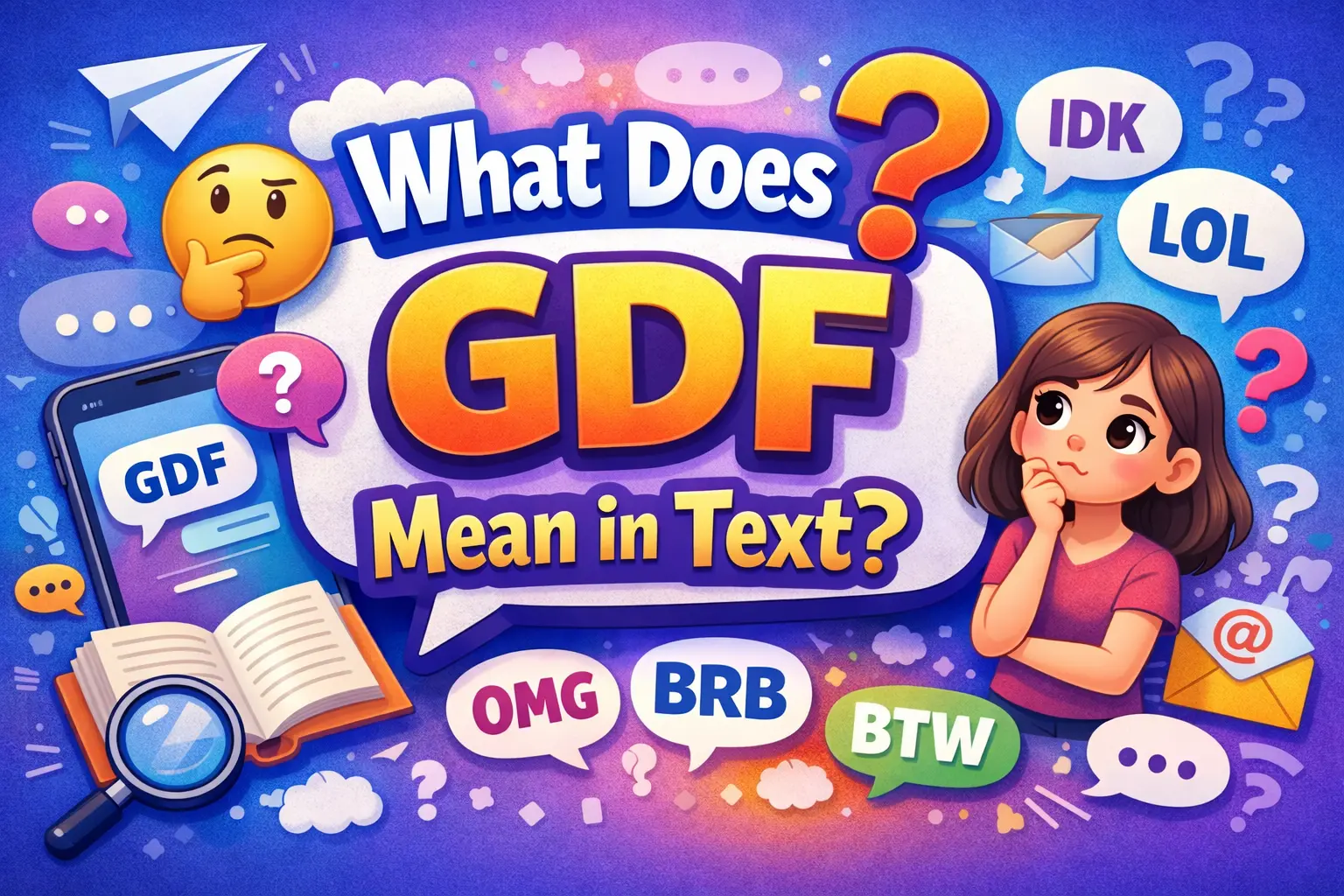
If you’ve ever seen “GDF” pop up in a message and paused for a second, you’re not alone. Short text abbreviations like this can feel confusing because they often carry multiple meanings depending on context, tone, and even the relationship between people.
So what does GDF mean in text?
In most casual online conversations, GDF is used as slang, shorthand, or a quick expression that saves time while still conveying emotion or attitude. People search for it because it is not as common as abbreviations like “LOL” or “OMG,” which makes its meaning less obvious.
This article clears up that confusion. You’ll not only understand what GDF means, but also how it feels when someone uses it, when to use it yourself, and when to avoid it completely.
GDF – Quick Meaning
GDF usually stands for:
- “Go Die Fast” (harsh or joking insult depending on tone)
- “Good Day Friend” (rare, polite, or sarcastic use)
- Sometimes used as a random shorthand in gaming or private chats
The most common meaning online is “Go Die Fast,” but it is not always meant literally. Often, it is used jokingly among friends.
Examples:
- “You beat me again? GDF 😂”
- “Bro ate my fries… GDF 😭”
- “If you spoil the ending, GDF fr”
Tone matters a lot here. The same phrase can feel playful or offensive depending on context.
Origin & Background
GDF is not an officially standardized acronym. It grew organically from internet culture where people shorten phrases for speed and impact.
Its most common interpretation, “Go Die Fast,” likely evolved from earlier phrases like “go die” or “drop dead,” which were used both seriously and sarcastically in online forums and gaming communities.
As platforms like TikTok, Instagram, and WhatsApp became more conversational, users started softening harsh expressions with humor. That is where GDF found its place. It sounds aggressive on the surface, but among friends, it often carries a playful or exaggerated tone.
In some niche groups, especially older forums, GDF also appeared as “Good Day Friend,” though this version is far less common today.
Over time, the meaning shifted from literal insult to emotional exaggeration. It became a way to express frustration, jealousy, or playful annoyance without being taken too seriously.
Real-Life Conversations
Here’s how GDF actually shows up in everyday chats.
WhatsApp Chat
Person A: I just finished the whole series in one night
Person B: WHAT?? I’m still on episode 2 😭
Person A: GDF 😂 you’re too slow
Instagram DMs
Person A: I met your favorite celebrity today
Person B: STOP LYING
Person A: I swear 😎
Person B: GDF I’m jealous
TikTok Comments
User 1: I tried this recipe and burned everything
User 2: Same 😭
User 3: My kitchen almost exploded
User 2: GDF 😂
Text Messages
Person A: I got 95% on the test
Person B: I studied all night and got 70
Person B: GDF bro 😭
In all these examples, GDF is not meant literally. It reflects emotion, not intention.
Emotional & Psychological Meaning
At its core, GDF is about emotional exaggeration.
People use it when they feel:
- Playful frustration
- Jealousy
- Friendly competition
- Mock anger
It works because modern communication often lacks tone. So instead of writing long explanations, people use strong phrases to quickly express how they feel.
Here’s a relatable scenario.
You spend hours preparing for something, and your friend casually succeeds without trying. You don’t actually wish harm on them, but you feel that mix of admiration and annoyance. Saying “GDF” in that moment captures that feeling in a raw, exaggerated way.
It reveals something deeper about modern communication. People prefer short, emotionally loaded expressions rather than long explanations. It saves time and strengthens social bonds when used correctly.
Usage in Different Contexts
Social Media
On platforms like TikTok or Instagram, GDF is mostly used in a humorous or exaggerated way. It often appears in comments reacting to impressive or frustrating content.
Friends & Relationships
Among close friends, it can be playful and harmless. It usually signals comfort and familiarity.
However, tone matters. Without a strong relationship, it may come off as rude.
Work / Professional Settings
Avoid using GDF in professional communication. It can easily be misunderstood and may appear disrespectful.
Casual vs Serious Tone
- Casual tone: playful, joking, harmless
- Serious tone: harsh, offensive, inappropriate
Understanding the difference is key to using it correctly.
When NOT to Use It
There are moments where GDF can cause real problems.
- In formal conversations
- With people you don’t know well
- During serious or emotional discussions
- In multicultural settings where tone may be misread
Even if you mean it jokingly, the other person might not interpret it that way.
Common Misunderstandings
Many people misread GDF because they take it literally.
Common mistakes include:
- Thinking it is always aggressive
- Assuming it is appropriate in all contexts
- Misjudging tone in text messages
The biggest confusion comes from tone. Without facial expressions or voice, text can easily be misinterpreted.
Comparison Table
| Expression | Meaning | Tone | Usage |
|---|---|---|---|
| GDF | Go Die Fast | Playful or harsh | Friends, jokes |
| LOL | Laugh Out Loud | Light | Universal |
| STFU | Shut The F Up | Aggressive or joking | Risky |
| BRUH | Expression of disbelief | Casual | Social media |
| Congrats | Positive acknowledgment | Friendly | All settings |
| Ignore | Opposite intent | Neutral | Direct |
Key Insight:
GDF sits in a gray area. It is emotionally strong but socially flexible. Its meaning depends more on the relationship than the words themselves.
Variations / Types
Here are some related variations and similar expressions:
- GDFR – “Go Die Fast, Really” for extra emphasis
- GDF lol – Softens the tone with humor
- GDF bro – Friendly and casual
- GDF fr – Adds seriousness or emphasis
- GDF 😂 – Clearly playful
- GDF pls – Sarcastic exaggeration
- GDF rn – Expresses immediate reaction
- GDF omg – Combines shock and humor
- GDF no way – Reaction to disbelief
- GDF seriously – Slightly stronger tone
Each variation tweaks the emotional intensity without changing the core meaning.
How to Respond When Someone Uses It
Casual Replies
- “Haha relax 😂”
- “You love me really”
- “Stay mad 😎”
Funny Replies
- “Already on my way 💀”
- “Too late, I’m immortal”
- “Plot twist, I win again”
Mature Replies
- “Okay okay, I get it 😄”
- “Don’t be salty”
- “You’ll get me next time”
Respectful Replies
- “Hey, let’s keep it friendly”
- “I know you’re joking, but chill”
- “All good, no worries”
Your response should match the tone and relationship.
Regional & Cultural Usage
Western Culture
More likely to be used casually among friends. Humor and sarcasm are common, so it is often not taken literally.
Asian Culture
May be less common and sometimes misunderstood due to more indirect communication styles.
Middle Eastern Culture
Tone sensitivity is higher. Strong phrases like GDF may feel disrespectful unless used among close friends.
Global Internet Usage
Online communities often normalize exaggerated language, making GDF feel less intense than it sounds.
Generational Differences
- Gen Z: Uses it playfully and frequently
- Millennials: Understand it but may use it less
- Older generations: More likely to misinterpret it as serious
Is It Safe for Kids?
GDF is not ideal for kids.
Even if used jokingly, it includes language that can sound aggressive or harmful. Younger users may not fully understand tone or context, which increases the risk of miscommunication.
It is better for kids to stick to lighter expressions.
FAQs
1. What does GDF mean in texting?
It usually means “Go Die Fast,” often used jokingly to express frustration or playful anger.
2. Is GDF rude?
It can be. Among friends, it may be harmless. In other contexts, it can feel offensive.
3. Can GDF be positive?
Not directly. It is more of a sarcastic or exaggerated reaction rather than a positive phrase.
4. Is GDF commonly used?
It is less common than major slang but still appears in casual online conversations.
5. Should I use GDF at work?
No. It is not appropriate for professional communication.
6. How do I know if someone is joking?
Look for emojis, tone, and your relationship with the person.
7. Are there safer alternatives?
Yes. You can use “bruh,” “wow,” or “you’re unbelievable” instead.
Conclusion
GDF is one of those expressions that shows how language keeps evolving online. On the surface, it sounds harsh. But in the right context, it becomes playful, exaggerated, and even bonding.
The key is awareness. Understand who you are talking to, read the tone carefully, and use it only where it feels natural.
When used thoughtfully, GDF is not just slang. It is a snapshot of how modern communication blends emotion, humor, and brevity into just three letters.