

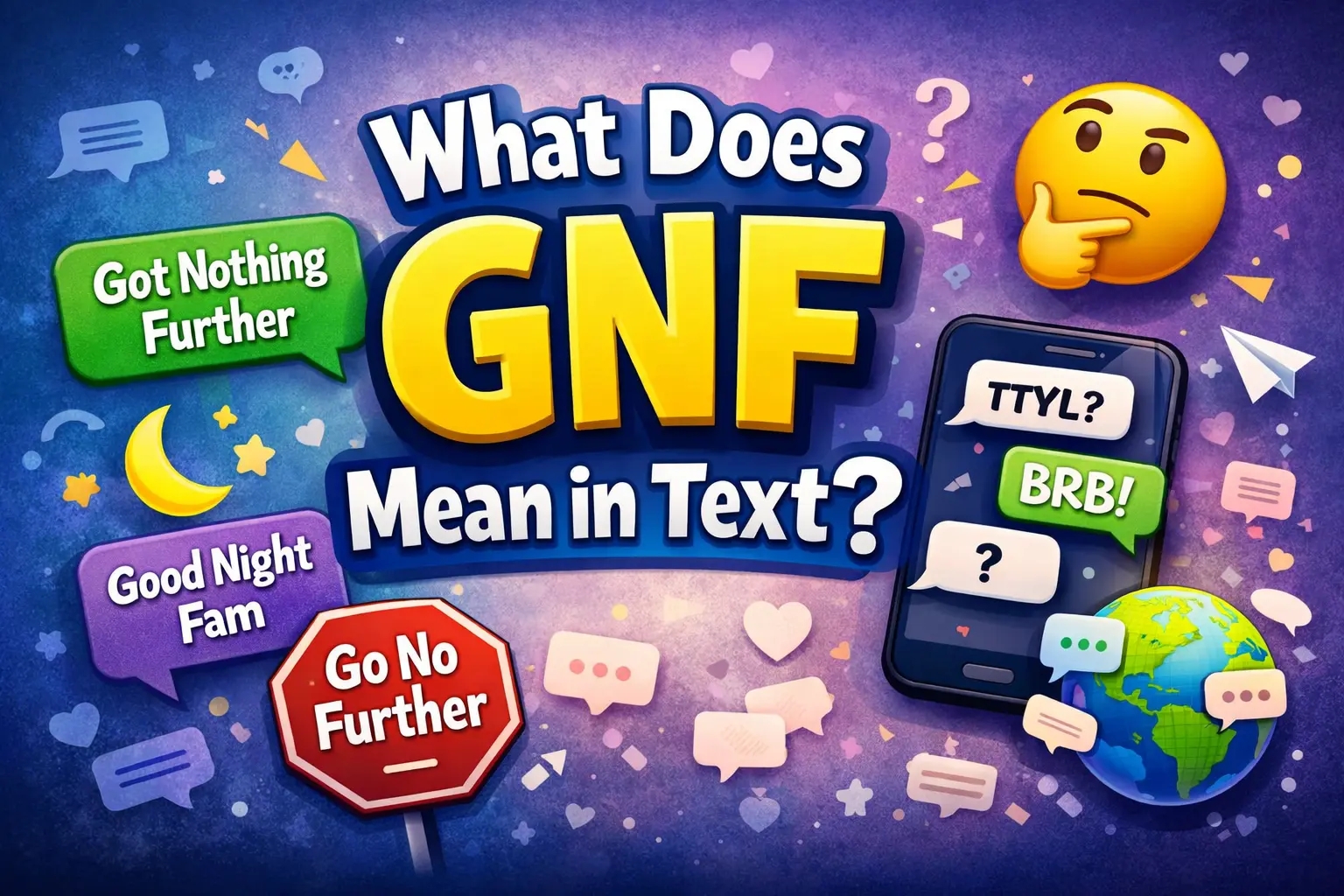
If you have come across the abbreviation “GNF” in a chat, comment, or social media post, you are not alone. Many people search for what does gnf mean in text because its meaning is not immediately obvious. Unlike common acronyms such as LOL or BRB, GNF is more niche and often depends on context.
In today’s fast-moving digital conversations, slang evolves quickly. People shorten phrases not only to save time but also to express tone, emotion, or identity. GNF is one of those expressions that can feel confusing at first glance, especially if you are not familiar with the communities or platforms where it is used.
This guide breaks down the meaning of GNF in simple terms, explains its origin, shows how it is used in real conversations, and helps you understand when and how to respond. By the end, you will feel confident recognizing and using it appropriately in everyday communication.
GNF – Quick Meaning
GNF is most commonly used as a slang abbreviation that can stand for:
- “Got Nothing Further”
- “Good Night Fam” (in casual texting contexts)
- “Go No Further” (less common, situational)
The meaning depends heavily on context, tone, and the conversation itself.
Simple examples:
- “Alright, GNF for now.”
- “GNF, talk tomorrow.”
- “That’s all I have, GNF.”
In many casual chats, especially among friends, GNF is often interpreted as a closing statement meaning the conversation is ending or there is nothing more to add.
Origin & Background
Unlike widely standardized acronyms, GNF does not have a single clearly documented origin. Instead, it emerged organically across online communication platforms such as texting, forums, and social media.
Its usage grew as people began abbreviating common phrases in order to communicate faster. Over time, different communities adapted GNF to suit their own conversational habits.
Social media platforms like Instagram, TikTok, and messaging apps contributed to its spread. As users interacted globally, abbreviations like GNF became part of a broader digital shorthand culture.
The meaning also evolved depending on context. In some circles, it became a casual way to sign off conversations. In others, it signals finality or closure in discussions.
Real-Life Conversations
Here are some realistic examples of how GNF appears in everyday communication.
Conversation 1: WhatsApp Chat
Person A: Are you coming to the meeting later?
Person B: Yes, but I don’t have updates yet. GNF for now.
Conversation 2: Instagram DM
Person A: Can you send me the details?
Person B: I already shared everything. GNF 😊
Conversation 3: TikTok Comment Thread
Person A: Why did you stop replying?
Person B: There was nothing more to add, GNF.
Conversation 4: Text Message Between Friends
Person A: Let’s continue this tomorrow.
Person B: Sure, GNF. Good night.
These examples show that GNF often acts as a conversational closure or a signal that the speaker has nothing further to contribute at that moment.
Emotional & Psychological Meaning
GNF is more than just an abbreviation. It reflects how people manage communication boundaries in digital spaces.
Using GNF often indicates:
- A desire to end a conversation politely
- A sense of completeness or finality
- Emotional neutrality rather than engagement
- Efficiency in communication
In modern communication, people prefer short, clear signals to avoid over-explaining. GNF fits this pattern well.
Personal-style scenario
Imagine you are chatting with a colleague late at night. You have already discussed everything related to a task. Instead of typing a long closing message, you simply write “GNF” to indicate there is nothing more to discuss. This keeps the interaction concise while still being clear and respectful.
Psychologically, this reflects a balance between social connection and personal boundaries. It allows individuals to disengage without sounding abrupt or rude.
Usage in Different Contexts
GNF is flexible, but its meaning and appropriateness depend on where and how it is used.
Social Media
On platforms like Instagram, TikTok, or Twitter, GNF is often used in comments or captions to indicate closure or final thoughts.
Friends & Relationships
Among friends, it is commonly used as a casual sign-off in conversations, similar to saying “talk later” or “good night.”
Work or Professional Settings
GNF is generally not recommended in formal communication. In professional emails or workplace chats, it may appear unclear or unprofessional unless the team culture is very informal.
Casual vs Serious Tone
- Casual tone: Acceptable and understood among peers
- Serious tone: May require clarification or a more explicit phrase
Using GNF in the wrong tone can lead to confusion, especially with people unfamiliar with slang.
When NOT to Use It
There are situations where using GNF may not be appropriate:
- Formal emails or business communication
- Conversations with people who may not understand slang
- Academic or professional documents
- Sensitive discussions requiring clarity
Cultural sensitivity also matters. In global communication, not everyone interprets abbreviations the same way. Using GNF with someone unfamiliar with it may create misunderstanding.
Common Misunderstandings
GNF can be confusing for several reasons:
- It has multiple possible meanings
- It lacks a universal definition
- Tone can be misinterpreted without context
- Some people assume it always means “Good Night Fam,” which is not always accurate
A common mistake is taking it literally without considering the conversation. Context is essential when interpreting abbreviations like GNF.
Another misunderstanding is assuming it is always a friendly or emotional phrase. In reality, it can simply mean the speaker has nothing further to add.
Comparison Table
| Expression | Meaning | Tone | Usage Context |
|---|---|---|---|
| GNF | Got Nothing Further / Good Night Fam | Neutral to casual | Ending conversations |
| BRB | Be Right Back | Temporary pause | Short breaks |
| TTYL | Talk To You Later | Casual closing | Informal chats |
| FYI | For Your Information | Informational | Neutral updates |
| IDC | I Don’t Care | Dismissive | Expressing indifference |
Key Insight:
GNF is primarily a conversational closure phrase, while most similar abbreviations either indicate time, information, or emotion rather than finality.
Variations / Types
Here are some variations or related interpretations of GNF:
- Got Nothing Further
Indicates no additional information to share. - Good Night Fam
Used as a friendly sign-off in evening chats. - Go No Further
Implies stopping or ending a discussion. - General Notice Flag
Rare technical or niche usage. - Global Network Function
Used in specialized technical contexts. - Give No Feedback
Indicates silence or no response. - Got No Follow-up
Suggests the conversation is complete. - General Note Finished
Used informally in notes or summaries. - Go Next Forward
Rare motivational or directional usage. - Game Night Finished
Used in gaming communities after sessions.
These variations highlight how flexible abbreviations can become depending on the environment and community.
How to Respond When Someone Uses It
Your response to GNF depends on tone and context.
Casual Replies
- “Got it 👍 talk later”
- “Alright, see you!”
- “GNF, have a good one!”
Funny Replies
- “GNF? I guess I’ll stop talking too 😄”
- “Copy that, mission complete.”
- “Understood, ending chat mode 😂”
Mature Replies
- “Thanks for the update, we can continue later.”
- “Noted, appreciate it.”
Respectful Replies
- “Understood, have a great day.”
- “Alright, looking forward to continuing tomorrow.”
Choosing the right response helps maintain clarity and smooth communication.
Regional & Cultural Usage
GNF is mostly used in global online communication, but interpretation varies across cultures.
Western Culture
Commonly used in casual texting and social media. Younger users are more familiar with it.
Asian Culture
Usage exists mainly among English-speaking users or those active on international platforms. It may not be widely recognized in local languages.
Middle Eastern Culture
Adoption is growing among younger, digitally active users, especially in messaging apps.
Global Internet Usage
GNF is part of a broader trend of internet shorthand used worldwide, especially in cross-border communication.
Generational Differences
- Gen Z: More likely to understand and use slang like GNF naturally
- Millennials: Familiar but may use it less frequently
- Older generations: Less likely to recognize without explanation
Is It Safe for Kids?
GNF is generally considered safe because it is not offensive or harmful. However, children may not understand its meaning without context.
Parents and educators may need to explain slang to ensure clear communication. It is always better to use full phrases in educational or formal settings to avoid confusion.
FAQs
1. What does GNF mean in text messages?
GNF usually means “Got Nothing Further” or sometimes “Good Night Fam,” depending on context.
2. Is GNF a positive or negative term?
It is neutral. It simply indicates closure or lack of additional information.
3. Can GNF be used in professional emails?
No, it is best avoided in formal communication because it may confuse readers.
4. Is GNF the same as TTYL?
No. TTYL means “Talk To You Later,” while GNF often means the conversation has nothing more to add.
5. Why do people use GNF?
People use it to keep conversations short, clear, and efficient.
6. Does GNF always mean the same thing?
No, its meaning depends on context and the intent of the speaker.
7. Is GNF commonly used worldwide?
It is used globally in online communication, but recognition varies by region and generation.
Conclusion
Understanding what GNF means in text is a small but useful step in navigating modern digital communication. While it may seem confusing at first, its meaning becomes clear once you see how it functions in real conversations.
GNF is primarily a shorthand for closing a discussion or indicating that there is nothing further to add. Its flexibility allows it to adapt to casual chats, social media interactions, and friendly exchanges.
As with any slang, context is key. When used appropriately, GNF can make conversations smoother, quicker, and more natural. Recognizing such expressions helps you stay confident and connected in today’s fast-paced communication world.