
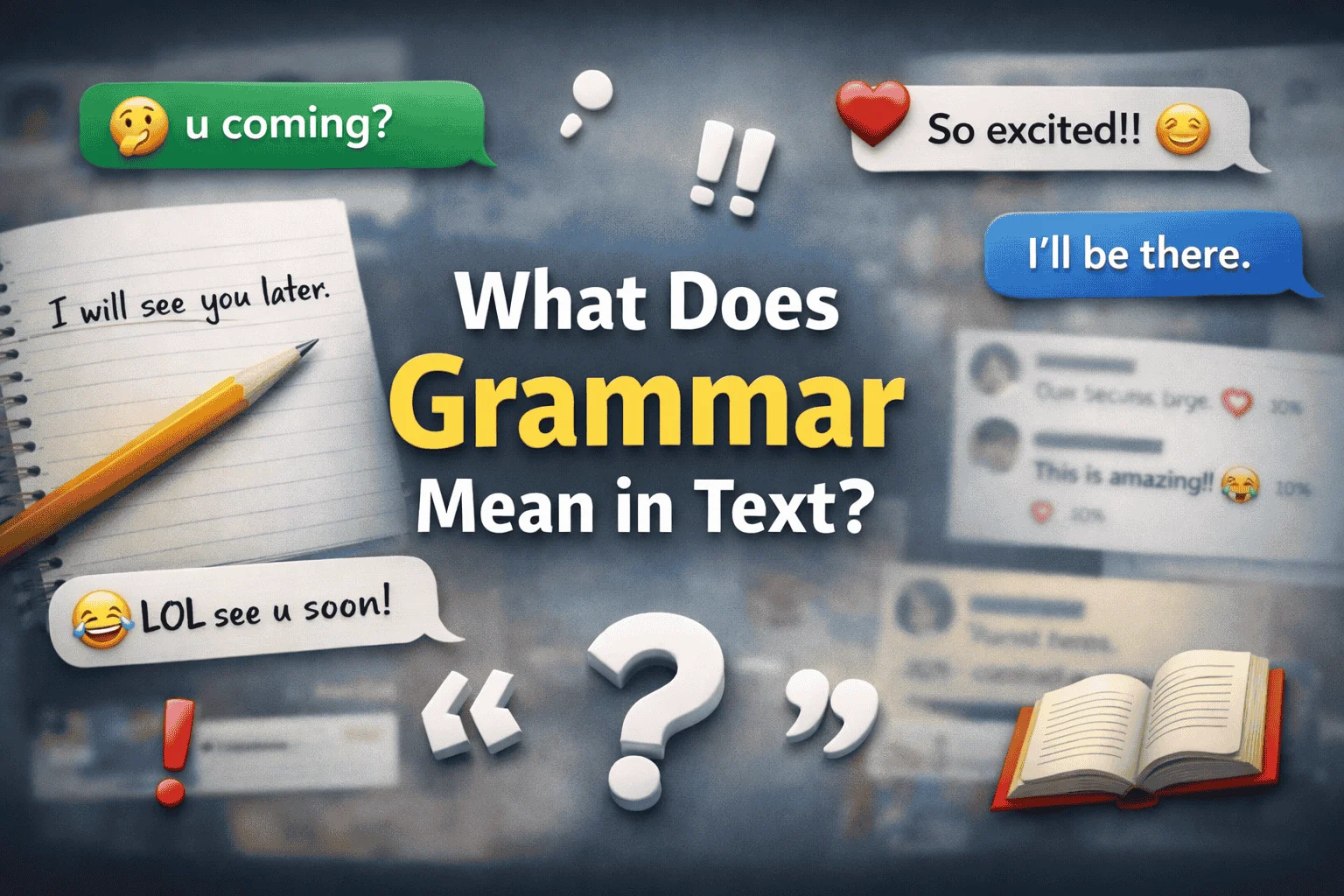
If you’ve ever paused before sending a message and wondered, “Is my grammar okay?” you’re not alone. The phrase what does grammar mean in text is something people search when they want clarity, confidence, and maybe a little reassurance that they’re communicating the right way.
In today’s world of quick replies, emojis, and voice notes, grammar in text doesn’t always look like what we learned in school. It has evolved. Sometimes it’s strict and formal. Other times, it’s relaxed and expressive.
This article clears the confusion. You’ll understand what grammar means in texting, how it works in real conversations, and when it matters more than you think.
What Does Grammar Mean in Text – Quick Meaning
Grammar in text refers to how you structure words, sentences, and punctuation when communicating through messages.
It includes:
- Sentence structure
- Word order
- Punctuation and capitalization
- Tone and clarity
In texting, grammar can be:
- Formal: “I will call you later.”
- Casual: “i’ll call u later”
- Expressive: “I’ll call you later!!! 😊”
Examples:
- “Are you coming?”
- “you coming?”
- “Coming??”
All three communicate the same idea, but the grammar changes the tone and clarity.
Origin & Background
Grammar has always been the backbone of language. Traditionally, it followed strict rules shaped by literature, education systems, and formal communication.
But texting changed everything.
With the rise of mobile phones and platforms like WhatsApp, Instagram, and TikTok, people started prioritizing speed and emotion over perfection. Abbreviations, emojis, and informal structures became normal.
For example:
- “You are” became “you’re” and then “ur”
- Full sentences became fragments
- Punctuation became optional or expressive
Social media accelerated this shift. Influencers, memes, and viral trends reshaped how people write. Grammar is no longer just about correctness. It’s about connection, personality, and context.
Real-Life Conversations
WhatsApp Chat
Person A: hey did u finish the assignment
Person B: yeah just sent it 👍 check ur email
Instagram DM
Person A: omg your outfit was stunning last night
Person B: thank youu 😭💖 means a lot
TikTok Comments
Person A: this video made me cry fr
Person B: same like why am I emotional over this 😭
Text Message
Person A: Are you free tomorrow?
Person B: kinda busy but we can meet later
These examples show how grammar adapts. Some messages ignore traditional rules, but they still feel natural and clear.
Emotional & Psychological Meaning
Grammar in text is not just about correctness. It reflects emotion, personality, and intention.
For example:
- Proper grammar can feel serious or respectful
- Casual grammar can feel friendly and relaxed
- Lack of punctuation can feel cold or rushed
People often adjust their grammar based on how they feel.
Imagine this situation:
You text someone: “Okay.”
They reply: “ok”
That small difference can feel huge. One may seem neutral, the other distant.
From experience, many people subconsciously read tone through grammar. A simple message can feel warm or cold depending on how it’s written.
Usage in Different Contexts
Social Media
Grammar is flexible here. People mix words, emojis, and slang freely. Clarity matters, but perfection doesn’t.
Example:
“this made my day 😭💖”
Friends & Relationships
Casual grammar is common. It builds comfort and closeness.
Example:
“miss u already”
Work / Professional Settings
Grammar becomes more structured. Clear sentences and correct punctuation matter.
Example:
“Please review the document and let me know your feedback.”
Casual vs Serious Tone
- Casual: “what’s up”
- Serious: “What is your update on this matter?”
The same message can feel very different depending on grammar.
When NOT to Use It
There are moments when relaxed grammar can create problems.
Avoid informal grammar:
- In job applications
- In formal emails
- In academic writing
- When clarity is critical
Also be careful in cross-cultural conversations. What feels casual to you might seem careless to someone else.
Common Misunderstandings
1. Grammar Doesn’t Matter in Text
It does. Even small errors can change meaning or tone.
2. Short Messages Are Always Better
Sometimes short messages feel abrupt or rude.
3. Emojis Replace Grammar Completely
They help with tone but don’t replace clarity.
4. Informal Grammar Means Laziness
Not always. It often reflects comfort and context.
Comparison Table
| Expression Type | Example | Meaning | Tone |
|---|---|---|---|
| Proper Grammar | “I am coming now.” | Clear and formal | Professional |
| Casual Grammar | “I’m coming now” | Relaxed but correct | Friendly |
| Slang/Short Form | “coming now” | Quick and informal | Very casual |
| Opposite (No Clarity) | “…” | Confusing or unclear | Cold/uncertain |
| Similar Expression | “on my way” | Same meaning, different form | Neutral |
Key Insight:
Grammar is not fixed in texting. It shifts based on context, but clarity and tone always matter more than strict rules.
Variations / Types of Grammar in Text
- Formal Grammar
Used in professional or serious communication. - Informal Grammar
Relaxed structure used with friends. - Slang-Based Grammar
Includes abbreviations like “idk” or “brb”. - Emoji-Supported Grammar
Words combined with emojis to express tone. - Minimal Grammar
Short phrases without full sentences. - Expressive Grammar
Repeated letters or punctuation like “soooo happy!!!” - Voice-to-Text Grammar
Sometimes messy but natural. - Code-Switching Grammar
Mixing languages in one message. - Aesthetic Grammar
Lowercase text for style like “i love this”. - Hyper-Correct Grammar
Perfect structure, often used to sound serious.
How to Respond When Someone Uses It
Casual Replies
- “got it 👍”
- “sounds good”
Funny Replies
- “wow look at you using full sentences 😂”
- “grammar level 100 unlocked”
Mature Replies
- “Thanks for explaining clearly.”
- “I understand your point.”
Respectful Replies
- “I appreciate your message.”
- “Thank you for sharing that.”
Regional & Cultural Usage
Western Culture
Grammar in texting is highly flexible. Informal language is widely accepted.
Asian Culture
Respect and hierarchy influence grammar. Politeness is often prioritized.
Middle Eastern Culture
Tone matters deeply. Respectful grammar is important in many situations.
Global Internet Usage
A mix of styles. English grammar blends with local expressions.
Generational Differences
- Gen Z: Creative, flexible, emoji-heavy
- Millennials: Balanced between formal and casual
Is It Safe for Kids?
Yes, but with guidance.
Kids often use informal grammar naturally. It helps them express themselves quickly. However, they should still learn proper grammar for school and future communication.
Balance is key.
FAQs
1. What does grammar mean in texting?
It refers to how words, sentences, and punctuation are used to communicate clearly in messages.
2. Is grammar important in text messages?
Yes. It affects clarity, tone, and how your message is understood.
3. Can I ignore grammar while texting?
You can relax it, but completely ignoring it can cause confusion.
4. Why do people use bad grammar in texts?
Usually for speed, comfort, or to sound casual.
5. Does grammar affect tone?
Absolutely. Even small changes can make a message feel warm or cold.
6. Is informal grammar unprofessional?
In casual settings, no. In professional settings, it can be.
7. How can I improve my texting grammar?
Focus on clarity, read your message before sending, and adjust based on context.
Conclusion
Grammar in text is not about strict rules anymore. It’s about clarity, tone, and connection.
Sometimes a perfectly written sentence is the right choice. Other times, a simple “ok” or “got it 😊” feels more natural.
The key is awareness. Understand your audience, your intention, and the situation.
When you do that, your grammar becomes more than just correct. It becomes effective, expressive, and human.