
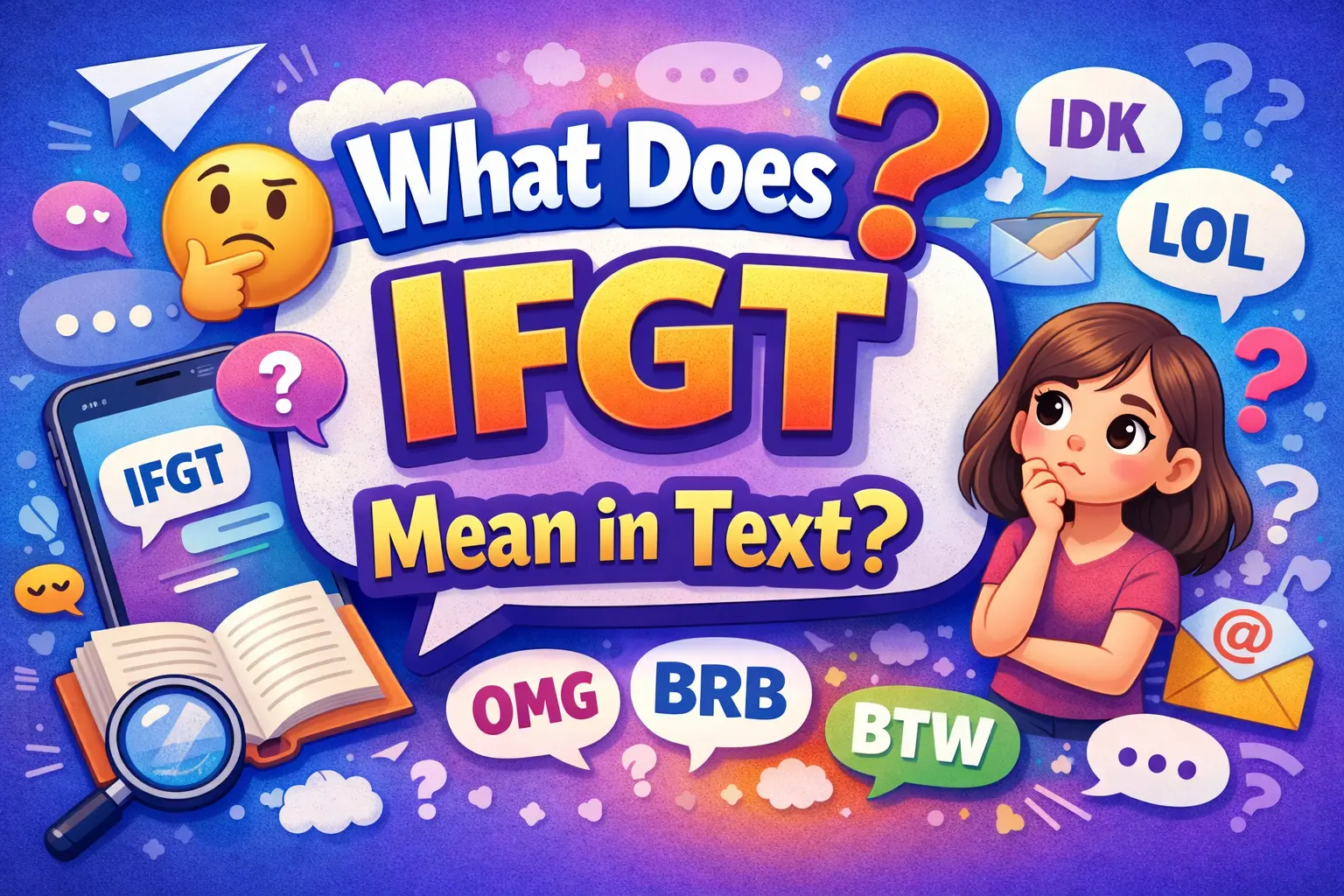
If you’ve recently come across “IFGT” in a message and paused for a second, you’re not alone. It’s one of those short, slightly cryptic internet abbreviations that can feel confusing at first glance. Unlike popular acronyms that show up everywhere, IFGT is more niche and often depends on context.
People search for “what does IFGT mean in text” because it doesn’t have one universal meaning. Its tone can shift depending on who’s using it, how it’s written, and where it appears. That’s exactly where the confusion comes in.
In this guide, you’ll get a clear, real-world understanding of IFGT. Not just what it stands for, but how people actually use it in conversations, what emotion it carries, and when it’s better to avoid it.
IFGT – Quick Meaning
IFGT typically stands for: “I Feel Good Today.”
It’s used to express a positive mood, emotional relief, or a sense of personal confidence.
Simple Breakdown:
- I = I
- F = Feel
- G = Good
- T = Today
Example Uses:
- “Woke up early, went for a run… IFGT 😌”
- “After that talk with you, IFGT honestly.”
- “No stress, no drama… IFGT.”
At its core, IFGT is about feeling mentally or emotionally better in the moment.
Origin & Background
IFGT isn’t one of those long-standing internet acronyms like “LOL” or “BRB.” It’s a more recent, low-frequency slang that emerged organically in texting culture.
It likely grew out of:
- The trend of shortening emotional expressions
- The rise of daily mood updates on social media
- The need to communicate feelings quickly without long sentences
Platforms like TikTok, Instagram, and Snapchat played a big role. People began sharing quick emotional snapshots of their day, and phrases like “I feel good today” naturally got compressed into IFGT.
Over time, its meaning stayed relatively stable but became more personal and context-driven. It’s less about grammar and more about vibe.
Real-Life Conversations
Here’s how IFGT actually shows up in real conversations.
1. WhatsApp Chat
Person A: You okay now? Yesterday you seemed stressed
Person B: Yeah, took a break and cleared my head
Person B: IFGT 😊
2. Instagram DM
Person A: That glow in your pic is different 🔥
Person B: Haha thank you
Person B: Honestly IFGT these days
3. TikTok Comments
User 1: You look so happy in this video
User 2: Not gonna lie… IFGT after a long time
4. Text Message
Person A: Did the interview go well?
Person B: It did! I was nervous but it worked out
Person B: IFGT 🙌
These examples show something important. IFGT isn’t just about feeling “good.” It often reflects relief after stress, emotional recovery, or quiet happiness.
Emotional & Psychological Meaning
On the surface, IFGT sounds simple. But emotionally, it carries more depth than you might expect.
When someone says IFGT, they are often expressing:
- A sense of inner calm
- Relief after anxiety or pressure
- Small personal wins
- Emotional healing
In modern communication, people don’t always want to explain everything. So instead of writing a full paragraph about how they feel, they use something like IFGT to summarize their emotional state.
A Real-Life Scenario
Imagine someone who had a rough week. Deadlines, arguments, mental stress. Then one day, things settle. They go for a walk, listen to music, and feel lighter.
Instead of explaining all of that, they just text:
“IFGT.”
That one line carries the weight of their experience.
Usage in Different Contexts
1. Social Media
IFGT is often used in captions, comments, or stories:
- To share a positive mood update
- To reflect self-growth or healing
- To match aesthetic or “soft life” content
2. Friends & Relationships
Among friends, IFGT feels natural and casual:
- “You talked to them?”
- “Yeah… IFGT now.”
It signals emotional progress without over-explaining.
3. Work / Professional Settings
This is where things change.
Using IFGT in professional communication can feel:
- Too informal
- Slightly unclear
Instead of “IFGT,” you’d say:
- “I’m feeling much better today.”
- “Things are going well now.”
4. Casual vs Serious Tone
- Casual: Light, relaxed, expressive
- Serious: Can feel vague or incomplete
IFGT works best in informal, emotionally open spaces.
When NOT to Use It
There are situations where IFGT might not land well.
Avoid using IFGT:
- In formal emails or job-related messages
- During serious conversations where clarity matters
- With people unfamiliar with slang
- In emotionally sensitive situations where more explanation is needed
For example, replying “IFGT” to someone asking about a serious issue might feel dismissive.
Common Misunderstandings
1. Thinking It Has a Fixed Meaning
Some assume IFGT has multiple official meanings. In reality, it’s mostly interpreted as “I Feel Good Today,” but context still matters.
2. Tone Confusion
Without emojis or context, IFGT can feel:
- Neutral
- Slightly distant
Tone depends heavily on surrounding text.
3. Literal vs Emotional Meaning
It’s not always about physical feeling. Often, it reflects:
- Mental state
- Emotional clarity
- Inner peace
Comparison Table
| Expression | Meaning | Tone | When to Use |
|---|---|---|---|
| IFGT | I Feel Good Today | Calm, reflective | Mood updates |
| I’m good | General well-being | Neutral | Everyday replies |
| Feeling great | Strong positivity | Energetic | Celebrations |
| Finally okay | Recovery | Emotional | After tough times |
| Not bad | Mild positivity | Casual | Light conversations |
Key Insight
IFGT sits in a unique space. It’s not overly excited like “feeling amazing,” and not as plain as “I’m good.” It feels more personal, like a quiet moment of emotional balance.
Variations / Types
Here are similar expressions and slight variations you might see:
- IFG – I Feel Good
Shorter version, less specific to “today” - IFGB – I Feel Good Bro
Adds a friendly, casual tone - IFGRN – I Feel Good Right Now
Focuses on the present moment - IMGD – I’m Good
Simpler and more common - FGT – Feel Good Today
Less personal, more statement-like - VGT – Very Good Today
Stronger emphasis on positivity - IFBT – I Feel Better Today
Used after a rough period - MGT – Mood Good Today
More stylized, social media tone - IFT – I Feel That
Different meaning, often confused - IGT – I’m Good Today
Alternative phrasing
How to Respond When Someone Uses It
Casual Replies
- “Love that for you 😊”
- “Good vibes only”
- “Glad to hear that”
Funny Replies
- “Who are you and what did you do with yesterday’s you 😄”
- “Finally, character development”
Mature Replies
- “That’s really good to hear. You deserve it.”
- “I’m happy things are getting better for you.”
Respectful Replies
- “I’m glad you’re feeling better today.”
- “That’s important. Take care of yourself.”
Regional & Cultural Usage
Western Culture
More open emotional expression. IFGT fits naturally into daily conversations and self-expression.
Asian Culture
People may prefer clearer or more complete sentences. IFGT might feel too vague unless used among close friends.
Middle Eastern Culture
Communication tends to value clarity and respect. IFGT is used mostly in informal chats, not formal settings.
Global Internet Usage
Online spaces blend cultures. IFGT is understood mostly by younger users familiar with slang.
Generational Differences
- Gen Z: Comfortable using IFGT casually
- Millennials: Understand it but may prefer full sentences
Is It Safe for Kids?
Yes, IFGT is generally safe. It carries a positive emotional meaning and doesn’t include harmful or inappropriate content.
However, kids should understand:
- When slang is appropriate
- How to communicate clearly in formal situations
FAQs
1. Does IFGT always mean “I Feel Good Today”?
Mostly yes, but context can slightly shift its tone or intention.
2. Is IFGT popular slang?
It’s not extremely common, but it appears in certain online circles and casual chats.
3. Can IFGT be used sarcastically?
Rarely, but tone and context can make anything sound sarcastic.
4. Is IFGT formal or informal?
It’s strictly informal and best used in casual communication.
5. Can I use IFGT in captions?
Yes, especially for mood-based or self-care posts.
6. Why do people use IFGT instead of full sentences?
To express feelings quickly and keep messages short and natural.
7. Is IFGT similar to “I’m okay”?
Not exactly. IFGT usually implies a more positive and intentional emotional state.
Conclusion
Understanding what IFGT means in text goes beyond just decoding letters. It’s about recognizing how people express emotions in a fast, digital world.
IFGT represents something simple yet meaningful. A moment of calm, a quiet win, or a small shift toward feeling better. That’s why it resonates.
When used in the right context, it feels authentic and relatable. Just remember that clarity matters. Use it where it fits naturally, and don’t hesitate to switch to full words when the situation calls for it.
Language keeps evolving, but the need to express how we feel stays the same. IFGT is just one modern way of saying, “I’m doing okay. Maybe even better than okay.”