
If you’ve ever received a quick “mb” in a message and paused for a second wondering what it meant, you’re not alone. Texting slang evolves fast, and short forms like this often carry more emotional nuance than they appear to on the surface.
People search “what does mb mean in text” because the abbreviation shows up in everyday conversations—apologies, casual chats, gaming, social media replies—and its tone can change depending on context. Is it sincere? Dismissive? Friendly?
This guide clears that confusion. You’ll learn the exact meaning of “mb,” where it came from, how people actually use it in real conversations, and when you should (or shouldn’t) use it yourself.
MB – Quick Meaning
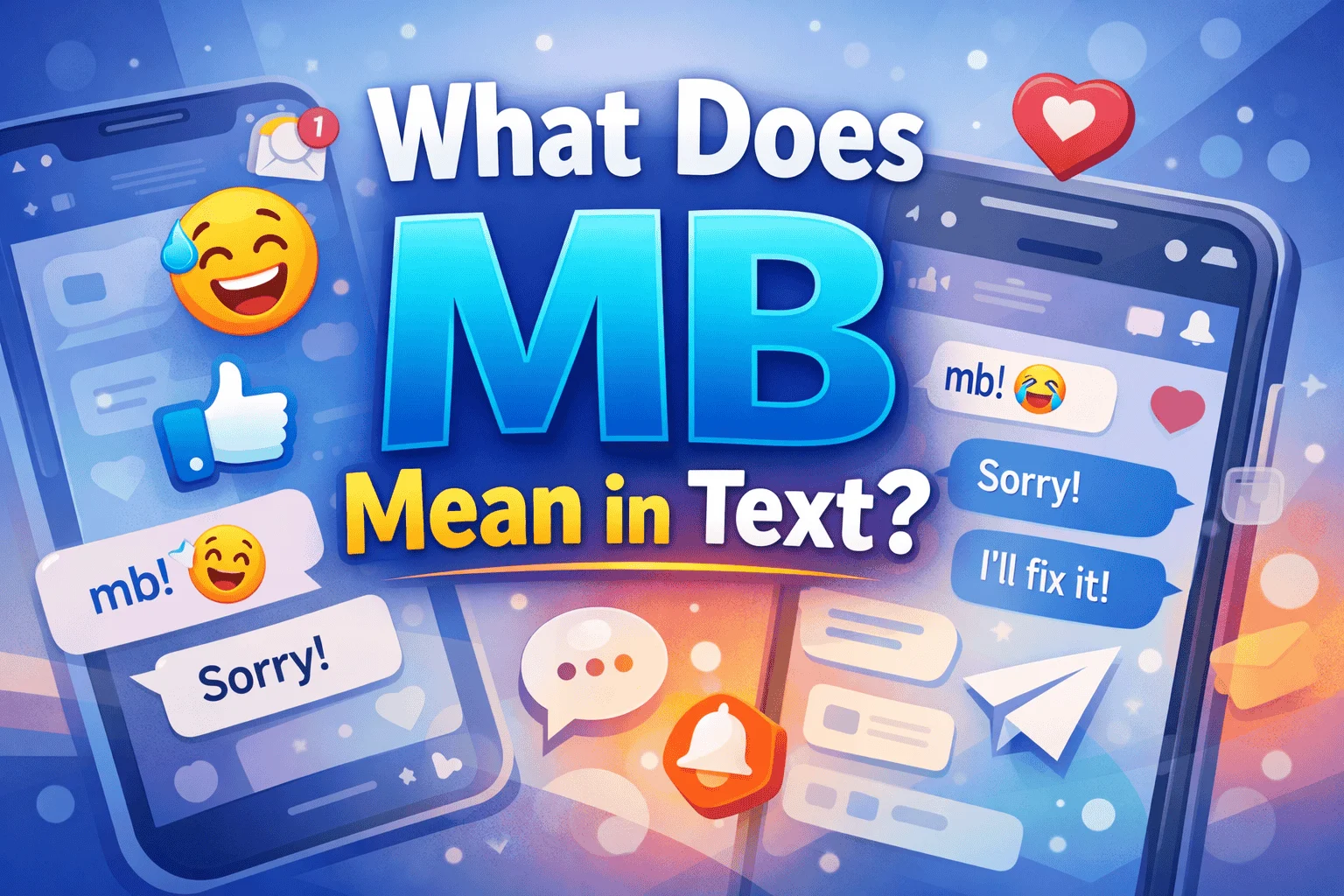
MB in text most commonly means:
👉 “My bad.”
It’s a casual way to admit a mistake, apologize lightly, or acknowledge fault without sounding overly formal or dramatic.
Simple examples:
- “mb I forgot to reply earlier”
- “oh mb that was my fault”
- “mb didn’t see your message”
Tone-wise, it usually feels:
- Casual
- Friendly
- Low-pressure
- Non-defensive
Origin & Background
“MB” comes from the spoken phrase “my bad,” which emerged in American slang in the late 20th century, especially in sports and street culture. Athletes would say “my bad” after making a mistake during a game—missing a pass, losing possession, or miscommunicating.
As texting and instant messaging grew, people naturally shortened commonly spoken phrases. Just like:
- “brb” → be right back
- “idk” → I don’t know
- “mb” → my bad
Social media accelerated this shift. Platforms like messaging apps, gaming chats, and comment sections rewarded speed and brevity. “MB” became a frictionless apology—quick to type, emotionally soft, and socially accepted.
Over time, its meaning softened further. It no longer always signals serious fault. Often, it’s simply conversational glue—keeping interaction smooth without heavy emotional weight.
Real-Life Conversations
Person A: Did you send the file?
Person B: mb I thought I already did 😭 sending now
Instagram DMs
Person A: You left me on seen lol
Person B: omg mb I opened it at work
TikTok Comments
Person A: You copied that idea from someone else
Person B: mb didn’t realize it was similar
Text Messages
Person A: We were meeting at 6 not 7
Person B: mb I mixed up the time
These examples show something important: “mb” rarely signals deep apology. It’s more like a quick acknowledgment that keeps the relationship comfortable.
Emotional & Psychological Meaning
“MB” expresses light accountability without emotional heaviness.
People use it because:
- They want to admit a mistake quickly
- They want to avoid conflict escalation
- They want to keep tone relaxed
- They don’t want to sound overly serious
Psychologically, it communicates:
👉 “I recognize the mistake.”
👉 “I’m not defensive.”
👉 “Let’s move on easily.”
Personal-style scenario
I once messaged a colleague the wrong meeting link. When they pointed it out, I replied, “mb — here’s the correct one.” The response stayed light. No awkwardness, no over-apology. Just smooth correction.
That’s the power of “mb”: it repairs small social friction instantly.
Usage in Different Contexts
Social Media
Used in comments or replies when correcting oneself or acknowledging an error.
Example:
“mb wrong info earlier”
Tone: casual, neutral
Friends & Relationships
Very common among friends or partners.
Example:
“mb I forgot your call”
Tone: warm, informal
Work / Professional Settings
Use cautiously. It may sound too casual unless workplace culture is relaxed.
Better:
“Sorry about that”
instead of
“mb”
Casual vs Serious Tone
- Casual: mb lol I messed up
- Neutral: mb I misunderstood
- Serious: Not appropriate → use full apology
When NOT to Use It
Avoid “mb” when:
- The mistake is serious
- Emotional harm occurred
- Professional communication requires formality
- Cultural expectations favor respectful language
- You’re apologizing to elders or authority figures
Example where it feels wrong:
“mb for missing the deadline”
That sounds dismissive rather than accountable.
Common Misunderstandings
1. It always means apology
Sometimes it just means acknowledgment, not remorse.
2. It’s rude
Not inherently. Tone depends on relationship and context.
3. It’s sarcastic
Usually not—unless paired with sarcasm markers.
4. It means megabyte
In tech contexts, yes. In chat, usually “my bad.”
Comparison Table
| Expression | Meaning | Tone | Usage |
|---|---|---|---|
| MB | My bad | Casual apology | Friends/chat |
| My fault | Direct blame | Neutral | All contexts |
| Sorry | Apology | Flexible | Universal |
| Oops | Small mistake | Light | Informal |
| That’s on me | Ownership | Mature | Professional/casual |
| Not my bad | Denial | Defensive | Argument |
| My mistake | Formal apology | Polite | Work |
Key Insight:
“MB” sits at the intersection of apology and casual rapport. It signals responsibility without emotional weight—ideal for low-stakes social repair.
Variations / Types
- mb lol — playful apology
- mb 😭 — embarrassed mistake
- mb fr — sincere acknowledgment
- mb I forgot — specific fault
- big mb — larger mistake
- mb my bad — emphasis
- mb didn’t know — misunderstanding
- mb wrong person — texting error
- mb that’s on me — stronger ownership
- mb bro — friendly tone
How to Respond When Someone Uses It
Casual Replies
- all good
- no worries
- happens
Funny Replies
- forgiven this time 😌
- strike one
- you owe me coffee
Mature Replies
- thanks for acknowledging
- appreciate it
- it’s okay
Respectful Replies
- no problem at all
- thank you for clarifying
- understood
Regional & Cultural Usage
Western Culture
Common and widely understood. Seen as relaxed accountability.
Asian Culture
Less common in formal societies. Full apologies preferred in respectful hierarchies.
Middle Eastern Culture
Context-dependent. Casual among peers, but not with elders or authority.
Global Internet Usage
Widely recognized due to gaming and social media.
Generational Differences
Gen Z:
Very common, default quick apology.
Millennials:
Understand and use casually.
Older generations:
May find it too informal or unclear.
Is It Safe for Kids?
Yes. “MB” is harmless slang meaning “my bad.”
However, children should also learn when a full apology is more appropriate—especially in school or respectful situations.
FAQs
1. Does MB always mean my bad?
In texting and social media, yes—most of the time.
2. Is MB rude?
No. It’s a casual apology. Tone depends on context.
3. Can MB mean something else?
Yes. In technical contexts it means “megabyte.”
4. Is MB appropriate at work?
Only in informal workplaces. Otherwise use “sorry.”
5. Is MB sarcastic?
Usually not unless paired with sarcasm cues.
6. Is MB Gen Z slang?
Popular with Gen Z but used across age groups.
7. What’s stronger than MB?
“My fault,” “I apologize,” or “that’s on me.”
Conclusion
“MB” may look like a tiny abbreviation, but socially it carries a meaningful function: it lets people acknowledge small mistakes quickly, gently, and without emotional heaviness. In modern digital communication—where speed and tone balance matter—it acts as a social softener, keeping conversations comfortable and relationships smooth.
Used among friends, peers, and casual contexts, it signals humility and ease. Used in serious situations, it can feel insufficient. The key is matching the apology to the emotional weight of the moment.
Once you understand this nuance, you can read “mb” accurately—and use it confidently—without second-guessing tone or intention.