
If you’ve seen “MFA” pop up in a text message, Instagram DM, or comment section, you’re not alone in wondering what it actually means. It’s one of those abbreviations that can feel confusing because it doesn’t have just one definition. The meaning depends heavily on context, tone, and even the platform where it’s used.
People search for “what does MFA mean in text” because they want clarity in real conversations. Is it something serious, like a security term? Or is it casual slang used between friends? The truth is, it can be both.
This guide clears up that confusion in a practical, human way. By the end, you’ll know exactly how to read it, when to use it, and when to avoid it.
MFA – Quick Meaning
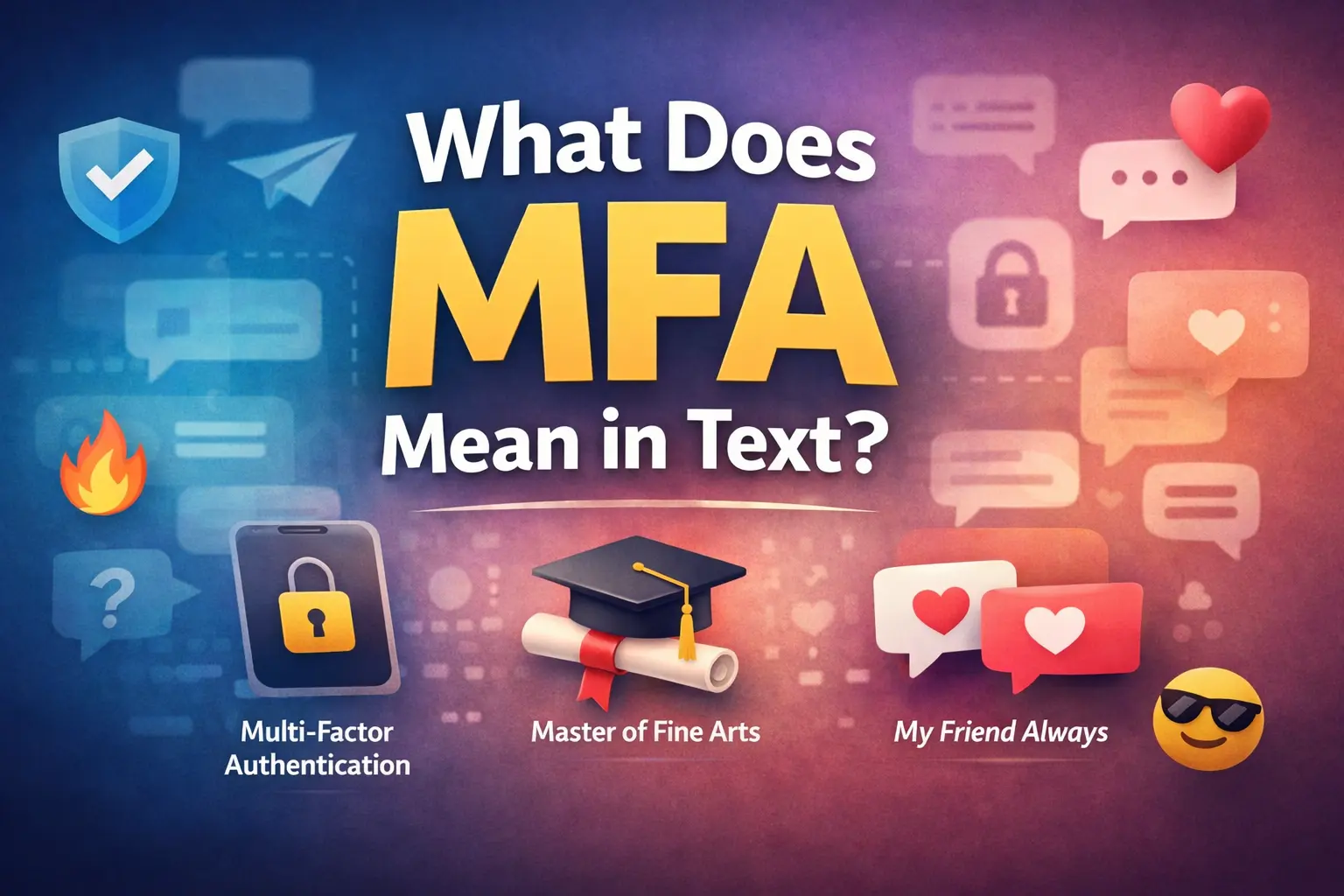
“MFA” most commonly stands for:
- Multi-Factor Authentication in tech and security contexts
- “My Friend Always” or casual slang variations in informal texting
- Occasionally used as an abbreviation for Master of Fine Arts in academic contexts
Example meanings in text:
- “Turn on MFA for your account”
- “You’re my MFA no matter what ❤️”
- “She’s applying for an MFA this year”
The key is simple. Context decides everything.
Origin & Background
“MFA” didn’t start as slang. It originally comes from professional and academic spaces.
In cybersecurity, Multi-Factor Authentication became widely used as online security threats increased. Banks, email providers, and apps began encouraging users to enable MFA to protect their accounts.
At the same time, in universities, MFA has long stood for Master of Fine Arts, a postgraduate degree in creative fields like writing, film, or visual arts.
The shift into casual texting happened more recently. Social media platforms like TikTok and Instagram encouraged shorter, faster communication. People began reinterpreting abbreviations emotionally and creatively.
That’s how “MFA” started showing up in chats as a playful or affectionate shorthand. It is not as universally recognized in slang as other abbreviations, but it is growing in niche circles.
Real-Life Conversations
Here’s how “MFA” actually appears in everyday chats.
WhatsApp Chat
Person A: Did you enable MFA on your account?
Person B: Not yet, is it important?
Person A: Yeah, it keeps your account safe.
Instagram DM
Person A: You always got my back 😭
Person B: Of course, I’m your MFA forever ❤️
TikTok Comments
User1: This app needs better security fr
User2: Just turn on MFA, it helps a lot
Text Message
Person A: I got into the program!
Person B: No way! MFA? That’s huge 🔥
Emotional & Psychological Meaning
When used casually, “MFA” carries emotional weight.
In slang, it can signal loyalty, reassurance, or closeness. It’s not just about saving time. It’s about expressing something quickly but meaningfully.
People use abbreviations like this because modern communication is fast, but emotions are still deep. A short phrase like “you’re my MFA” can feel personal because it sounds like an inside language.
From a psychological perspective, it reflects how people build connection in digital spaces. Shortcuts become symbols of trust.
Imagine this scenario. You’re going through a rough day, and a friend texts, “I’m your MFA, always here.” Even if the phrase isn’t standard, the intent is clear. It feels comforting.
Usage in Different Contexts
Social Media
On platforms like TikTok or Instagram, “MFA” is most often used in its tech meaning or creatively as slang.
It depends on the content. A security-related post uses it literally. A personal post may use it emotionally.
Friends & Relationships
Among friends, it can become a personalized phrase.
It might not be universally understood, but within a group, it can carry a shared meaning like loyalty or support.
Work / Professional Settings
In professional communication, “MFA” almost always means Multi-Factor Authentication.
For example:
“Please enable MFA before accessing the system.”
Using it casually in a work email would likely confuse people.
Casual vs Serious Tone
- Casual tone: Emotional or playful meaning
- Serious tone: Technical or academic meaning
The tone of the conversation is your biggest clue.
When NOT to Use It
There are situations where using “MFA” can cause confusion or feel inappropriate.
- In formal emails or job applications
- When speaking to someone unfamiliar with internet slang
- In sensitive conversations where clarity matters
- In cross-cultural communication where meanings may differ
If there’s any doubt, it’s better to use full words instead.
Common Misunderstandings
One of the biggest issues with “MFA” is assumption.
People often assume it only means one thing. That’s where confusion starts.
Common mistakes:
- Thinking it always means security
- Misreading emotional intent as technical language
- Using it casually in formal settings
Another issue is tone. A message like “use MFA” can sound urgent or serious, while “you’re my MFA” feels emotional. The same abbreviation creates completely different impressions.
Comparison Table
| Expression | Meaning | Context | Tone |
|---|---|---|---|
| MFA | Multi-Factor Authentication or slang meaning | Tech or casual | Serious or emotional |
| OTP | One True Pairing | Fandom/social media | Romantic |
| BFF | Best Friends Forever | Casual texting | Friendly |
| IDK | I Don’t Know | Everyday chat | Neutral |
| ASAP | As Soon As Possible | Work or urgent messages | Serious |
Key Insight:
Abbreviations like “MFA” are flexible. Their meaning is shaped more by context than by the letters themselves.
Variations / Types
Here are different ways “MFA” may appear or be interpreted:
- MFA (Tech) – Multi-Factor Authentication
- MFA (Academic) – Master of Fine Arts
- MFA (Slang) – My Friend Always
- MFA ❤️ – Emotional or affectionate tone
- MFA lol – Light, joking usage
- MFA?? – Asking for clarification
- Use MFA – Instructional or security-related
- My MFA fr – Emphasizing loyalty
- MFA vibes – Suggesting closeness or trust
- No MFA? – Highlighting risk or concern
How to Respond When Someone Uses It
Casual Replies
- “Got you, makes sense”
- “Haha okay I see”
Funny Replies
- “MFA sounds like a secret code 😂”
- “I need a dictionary for this one”
Mature Replies
- “That’s a good point, I’ll keep that in mind”
- “I understand what you mean now”
Respectful Replies
- “Thanks for explaining that”
- “Appreciate you looking out for me”
Regional & Cultural Usage
Western Culture
More likely to recognize MFA as a tech term. Slang use exists but is less standardized.
Asian Culture
Often used in academic or professional contexts. Slang usage is less common but growing through social media.
Middle Eastern Culture
Primarily understood in formal or technical contexts. Casual reinterpretation depends on exposure to global trends.
Global Internet Usage
Online platforms blur boundaries. A single abbreviation like “MFA” can carry multiple meanings at once.
Generational Differences
- Gen Z: More likely to experiment with meanings and use it creatively
- Millennials: More likely to stick to established meanings like security or education
Is It Safe for Kids?
Yes, “MFA” is generally safe.
However, context matters. In most cases, it’s either a harmless technical term or a casual expression. Parents and educators should still encourage kids to ask when they don’t understand something.
Clarity builds better communication habits.
FAQs
1. What does MFA mean in texting?
It usually means Multi-Factor Authentication or a casual phrase depending on context.
2. Is MFA slang or technical?
It can be both. Context determines the meaning.
3. What does MFA mean on Instagram?
It may refer to account security or be used creatively in personal conversations.
4. Can MFA mean something emotional?
Yes, in some chats it can represent loyalty or closeness.
5. Should I use MFA in professional emails?
Only if you mean Multi-Factor Authentication.
6. Is MFA widely used as slang?
Not as common as other abbreviations, but it appears in niche groups.
7. How do I know which meaning is correct?
Look at the context, tone, and topic of the conversation.
Conclusion
“MFA” is a perfect example of how modern language evolves. One abbreviation can live in completely different worlds at the same time. It can protect your online accounts, represent years of academic effort, or quietly express loyalty in a conversation.
The real skill is not just knowing what it means, but knowing how it feels in context.
Once you start paying attention to tone, platform, and intent, understanding “MFA” becomes natural. And when you use it thoughtfully, it can make your communication clearer, smarter, and even more personal.