
If you have ever received a message that simply says “NMO” and paused for a second, you are not alone.
Text slang moves fast. One day you understand everything. The next day, three letters show up in your WhatsApp or Instagram DMs and suddenly you are searching online, wondering if you missed something important.
So what does NMO mean in text?
The short answer is simple. But the way people use it can feel layered, emotional, and sometimes slightly confusing. In this guide, I will break it down clearly, share real conversation examples, explain its emotional undertone, and help you understand when to use it and when to avoid it.
Let’s decode it properly.
NMO – Quick Meaning
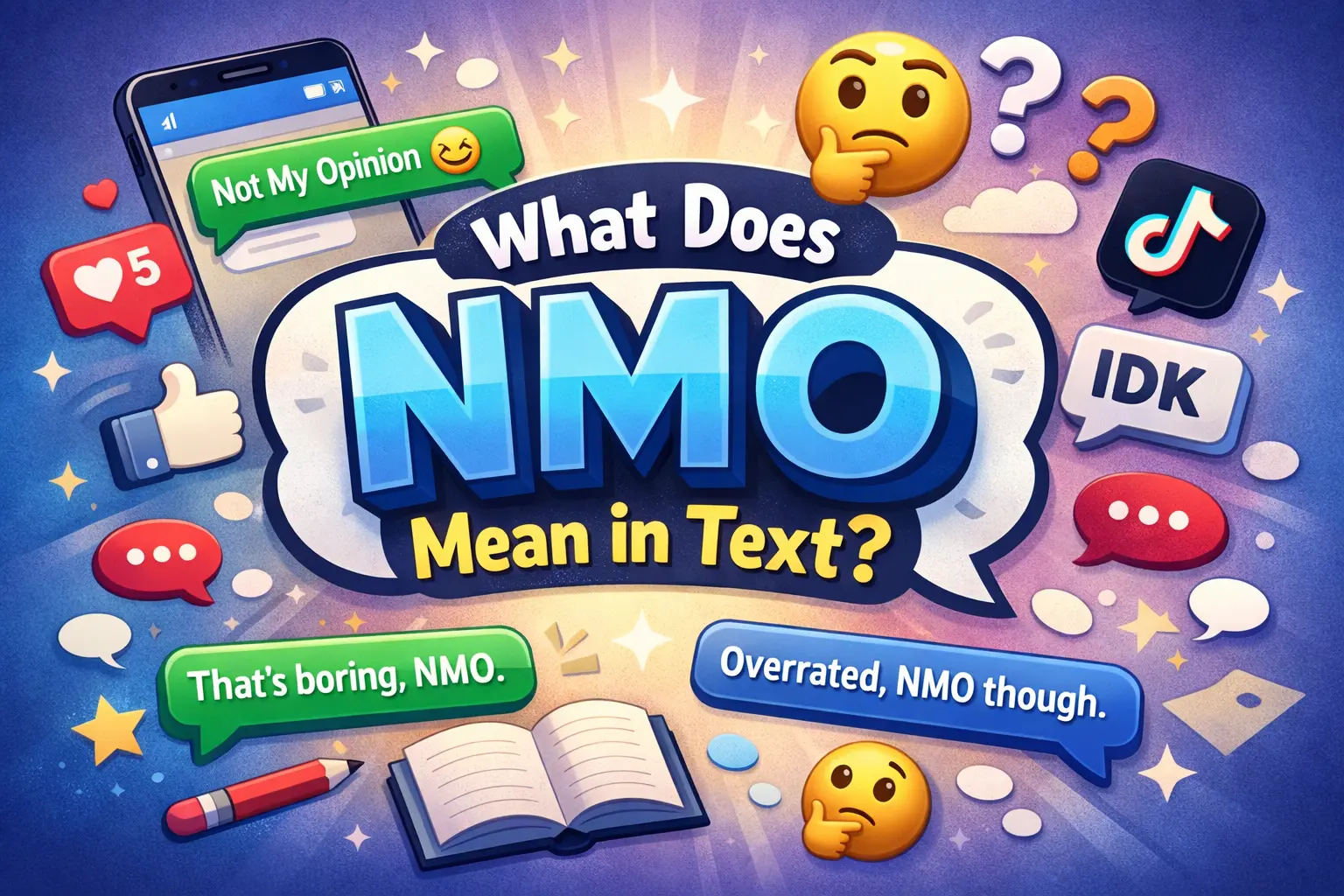
NMO most commonly stands for: “Not My Opinion.”
It is used when someone wants to:
- Distance themselves from a statement
- Clarify that they are repeating someone else’s view
- Avoid being personally blamed for an opinion
- Stay neutral in a discussion
Simple Examples
- “That movie was boring, NMO.”
- “He said the outfit looked weird, NMO.”
- “It might be overrated, NMO though.”
In short, it signals: This is not necessarily what I personally believe.
It works like a small protective shield in digital conversations.
Origin and Background of NMO
Unlike popular abbreviations such as LOL or OMG, NMO is not rooted in early internet chatrooms from the 1990s. It gained traction later through texting culture and social media.
As online conversations became more opinion-driven, especially on platforms like Instagram and TikTok, people started needing quick ways to soften their statements.
In comment sections, debates escalate quickly. One strong opinion can turn into an argument within seconds. So abbreviations like NMO emerged as a way to reduce confrontation.
It reflects something deeper about modern communication. We are constantly balancing honesty with social harmony.
The phrase likely evolved from the longer expression “in my opinion.” Ironically, NMO does the opposite. Instead of claiming ownership, it removes it.
On fast-paced platforms like TikTok comment threads, you will often see:
“Not funny, NMO.”
“Overhyped song, NMO.”
It shows how internet culture values both expression and self-protection.
Real-Life Conversations
Here is how NMO appears in everyday chats.
1. WhatsApp Conversation
Person A: Did you like her presentation?
Person B: It felt rushed, NMO. Maybe I missed something though.
Notice how Person B softens the critique.
2. Instagram DMs
Person A: I’m thinking of cutting my hair short.
Person B: I liked it long better, NMO. But you’ll rock anything.
Here, NMO protects the friendship while expressing preference.
3. TikTok Comments
User1: This trend is annoying.
User2: Kinda repetitive now, NMO.
The tone feels less aggressive because of those three letters.
4. Text Message Between Friends
Person A: He was rude yesterday.
Person B: I think he was just stressed, NMO.
It shows disagreement without creating conflict.
In every case, NMO acts like a social cushion.
Emotional and Psychological Meaning
On the surface, NMO is neutral.
But psychologically, it reveals something interesting about how we communicate today.
It often expresses:
- Hesitation
- Politeness
- Social awareness
- Fear of backlash
- Emotional intelligence
We live in a time where opinions can easily trigger strong reactions. So people use disclaimers to avoid confrontation.
I once saw a friend hesitate before commenting on a viral post about fashion. She typed a strong critique, then paused, added “NMO,” and finally hit send. That small addition changed her tone from aggressive to reflective.
NMO is not just slang. It is emotional self-protection.
It signals: “I am sharing something, but I am not attacking you.”
That subtle difference matters in digital relationships.
Usage in Different Contexts
Social Media
On platforms like Instagram or TikTok, NMO appears mostly in comment sections. It reduces tension and prevents heated arguments.
Example:
“That remix isn’t as good as the original, NMO.”
It keeps discussions safer.
Friends and Relationships
Among close friends, NMO softens honesty.
Example:
“I liked your old style better, NMO.”
It shows care while still being truthful.
Work or Professional Settings
In professional communication, NMO is rarely appropriate.
Instead of writing NMO in an email, it is better to say:
“In my view” or “From my perspective.”
Work environments require clearer, more formal language.
Casual vs Serious Tone
In casual conversations, NMO feels light and conversational.
In serious debates, it can sound defensive or distancing.
Tone depends entirely on context.
When Not to Use It
Even harmless slang can be misused.
Avoid NMO:
- In formal emails
- During serious conflicts
- When clarity is required
- When you need to fully own your opinion
- In academic discussions
Sometimes adding NMO can make you appear uncertain or unwilling to stand behind your words.
If you believe something strongly, say it clearly instead of hiding behind abbreviations.
Common Misunderstandings
People often confuse NMO with other meanings.
1. Thinking It Means “No More”
In some contexts, NMO could be misread as “no more.” But that is not its standard texting meaning.
2. Tone Confusion
Without voice tone, NMO can feel sarcastic.
Example:
“Sure, great idea, NMO.”
That could sound passive-aggressive.
3. Literal vs Figurative Meaning
Some people use NMO casually even when they actually agree with the statement. It becomes a habit rather than a precise disclaimer.
Understanding tone is key.
Comparison Table
| Expression | Meaning | Tone | Usage Context |
|---|---|---|---|
| NMO | Not My Opinion | Neutral, distancing | Casual texting |
| IMO | In My Opinion | Confident | Opinions |
| IMHO | In My Humble Opinion | Polite | Debates |
| IDK | I Don’t Know | Uncertain | General chats |
| Agree to disagree | Respectful disagreement | Mature | Serious discussions |
Key Insight
NMO removes ownership. IMO claims ownership. That small shift changes the emotional weight of the message.
Variations and Types of NMO
Here are common related forms:
- IMO – In my opinion. Stronger ownership.
- IMHO – In my humble opinion. Softer tone.
- Just saying – Casual disclaimer.
- No offense – Attempts to reduce harm before criticism.
- Lowkey – Quiet or subtle opinion.
- Highkey – Strong and obvious opinion.
- TBH – To be honest. Direct expression.
- FWIW – For what it’s worth. Neutral sharing.
- My two cents – Informal opinion.
- Respectfully – Polite disagreement starter.
Each serves a slightly different emotional purpose.
How to Respond When Someone Uses NMO
When someone writes NMO, here are ways you can reply.
Casual Replies
- “Fair enough.”
- “I get that.”
- “That makes sense.”
Funny Replies
- “Okay critic!”
- “Noted, movie reviewer.”
- “We’ll agree to disagree.”
Mature Replies
- “Thanks for sharing your perspective.”
- “I appreciate your honesty.”
- “That’s an interesting take.”
Respectful Replies
- “I see where you’re coming from.”
- “Let’s explore that more.”
- “Different views make it interesting.”
Responding calmly keeps conversations healthy.
Regional and Cultural Usage
Western Culture
In the US and UK, digital disclaimers are common. NMO fits into a culture that values individual expression but also avoids direct confrontation.
Asian Culture
In many Asian societies, harmony is important. People may prefer softer language rather than blunt disagreement. NMO aligns well with that indirect style.
Middle Eastern Culture
Respect plays a central role in communication. Direct criticism can feel harsh. NMO may help soften opinions among younger, internet-active users.
Global Internet Usage
Online communities mix cultures. Slang spreads quickly through TikTok and Instagram. NMO is understood mostly by younger users.
Generational Differences
Gen Z uses disclaimers frequently in comment sections.
Millennials understand it but may prefer longer phrasing.
Older generations may not recognize it at all.
Is It Safe for Kids?
Yes, NMO is generally safe.
It contains no harmful or inappropriate meaning.
However, context matters. Children should understand that using disclaimers does not replace respectful communication. Teaching them how to express opinions kindly is more important than teaching slang.
FAQs
1. Does NMO always mean Not My Opinion?
In most texting contexts, yes. However, meaning can depend on the conversation.
2. Is NMO rude?
No. It is usually meant to soften opinions, not attack someone.
3. Can NMO be sarcastic?
Yes. Tone depends on context. Without emojis or explanation, it may sound passive-aggressive.
4. Is NMO popular?
It is moderately common in online comments, especially among younger users.
5. Should I use NMO at work?
No. Use clearer and more professional language instead.
6. Is NMO the same as IMO?
No. IMO claims ownership. NMO removes it.
Conclusion
So what does NMO mean in text?
At its core, it means “Not My Opinion.” But emotionally, it means much more.
It reflects how modern communication balances honesty with caution. It shows how people protect relationships while still expressing ideas. It is a small linguistic tool with a surprisingly big social function.
If you choose to use it, use it thoughtfully. Let it soften your tone when needed, but do not hide behind it when clarity matters.
Digital communication is not just about speed. It is about intention.
When you understand the subtle power behind small phrases like NMO, your messages become clearer, kinder, and more confident.
And that makes all the difference.