
If you’ve received a text that simply says “WYF”, you’re not alone in wondering what it means. Text messaging and social media slang evolve quickly, and abbreviations often have multiple meanings depending on the conversation.
Many people search for “does WYF mean in text” because they encounter it on Snapchat, Instagram, TikTok, WhatsApp, or regular text messages and aren’t sure how to respond. The confusion usually comes from the fact that WYF can mean different things based on context, age group, and the relationship between the people chatting.
In this guide, you’ll learn exactly what WYF means, where it came from, how people use it today, and how to avoid common misunderstandings.
WYF – Quick Meaning
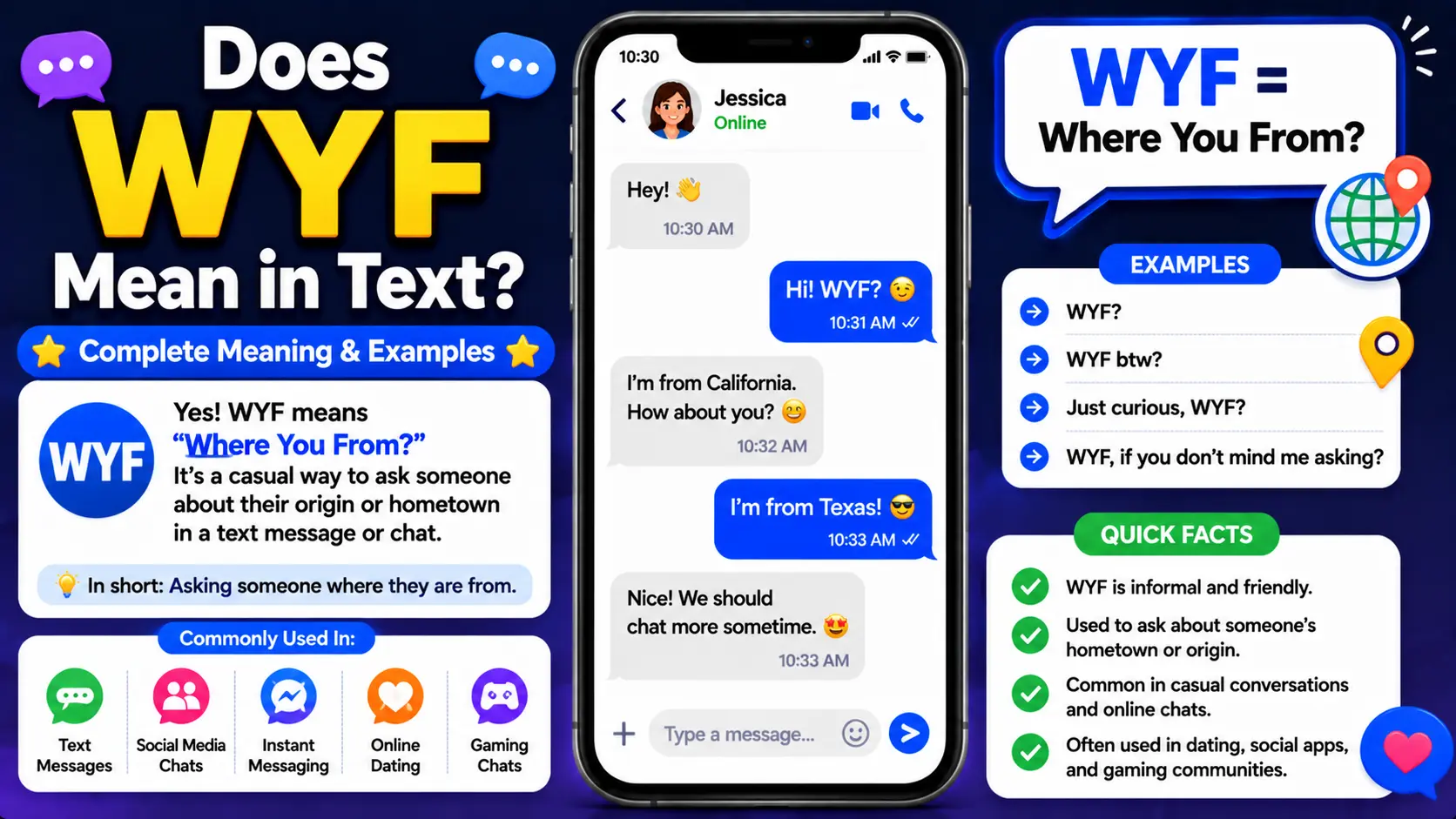
In texting, WYF most commonly means “Where You From?”
People use it as a quick way to ask someone about their location, hometown, country, or background.
Simple Definition
WYF = Where You From?
It is usually used when:
- Getting to know someone
- Starting a conversation
- Meeting new people online
- Chatting on social media
Examples
“Hey, WYF?”
“You seem cool. WYF?”
“WYF? I’m from Chicago.”
In most cases, the sender is simply asking where you live or where you originally come from.
Origin & Background
WYF emerged from the broader culture of internet shorthand that became popular during the early days of texting.
When SMS messages had character limits, people began shortening common phrases to save time and space. Expressions like:
- BRB (Be Right Back)
- IDK (I Don’t Know)
- WYD (What You Doing)
- WYA (Where You At)
became part of everyday digital communication.
WYF followed the same pattern.
As social media platforms grew, especially Instagram, Snapchat, TikTok, and online gaming communities, abbreviations became a fast and casual way to start conversations.
The phrase “Where you from?” is one of the most common questions people ask when meeting someone online. Eventually, users shortened it to WYF.
Today, it remains popular among teenagers, Gen Z users, gamers, and social media communities worldwide.
Real-Life Conversations
WhatsApp Conversation
Person A: Hey, you seem new here. WYF?
Person B: Lahore. What about you?
Person A: Karachi. Nice to meet you!
Instagram DM
Person A: Love your travel content.
Person B: Thanks!
Person A: WYF?
Person B: Originally from Toronto, but living in Dubai now.
TikTok Comments
Person A: Your accent sounds familiar.
Person B: Really?
Person A: Yeah, WYF?
Person B: Manchester, UK.
Text Message
Person A: We have a lot in common.
Person B: Haha, true.
Person A: BTW, WYF?
Person B: New York. You?
Person A: Boston.
Emotional & Psychological Meaning
On the surface, WYF looks like a simple question.
However, psychologically, it serves a bigger purpose.
People often use WYF to:
- Build connection
- Find common ground
- Establish trust
- Learn about someone’s background
- Continue a conversation naturally
Humans naturally seek familiarity. Knowing where someone comes from helps create a sense of identity and belonging.
Imagine chatting with someone online for the first time. After discussing hobbies, they ask, “WYF?” They’re not just asking about geography. They’re trying to understand your story and whether you share cultural experiences.
In many conversations, WYF acts as a social bridge rather than merely a location question.
Usage in Different Contexts
Social Media
WYF is extremely common on:
- TikTok
- Snapchat
- Discord
- X (Twitter)
Users often send it when meeting someone new online.
Example:
“Your videos are awesome. WYF?”
Friends & Relationships
Friends frequently use WYF when introducing new people into a group chat.
In dating conversations, it can be one of the first questions asked.
Example:
“WYF? Maybe we’re from the same city.”
Work or Professional Settings
WYF is generally not suitable for professional communication.
Instead, people would write:
- “Where are you based?”
- “Which city are you from?”
- “Where do you currently live?”
Professional communication values clarity over slang.
Casual vs Serious Tone
Casual:
“WYF?”
More Serious:
“Where are you originally from?”
The meaning remains similar, but the tone changes significantly.
When NOT to Use It
Although WYF is common, there are situations where it may not be appropriate.
Professional Emails
Avoid slang in business communication.
Formal Interviews
Using abbreviations can appear unprofessional.
Sensitive Situations
Some people may not feel comfortable sharing their location or background.
Cross-Cultural Conversations
Not everyone understands internet slang, which can create confusion.
Privacy Concerns
Avoid repeatedly asking WYF if someone seems hesitant to answer.
Respect for privacy always matters.
Common Misunderstandings
Assuming Everyone Knows It
Many people, especially older users, may not recognize WYF.
Confusing It with Other Acronyms
Some users mistake WYF for:
- WYA (Where You At)
- WYD (What You Doing)
- WYM (What You Mean)
Each has a different purpose.
Thinking It’s Rude
Some people interpret WYF as too direct.
In reality, most users mean it as friendly conversation.
Assuming It Always Refers to Current Location
Sometimes people mean:
- Where do you live now?
- Where were you born?
- What’s your cultural background?
Context matters.
Comparison Table
| Expression | Meaning | Purpose |
|---|---|---|
| WYF | Where You From? | Learn someone’s background |
| WYA | Where You At? | Ask current location |
| WYD | What You Doing? | Ask about current activity |
| WYM | What You Mean? | Ask for clarification |
| HBU | How About You? | Continue conversation |
| IDC | I Don’t Care | Express indifference |
| Nice to meet you | Formal introduction | Build connection |
| Stranger | Opposite social meaning | Lack of familiarity |
Key Insight
WYF is less about geography and more about connection. People often use it to discover shared experiences, cultures, or communities that can strengthen a conversation.
Variations and Related Types
1. WYA
Where You At?
Asks someone’s current location.
2. WYD
What You Doing?
Asks about current activities.
3. WYM
What You Mean?
Requests clarification.
4. HBU
How About You?
Returns a question.
5. HMU
Hit Me Up
Invites future contact.
6. SUP
What’s Up?
Casual greeting.
7. ASL
Age, Sex, Location
Classic internet introduction phrase.
8. IDC
I Don’t Care
Shows lack of interest.
9. LMK
Let Me Know
Requests information later.
10. TBH
To Be Honest
Introduces an honest opinion.
How to Respond When Someone Uses It
Casual Replies
- “I’m from Lahore.”
- “Originally from London.”
- “Texas. You?”
Funny Replies
- “Planet Earth.”
- “A secret kingdom.”
- “The internet.”
Mature Replies
- “I’m from Singapore and currently living in Sydney.”
- “I grew up in Toronto.”
Respectful Replies
- “I’d rather keep my location private.”
- “I’m from South Asia.”
- “I’m not comfortable sharing that yet.”
Regional & Cultural Usage
Western Culture
In North America and Europe, WYF is commonly used among younger social media users.
It’s often considered a normal conversation starter.
Asian Culture
Many users understand WYF through global internet culture.
However, some prefer more formal introductions.
Middle Eastern Culture
Usage varies by age group.
Younger users often recognize the abbreviation, while older generations may prefer full sentences.
Global Internet Usage
Gaming communities, online forums, and social platforms have helped spread WYF worldwide.
Many users learn it through exposure rather than formal language education.
Gen Z vs Millennials
Gen Z
- Uses abbreviations frequently
- Comfortable with shorthand
- Prefers quick messaging
Millennials
- Understand most slang
- May use full phrases more often
- Generally balance formal and informal communication
Generational differences often influence how often WYF appears in conversations.
Is It Safe for Kids?
Generally, yes.
WYF is usually a harmless question asking where someone is from.
However, parents and young users should remember that sharing personal location details online with strangers can create privacy concerns.
Teaching children to be cautious about revealing personal information remains important.
Frequently Asked Questions
What does WYF stand for in text messages?
WYF usually stands for “Where You From?”
Is WYF rude?
No. Most people use it casually and politely when getting to know someone.
Is WYF the same as WYA?
No.
- WYF = Where You From?
- WYA = Where You At?
They ask different questions.
Do adults use WYF?
Some do, but it is more common among teenagers and younger adults.
Can WYF have other meanings?
In rare cases, abbreviations can have alternative interpretations, but “Where You From?” is the most common texting meaning.
Should I answer WYF?
That depends on your comfort level. You can answer fully, partially, or politely decline.
Is WYF popular on TikTok and Instagram?
Yes. It is frequently used in comments, direct messages, and social interactions on these platforms.
Conclusion
If you’ve been wondering does WYF mean in text, the answer is simple: it most commonly means “Where You From?”
While it appears to be a straightforward question, it often serves a deeper social purpose. People use it to build connections, discover shared backgrounds, and keep conversations moving naturally.
Like many internet abbreviations, its meaning depends on context. Understanding who is asking and why can help you respond appropriately.
Whether you see WYF in a TikTok comment, an Instagram DM, a WhatsApp chat, or a text message, you’ll now recognize it as a friendly invitation to share a little about yourself. Knowing that makes digital conversations easier, more confident, and far less confusing.