
If you’ve seen someone type “IGB” in a message or comment and paused for a second, you’re not alone.
It’s one of those short internet expressions that feels obvious to insiders but confusing to everyone else.
People search “IGB mean in text” because the abbreviation looks familiar yet unclear.
It resembles other slang like “IG” or “TBH,” so the brain tries to guess.
But the meaning is slightly different and emotionally nuanced.
Understanding what IGB means solves a real communication gap.
It helps you read tone correctly, avoid awkward replies, and connect more naturally in chats.
Let’s break it down in a clear, human way.
IGB – Quick Meaning
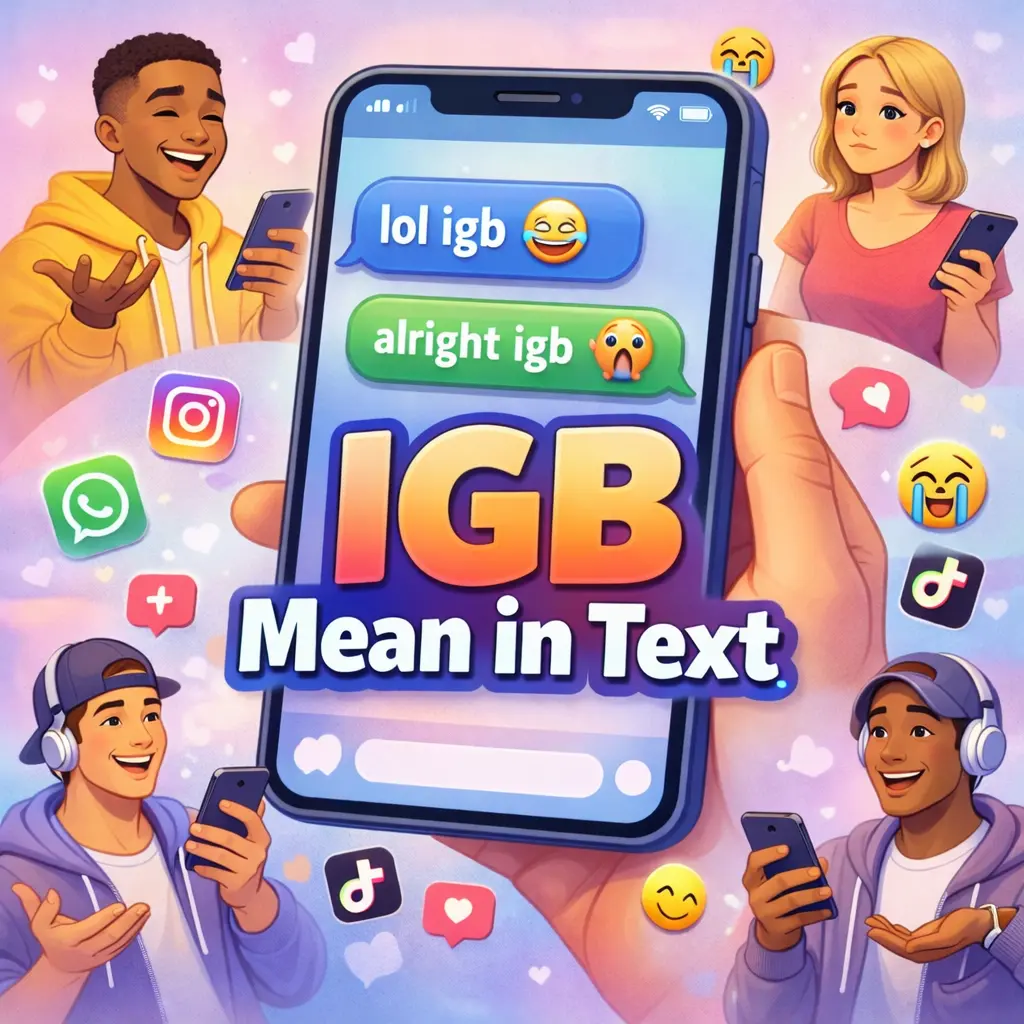
IGB = “I Guess Bro”
It’s a casual, slightly dismissive or uncertain response often used in texting and online chats.
Core meaning:
- Mild agreement without enthusiasm
- Indifference or lack of strong opinion
- Playful or teasing acknowledgment
- Soft disagreement without conflict
Examples:
“We can watch that movie.”
“IGB.”
“You’re probably right.”
“IGB lol.”
“I’ll just do it myself then.”
“IGB 😭”
Tone depends heavily on context and relationship.
Origin & Background
IGB follows a common internet pattern.
Users compress everyday speech into short, fast expressions.
It likely evolved from spoken phrases like:
- “I guess, bro.”
- “I guess so.”
- “Alright, bro, whatever.”
Online culture encourages speed and personality.
So phrases become initials.
First, “IG” became common for “I guess.”
Then communities that frequently use “bro” or “bruh” added the B.
Gaming chats and meme culture accelerated it.
Especially spaces where casual masculine slang is normal.
Over time, IGB shifted from literal meaning to tone marker.
Now it signals mood more than content.
It often expresses:
“I’m not invested enough to argue.”
Real-Life Conversations
Person A: You’re coming tomorrow right?
Person B: IGB if I wake up on time 😭
Instagram DM
Person A: That outfit lowkey suits you
Person B: IGB you just saying that
TikTok comments
Person A: This movie was mid
Person B: IGB the ending was kinda good tho
Text message
Person A: Let’s order pizza again
Person B: IGB we always eat that
These feel natural because IGB softens tone.
It avoids sounding harsh or fully committed.
Emotional & Psychological Meaning
IGB expresses low emotional investment.
It often carries:
- Mild reluctance
- Casual acceptance
- Detached agreement
- Playful resistance
Psychologically, it’s a safe response.
It lets someone participate without full commitment.
Modern messaging rewards low-effort reactions.
People want to stay engaged without long explanations.
IGB fits perfectly.
It signals presence without intensity.
Personal-style scenario:
A friend asks me to join a late hangout after a long day.
I’m tired but don’t want to disappoint.
So I reply:
“IGB if I still have energy.”
It communicates uncertainty gently.
No pressure. No rejection.
That’s why people use it.
Usage in Different Contexts
Social media
Used in comments or replies when reacting casually.
Often paired with emojis like 😭 or 😂.
Example:
“IGB that’s kinda true.”
Friends & relationships
Common among close friends.
Especially where teasing is normal.
Example:
“You think you’re funnier than me.”
“IGB.”
Work / professional settings
Not appropriate.
Too slang-heavy and ambiguous.
Even in casual workplaces, it may look unserious.
Casual vs serious tone
Casual: light, joking, relaxed
Serious: dismissive or uninterested
Tone depends on context and punctuation.
“IGB.” feels blunt.
“IGB lol” feels playful.
When NOT to Use It
Avoid IGB in:
- Professional communication
- Conflict resolution
- Emotional conversations
- Formal online spaces
- With people unfamiliar with slang
It can sound dismissive or passive-aggressive.
Example risk:
Someone shares something important.
Replying “IGB” may feel uncaring.
Cultural awareness matters too.
Some cultures value clear agreement.
IGB sounds vague there.
Common Misunderstandings
1. Thinking it means strong agreement
It does not.
It means weak or reluctant agreement.
2. Assuming it’s rude
It can be playful depending on relationship.
3. Confusing with “IG”
IG = I guess
IGB = I guess bro
IGB adds tone and attitude.
4. Reading it literally
Literal: “I guess, bro.”
Actual: “Fine, whatever, casually.”
Tone > words.
Comparison Table
| Expression | Meaning | Tone | Use Case |
|---|---|---|---|
| IGB | I guess bro | Casual, indifferent | Friends |
| IG | I guess | Neutral | General |
| IDK | I don’t know | Uncertain | Any |
| Sure | Agreement | Neutral | Broad |
| Whatever | Dismissive | Negative | Conflict |
| Bet | Strong agreement | Confident | Youth slang |
| Alright | Acceptance | Neutral | General |
Key Insight:
IGB sits between agreement and indifference.
It accepts without enthusiasm or resistance.
Variations / Types
- IG
I guess
Neutral version without attitude - IGS
I guess so
Slightly more agreeable - IGB lol
Playful agreement
Softens indifference - IGB bro
Emphasized casual tone
Friendly teasing - IGB then
Reluctant acceptance
Resigned tone - IGB 🤷♂️
Shrug energy
Detached mood - IGB yeah
Weak confirmation
Low enthusiasm - IGB fr
Acknowledged truth
Still casual - IGB tbh
Honest but unsure
Reflective tone - IGB ok
Minimal compliance
Passive acceptance
How to Respond When Someone Uses It
Casual replies
- “You’re so unserious 😭”
- “Just say yes bro”
- “I’ll take that as yes”
Funny replies
- “IGB energy detected”
- “That’s the weakest yes ever”
- “Commitment issues 😭”
Mature replies
- “No worries if not”
- “Let me know what you prefer”
- “We can decide later”
Respectful replies
- “All good either way”
- “Thanks for considering”
- “I appreciate it”
Match their tone and relationship level.
Regional & Cultural Usage
Western culture
Common in youth slang.
Especially male-coded friend groups.
Asian culture
Less common directly.
But similar indirect agreement exists.
People may use emojis instead.
Middle Eastern culture
Direct translations rare.
But casual brother terms exist.
Tone depends on closeness.
Global internet usage
Mostly in English-speaking spaces.
Gaming and meme communities spread it.
Generational differences
Gen Z: frequent use
Millennials: understand but less use
Older: often confused
Is It Safe for Kids?
Generally safe.
It contains no offensive meaning.
But tone awareness matters.
Kids may use it dismissively without realizing.
Parents and educators can explain:
It means “okay, I guess” casually.
Not full agreement.
FAQs
1. What does IGB stand for in texting?
IGB means “I guess bro,” a casual, mildly indifferent agreement.
2. Is IGB rude?
Not usually. Tone depends on context and relationship.
3. Is IGB the same as IG?
No. IG means “I guess.” IGB adds casual attitude.
4. Who uses IGB most?
Primarily Gen Z and online youth communities.
5. Can girls use IGB?
Yes. Despite “bro,” it’s gender-neutral online.
6. Is IGB positive or negative?
Neutral to mildly dismissive depending on context.
7. Should I use IGB at work?
No. It’s too informal and slang-based.
Conclusion
IGB is a small phrase with big social meaning.
It shows how modern texting balances connection and emotional distance.
People want to stay engaged without overcommitting.
So they say “IGB.”
It’s casual, safe, and socially flexible.
Used among friends, it signals relaxed acceptance.
Now that you understand the nuance, you can read it correctly.
And use it naturally when the tone fits.
Because sometimes, “I guess bro” says exactly enough.