
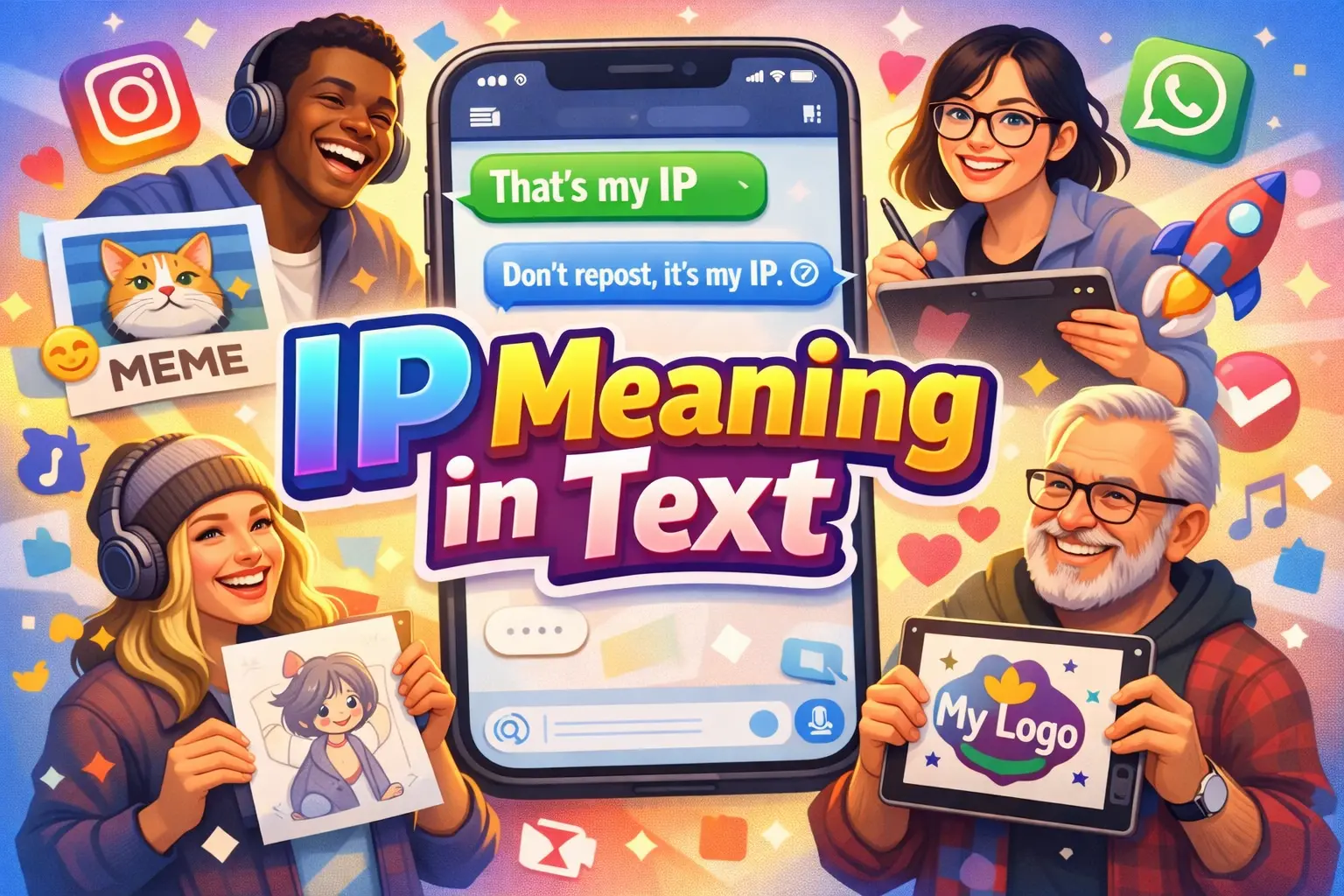
If you’ve ever received a message like “That’s my IP” or “Careful, that’s IP,” you may have paused and wondered what exactly it means. The confusion is understandable because “IP” has several meanings depending on context, tone, and platform.
People search this term mostly after seeing it in chats, comments, or online discussions and realizing the literal meaning they know does not quite fit the situation.
This article clears that confusion. You’ll learn what “IP” means in text conversations, where it comes from, how people use it emotionally, and when it might carry a different tone than expected.
IP – Quick Meaning
In texting and online conversations, IP most commonly means “intellectual property.”
It refers to something someone created or owns creatively or legally.
Simple definition:
- IP = Intellectual Property
- Something original that belongs to someone
- Often used in creative, online, or business contexts
Examples in messages:
“Please don’t repost, that’s my IP.”
“Using someone’s IP without credit isn’t cool.”
“We need permission to use their IP.”
Origin & Background
“IP” did not begin as slang. It originated in legal and business language, especially in copyright and trademark discussions.
As online creativity exploded through social media, the concept moved into everyday conversation. Artists, designers, meme creators, writers, and content creators began using “IP” casually to protect their work.
Social media accelerated this shift. Platforms like TikTok and Instagram made content easy to copy and repost. Creators needed a quick way to say, “This belongs to me.”
So the formal term “intellectual property” naturally shortened into texting-friendly “IP.”
Over time, the tone softened. It stopped sounding strictly legal and started sounding personal. Today, saying “my IP” often carries emotional ownership, not just legal ownership.
Real-Life Conversations
Person A: Can I use your logo idea for my page?
Person B: I’d rather you didn’t. That’s my IP 😅
Instagram DMs
Person A: I saw another brand using your art style
Person B: Yeah… people keep copying my IP lately
TikTok Comments
Person A: This trend was yours first
Person B: Thank you 😭 it’s literally my IP
Text Message
Person A: Should I post that joke you told yesterday?
Person B: Credit me. That’s my IP 😂
Emotional & Psychological Meaning
When someone says “IP” in conversation, they are usually expressing ownership, pride, and protectiveness.
It often signals:
- Personal investment
- Creative identity
- Boundary setting
- Desire for recognition
In modern communication, creativity is closely tied to identity. Online creators often feel their ideas represent who they are. So protecting IP feels personal, not just legal.
Real-life style scenario
A small artist spends months developing a unique illustration style. One day, they see a larger account using a nearly identical look without credit. When they message a friend saying, “They’re using my IP,” the phrase carries frustration, hurt, and defensiveness all at once.
So “IP” in text often reflects emotional ownership, not just legal ownership.
Usage in Different Contexts
Social Media
Most common usage.
Creators refer to art, memes, videos, designs, or characters as their IP.
Example:
“That character is my IP.”
Friends & Relationships
Used playfully about ideas or jokes.
Example:
“Hey, that nickname was my IP 😄”
Work / Professional Settings
Used more literally and seriously.
Example:
“This concept is company IP.”
Casual vs Serious Tone
Casual: playful ownership
“That dance move is my IP 😂”
Serious: legal or professional ownership
“We cannot share client IP.”
Tone depends heavily on context and emojis.
When NOT to Use It
Some situations make “IP” sound awkward or inappropriate.
- Everyday personal items
“That sandwich recipe is my IP” can sound exaggerated. - Emotional conversations
Using legal-style language can feel cold. - Cultural contexts unfamiliar with IP concept
Not everyone relates to ownership language around creativity. - Sensitive creative disputes
Direct accusations like “You stole my IP” can escalate conflict.
Common Misunderstandings
1. Confusing with Internet Protocol
In tech contexts, IP can mean internet address.
In texting, context usually shows creative ownership instead.
2. Assuming legal action
Most casual uses are emotional, not legal threats.
3. Thinking it sounds arrogant
Often it’s just protective, not boastful.
4. Taking playful IP claims literally
Friends often use it jokingly.
Comparison Table
| Expression | Meaning | Tone | Context |
|---|---|---|---|
| IP | Intellectual property | Protective | Creative/work |
| Credit me | Acknowledge me | Direct | Social media |
| My idea | Ownership | Casual | Friends |
| Trademark | Legal ownership | Formal | Business |
| Public domain | Free to use | Neutral | Legal |
| Open source | Shared use | Cooperative | Tech |
Key Insight:
“IP” sits between legal language and personal expression. It allows people to protect creative identity without sounding fully formal or confrontational.
Variations / Types
1. My IP
Something I created or own.
2. Their IP
Belongs to another creator or brand.
3. Company IP
Owned by an organization.
4. Original IP
Completely new creation.
5. Existing IP
Already established property.
6. Protected IP
Legally secured work.
7. Shared IP
Co-created ownership.
8. Personal IP
Individual creative work.
9. Brand IP
Logos, characters, brand assets.
10. Creative IP
Art, stories, designs, media.
How to Respond When Someone Uses It
Casual Replies
- “Fair enough 😄”
- “Got you”
- “I’ll credit you”
- “Your IP, your rules”
Funny Replies
- “I respect the IP empire”
- “All hail the IP owner 👑”
- “Licensed by you only 😂”
Mature Replies
- “I understand. I won’t use it.”
- “Thanks for clarifying ownership.”
- “I appreciate you telling me.”
Respectful Replies
- “I’ll ask before sharing.”
- “I’ll give proper credit.”
- “Your work deserves recognition.”
Regional & Cultural Usage
Western Culture
Highly familiar. Strong emphasis on individual creative ownership and branding.
Asian Culture
Understood in professional and creative industries. Casual usage still emerging in everyday chat.
Middle Eastern Culture
Growing awareness through digital entrepreneurship and creator economy. Less casual slang use compared to Western platforms.
Global Internet Usage
Widely understood among creators, gamers, designers, and online communities.
Generational Differences
Gen Z:
Uses IP casually and humorously.
“That meme format is my IP.”
Millennials:
More literal or professional use.
“That’s protected IP.”
Is It Safe for Kids?
Yes, generally safe.
“IP” simply refers to creative ownership. Children may encounter it in art, gaming, or fandom communities. The concept can even teach respect for others’ creations.
Parents may only need to explain that it means “something someone made.”
FAQs
1. What does IP mean in texting?
It usually means intellectual property, referring to something someone created or owns.
2. Does IP always mean legal ownership?
No. In casual chat it often means emotional or creative ownership.
3. Can IP be used jokingly?
Yes. Friends often use it playfully about ideas or jokes.
4. Is IP the same as copyright?
Copyright is one type of IP. IP is the broader category.
5. Why do creators say IP online?
To protect and identify their original work.
6. Does IP ever mean Internet Protocol in text?
Only in technical conversations. Context usually clarifies.
7. Is saying “my IP” rude?
No. It simply signals ownership or boundaries.
Conclusion
“IP” in text may look like a small abbreviation, but it carries a meaningful idea. It reflects how deeply people value their creativity and identity in the digital world.
Whether used seriously in business or playfully among friends, the phrase signals ownership, pride, and recognition.
Understanding it helps you navigate modern conversations with awareness and respect. And when you see someone say “that’s my IP,” you now know they are not just talking about rights. They are talking about something that feels personally theirs.