
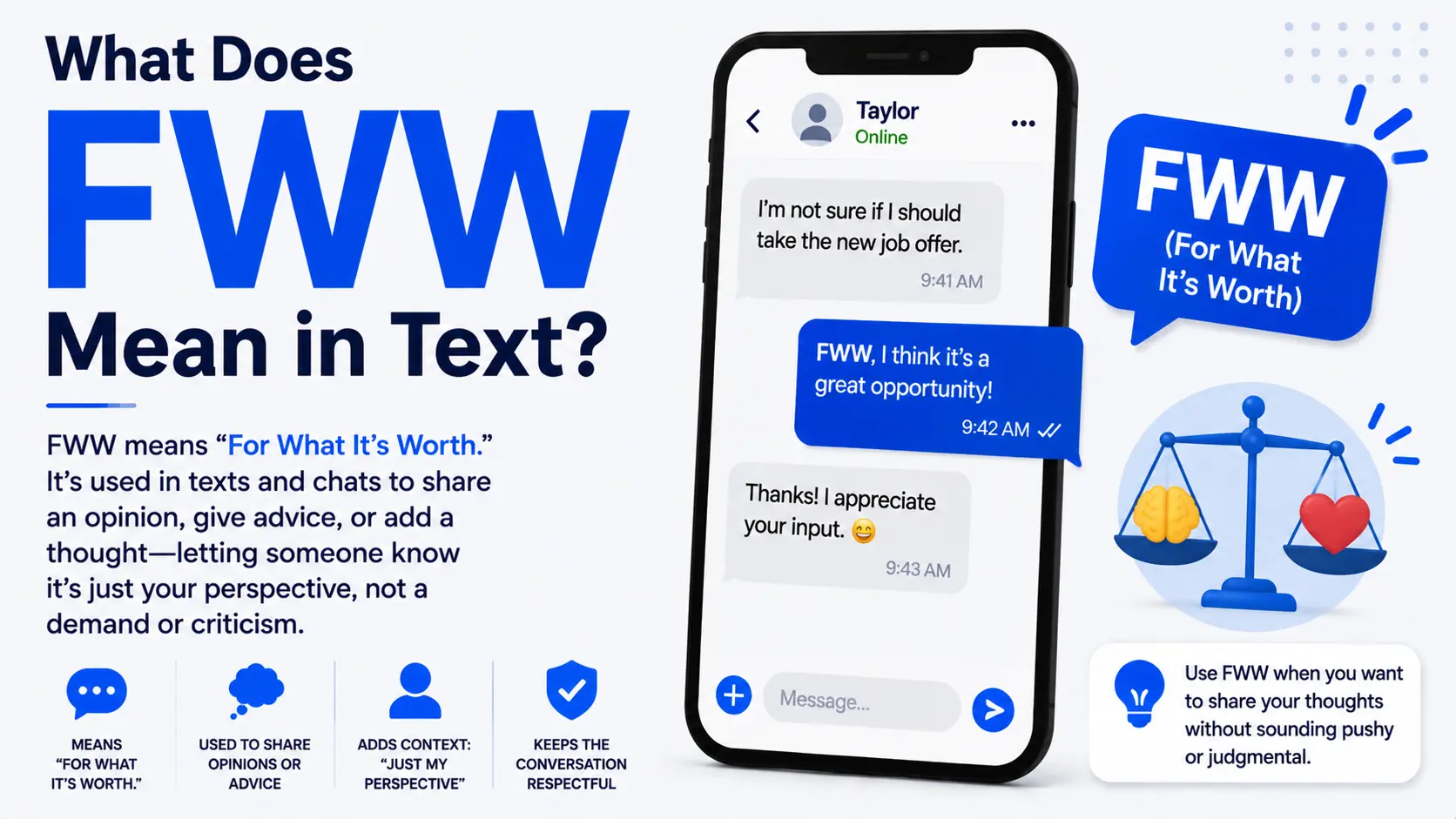
If you have ever seen someone type “FWW” in a message and paused for a second, you are not alone. Many people search for what does FWW mean in text because it is not one of the most common internet abbreviations.
Unlike widely known slang like “LOL” or “BRB,” FWW is confusing because it does not have a single fixed meaning. It can change depending on context, and in many cases, it is actually a typo or variation of another popular abbreviation.
In modern texting culture, even a small combination of letters can carry different meanings depending on tone, platform, or intent. That is why understanding FWW is important if you want to avoid misreading messages or misunderstanding conversations.
In this guide, we will break down everything you need to know about FWW in a simple, human way, including real conversations, emotional meaning, usage examples, and common misunderstandings.
FWW Meaning in Text – Quick Definition
In most real-world messaging situations, FWW is commonly understood as:
1. A Typo or Variation of “FWIW”
Most often, FWW is a mistaken or shortened form of FWIW, which stands for:
“For What It’s Worth”
This phrase is used when someone is giving an opinion that may or may not be important.
Example meanings:
- “FWW, I think you should try again.”
- “FWW, that movie was not that bad.”
- “FWW, I liked your idea better.”
2. Rare or Context-Based Uses
In some niche chats, FWW can also be:
- A personal shorthand inside a friend group
- A misspelling of another abbreviation
- A quick informal filler in fast typing
However, there is no globally fixed definition like “LOL” or “OMG.”
Origin & Background of FWW
FWW does not have a strong historical origin like traditional slang. Instead, it emerged naturally from fast digital communication.
Most linguists and internet language experts believe:
- It comes from typing shortcuts and autocorrect mistakes
- It is often linked to FWIW (For What It’s Worth)
- It spreads through WhatsApp, Instagram, and casual texting
- It became more visible as mobile typing increased
In fast conversations, people often drop letters or mistype phrases. Since “FWIW” is slightly harder to type, it sometimes gets reduced to “FWW” accidentally.
Over time, some users started using it intentionally, even without knowing the original phrase.
This is a common pattern in internet language evolution. Mistakes slowly become accepted slang.
Real-Life Conversations Using FWW
To understand FWW properly, it helps to see how it appears in real conversations.
💬 WhatsApp Chat Example
Person A:
I think I messed up the interview today.
Person B:
FWW, I think you did fine. They were just tough questions.
Person A:
You really think so?
Person B:
Yes, don’t stress too much.
💬 Instagram DM Example
Person A:
Should I post this picture or not?
Person B:
FWW, it looks really good. Just post it.
Person A:
Okay, I will go for it.
💬 TikTok Comment Section
User 1:
This trend is overrated.
User 2:
FWW, it is actually fun if you try it properly.
User 3:
I kind of agree with both of you.
💬 Text Message Between Friends
Friend 1:
I feel like I should quit this course.
Friend 2:
FWW, don’t quit so fast. Try finishing the semester first.
Friend 1:
Maybe you’re right.
These examples show that FWW is mostly used when someone is sharing an opinion gently, not forcing it.
Emotional & Psychological Meaning of FWW
FWW carries a subtle emotional tone in communication.
It often reflects:
1. Soft Opinions
People use it when they do not want to sound too strong or pushy.
2. Emotional Support
It is commonly used to reassure someone in a calm way.
3. Social Politeness
Instead of saying “You are wrong,” people soften it with FWW.
4. Low-Pressure Advice
It signals “this is just my opinion, take it or leave it.”
Real-life scenario
Imagine your friend is doubting their career choice. Instead of giving a strict answer, you say:
“FWW, I think you should give it more time before deciding.”
This feels supportive rather than controlling.
That is the emotional strength of this abbreviation. It reduces pressure in conversations and keeps communication friendly.
Usage in Different Contexts
1. Social Media
Used in comments and replies to give light opinions without sounding aggressive.
Example:
FWW, this update is actually pretty good.
2. Friends & Relationships
Very common in casual chats where emotional comfort matters.
Example:
FWW, you handled that situation better than you think.
3. Work or Professional Settings
Rarely used in formal communication. If used, it should be avoided or replaced with full sentences.
Bad example:
FWW, we should change the strategy.
Better:
In my opinion, we should consider changing the strategy.
4. Casual Conversations
Most natural usage happens here. It fits informal tone perfectly.
Example:
FWW, that restaurant is not worth the hype.
When NOT to Use FWW
Even though FWW is harmless, there are situations where it should be avoided.
1. Formal Emails
It looks unprofessional.
2. Academic Writing
Not appropriate in essays or reports.
3. Serious Emotional Conversations
It may feel too casual or dismissive.
4. Cross-Cultural Communication
Not everyone understands it clearly, leading to confusion.
Common Misunderstandings About FWW
Many people misunderstand FWW because it is not widely standardized.
Mistake 1: Thinking it is a fixed acronym
It does not have one official meaning.
Mistake 2: Confusing it with FWIW
Most people assume it is the same, and often they are right.
Mistake 3: Overusing it in formal tone
It can make messages look unclear or unprofessional.
Mistake 4: Assuming negative tone
FWW is usually neutral or supportive, not rude.
FWW vs Similar Expressions
| Expression | Meaning | Tone | Usage |
|---|---|---|---|
| FWW | For what it’s worth (or typo) | Soft opinion | Casual chats |
| FWIW | For what it’s worth | Neutral advice | Common internet slang |
| IMO | In my opinion | Direct opinion | General use |
| TBH | To be honest | Honest statement | Casual |
| IDK | I don’t know | Uncertain | Everyday texting |
Key Insight
FWW is less standardized than most abbreviations. It is best understood through context rather than definition.
Variations and Related Forms
Here are some related or similar forms you may see:
- FWIW – For what it’s worth
- FYI – For your information
- IMO – In my opinion
- IMHO – In my humble opinion
- TBH – To be honest
- IDK – I don’t know
- SMH – Shaking my head
- NGL – Not gonna lie
- TBF – To be fair
- IIRC – If I recall correctly
Each of these helps soften or structure online opinions.
How to Respond When Someone Uses FWW
Casual Replies
- “Yeah, I get what you mean.”
- “True, that makes sense.”
- “I see your point.”
Funny Replies
- “FWW or not, I’m still confused 😄”
- “That FWW hit differently 😂”
Mature Replies
- “Thanks for sharing your opinion.”
- “I appreciate your perspective.”
Respectful Replies
- “That is actually helpful, thank you.”
- “Good point, I will think about it.”
Regional & Cultural Usage
Western Culture
Mostly used as informal opinion-sharing, often replaced by FWIW.
Asian Digital Culture
Less common, sometimes confused with other slang.
Middle Eastern Users
Used in global chat apps but not widely recognized in daily slang.
Global Internet Usage
Seen mostly on social media platforms rather than formal communication.
Generational Differences
- Gen Z: Uses it casually or unknowingly
- Millennials: More likely to recognize it as FWIW variation
- Older users: Often confused by it
Is FWW Safe for Kids?
Yes, FWW is generally safe because it is not offensive or harmful. However, children may not understand it clearly since it is not a standard abbreviation.
Parents and teachers may still prefer full English phrases for clarity in learning environments.
FAQs About FWW
1. What does FWW mean in texting?
It usually means a variation or typo of “FWIW” which stands for “For what it’s worth.”
2. Is FWW a real acronym?
Not officially. It is mostly informal or accidental shorthand.
3. Is FWW the same as FWIW?
In most cases, yes. FWW is often used instead of FWIW.
4. Is FWW rude?
No, it is neutral and often supportive in tone.
5. Where is FWW used most?
It is mostly seen in WhatsApp, Instagram, and casual texting.
6. Should I use FWW in formal writing?
No, it is better to use full sentences in formal communication.
7. Why do people type FWW instead of FWIW?
Because of fast typing, autocorrect errors, or habit in casual messaging.
Conclusion
Understanding what does FWW mean in text becomes much easier once you realize it is not a strict abbreviation with one fixed meaning. In most cases, it is either a casual variation or a typo of “FWIW,” used to express gentle opinions or supportive thoughts.
What makes FWW interesting is not just its definition but how it reflects modern digital communication. People want to sound softer, more natural, and less direct in conversations, and even small abbreviations help achieve that.
Next time you see FWW in a chat, you will know it is usually a friendly way of saying “this is just my opinion.”