
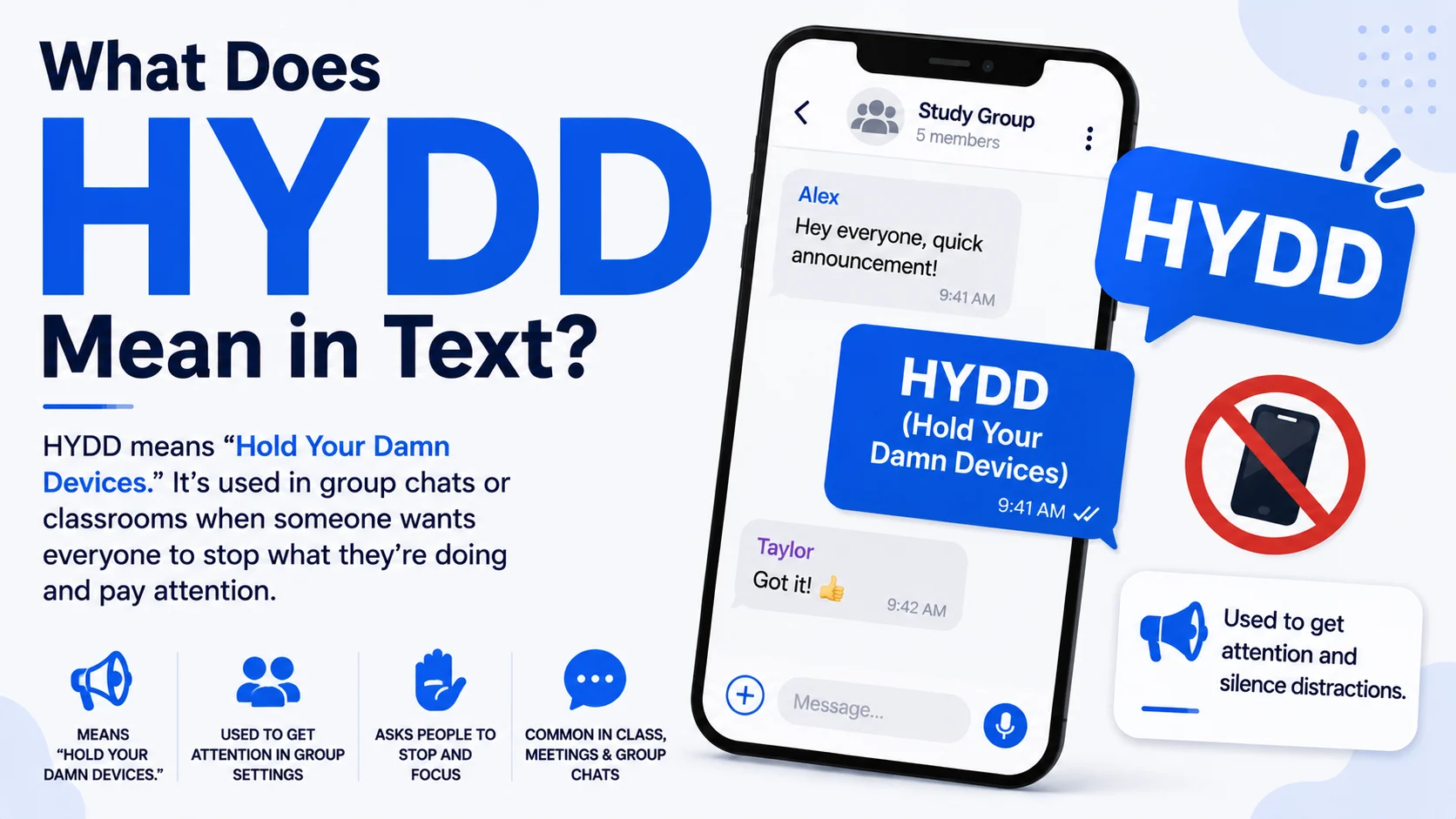
If you have ever seen “HYDD” in a text message or social media chat and felt confused, you are not alone. Many people search for what does hydd mean in text because it appears suddenly in conversations without explanation.
In today’s fast-moving digital world, short forms and slang evolve quickly. Sometimes they are intentional abbreviations, and other times they are simply typing mistakes that become popular. “HYDD” is one of those expressions that creates confusion because it is not officially standardized like many common internet acronyms.
People usually encounter it in WhatsApp chats, Instagram DMs, TikTok comments, or casual texting with friends. The meaning often depends on context, tone, and even the relationship between the speakers.
In this article, we will break down everything about HYDD in a simple, human way. You will learn its meaning, possible interpretations, emotional tone, real-life usage, misunderstandings, and how to respond naturally when someone sends it to you.
HYDD – Quick Meaning
In most texting contexts, HYDD is commonly understood as a variation or misspelling of:
“HYD” = How You Doing
So HYDD generally means:
- “How you doing?”
- A casual greeting or check-in
- Sometimes used playfully or with added emphasis
Examples:
- “Hey HYDD?” → “Hey, how are you doing?”
- “HYDD today?” → “How are you doing today?”
- “HYDD bro” → “How you doing, bro?”
In some rare cases, HYDD may also appear as a typo or personal shorthand, not a fixed acronym. That is why context matters a lot.
Origin & Background
The origin of HYDD is closely tied to the evolution of internet slang and texting culture.
The base form, HYD, became popular in early SMS and chat platforms where character limits encouraged abbreviations. Over time, people started adding extra letters for style, emotion, or simply by accident.
HYDD likely emerged from:
- Fast typing on mobile keyboards
- Autocorrect variations
- Emphasis on friendliness or tone
- Casual internet slang evolution
On platforms like Instagram and Snapchat, users often modify abbreviations to make messages feel more personal or expressive. Adding an extra “D” may not change the meaning but can make the message feel more playful or informal.
In modern digital communication, slang is less about strict grammar and more about emotional tone and speed. HYDD fits perfectly into that trend.
Real-Life Conversations (MANDATORY)
WhatsApp Chat Example 1
Person A: HYDD bro?
Person B: I’m good man, just tired from work. You?
Instagram DM Example
Person A: HYDD? Haven’t seen you online lately
Person B: I’m okay, just busy with studies
TikTok Comment Section
Person A: HYDD everyone in this comment section 😂
Person B: Doing fine, this video is hilarious
Text Message Example
Person A: HYDD today
Person B: Not bad, just relaxing at home
These examples show that HYDD is mostly used as a friendly opener rather than a serious question.
Emotional & Psychological Meaning
HYDD is more than just a shortcut for “how you doing.” It carries emotional weight depending on context.
People use it because:
- They want to check in casually without sounding formal
- It feels quick and effortless
- It creates a sense of closeness in digital conversations
Psychologically, it reflects modern communication habits where people prefer short, low-effort emotional check-ins instead of long messages.
Real-life scenario:
Imagine a friend you have not talked to in a while suddenly messages “HYDD.” It feels light, non-intrusive, and opens the door for conversation without pressure. That is the emotional function behind it.
It is a small phrase, but it carries friendliness, curiosity, and sometimes even concern.
Usage in Different Contexts
Social Media
Used in comments or DMs as a casual greeting:
- “HYDD everyone?”
- “HYDD fam?”
Friends & Relationships
Very common among close friends:
- Quick check-ins
- Casual conversation starters
Work or Professional Settings
Rarely appropriate unless the workplace is extremely informal:
- Better avoided in emails or formal chats
Casual vs Serious Tone
- Casual: Friendly and normal
- Serious: Can feel out of place or confusing
When NOT to Use It
HYDD is not suitable for every situation.
Avoid using it when:
- Talking to teachers, bosses, or formal contacts
- Writing professional emails
- Communicating in serious or sensitive situations
- The other person is not familiar with slang
Using it in the wrong context may make your message look careless or unclear.
Common Misunderstandings
People often misinterpret HYDD because:
- They assume it has a fixed dictionary meaning
- They think it is a new acronym with hidden meaning
- They confuse it with similar slang like HYD or HBD
Common mistakes:
- Thinking it is a formal abbreviation
- Overanalyzing it as a coded message
- Assuming it always has emotional seriousness
In reality, HYDD is mostly informal and context-driven.
Comparison Table
| Expression | Meaning | Tone | Usage |
|---|---|---|---|
| HYD | How you doing | Casual | Common texting |
| HYDD | How you doing (variation) | Very casual | Informal chats |
| HBU | How about you | Conversational | Replying |
| SUP | What’s up | Friendly | Greetings |
| HRU | How are you | Neutral | General texting |
Key Insight:
HYDD is not a formal acronym but a flexible slang variation of HYD, shaped by casual typing habits and conversational tone.
Variations / Types
Here are common variations related to HYDD:
- HYD → How you doing, standard form
- HYDD → Emphasized or typo variation
- HYYD → Extra informal version, same meaning
- HYD? → Simple question form
- HYD bro → Friendly masculine tone
- HYD girl → Casual friendly address
- HYD fam → Group or community greeting
- HYD tho → More expressive tone
- HYD rn → How you doing right now
- HYD lately → Checking in after time gap
Each variation carries slightly different emotional tone but similar meaning.
How to Respond When Someone Uses It
Casual Replies
- “I’m good, you?”
- “Doing well, thanks!”
- “All good here”
Funny Replies
- “Still trying to figure life out 😂”
- “Barely surviving but okay 😆”
- “Same chaos as always”
Mature Replies
- “I’m doing fine, hope you are well too”
- “Things are going steady, thank you for asking”
Respectful Replies
- “I appreciate you checking in. I’m doing okay”
- “Thank you for asking, I’m fine”
Regional & Cultural Usage
Western Culture
Common in texting and social media, especially among younger users.
Asian Culture
Used widely in informal chats, especially on WhatsApp and Instagram.
Middle Eastern Culture
Mostly seen among younger, English-speaking internet users.
Global Internet Usage
HYDD is not region-specific but belongs to global internet slang culture.
Generational Differences
- Gen Z: Uses it casually and frequently
- Millennials: Understand it but use it less often
- Older generations: May find it confusing
Is It Safe for Kids?
Yes, HYDD is generally safe because it is just a casual greeting. It does not contain harmful or offensive language. However, children may need guidance to understand slang properly so they can communicate clearly in different situations.
FAQs
1. What does HYDD mean in text?
It usually means “How you doing,” a casual way to ask how someone is.
2. Is HYDD correct grammar?
No, it is slang and not grammatically standard English.
3. Is HYDD the same as HYD?
Yes, HYDD is a variation or informal version of HYD.
4. Where is HYDD used?
Mostly in WhatsApp, Instagram, Snapchat, and casual texting.
5. Can I use HYDD in professional messages?
No, it is not suitable for formal or professional communication.
6. Is HYDD offensive?
No, it is friendly and neutral in tone.
7. Why do people add extra letters like HYDD?
Often for style, emphasis, or accidental typing.
Conclusion
Understanding slang like HYDD helps you stay connected in today’s fast digital communication world. While it may look confusing at first, its meaning is simple and friendly in most cases.
At its core, HYDD is just a relaxed way of asking “how you doing,” shaped by modern texting habits and informal online culture. The key is to always read the context before responding or interpreting it.
As digital language continues to evolve, expressions like HYDD remind us that communication is becoming faster, lighter, and more emotionally expressive in subtle ways. Once you understand it, you can confidently use or respond to it in everyday chats without confusion.