
If you have seen “JBH” in a text message or social media chat and felt confused, you are not alone. Modern digital conversations move fast, and new abbreviations appear almost daily. JBH is one of those short forms that often leaves people guessing.
Most commonly, JBH is used in informal texting to express honesty in a direct way. People use it to soften a truth, share feelings openly, or emphasize sincerity in a conversation.
The reason this term is widely searched is simple. It looks unclear at first glance. It is not part of traditional English, and it is not explained in most dictionaries. So users turn to search engines to understand what it means in real conversations.
In this article, you will learn everything about JBH, including its meaning, emotional tone, real chat examples, cultural usage, and how to respond naturally when someone uses it.
JBH – Quick Meaning
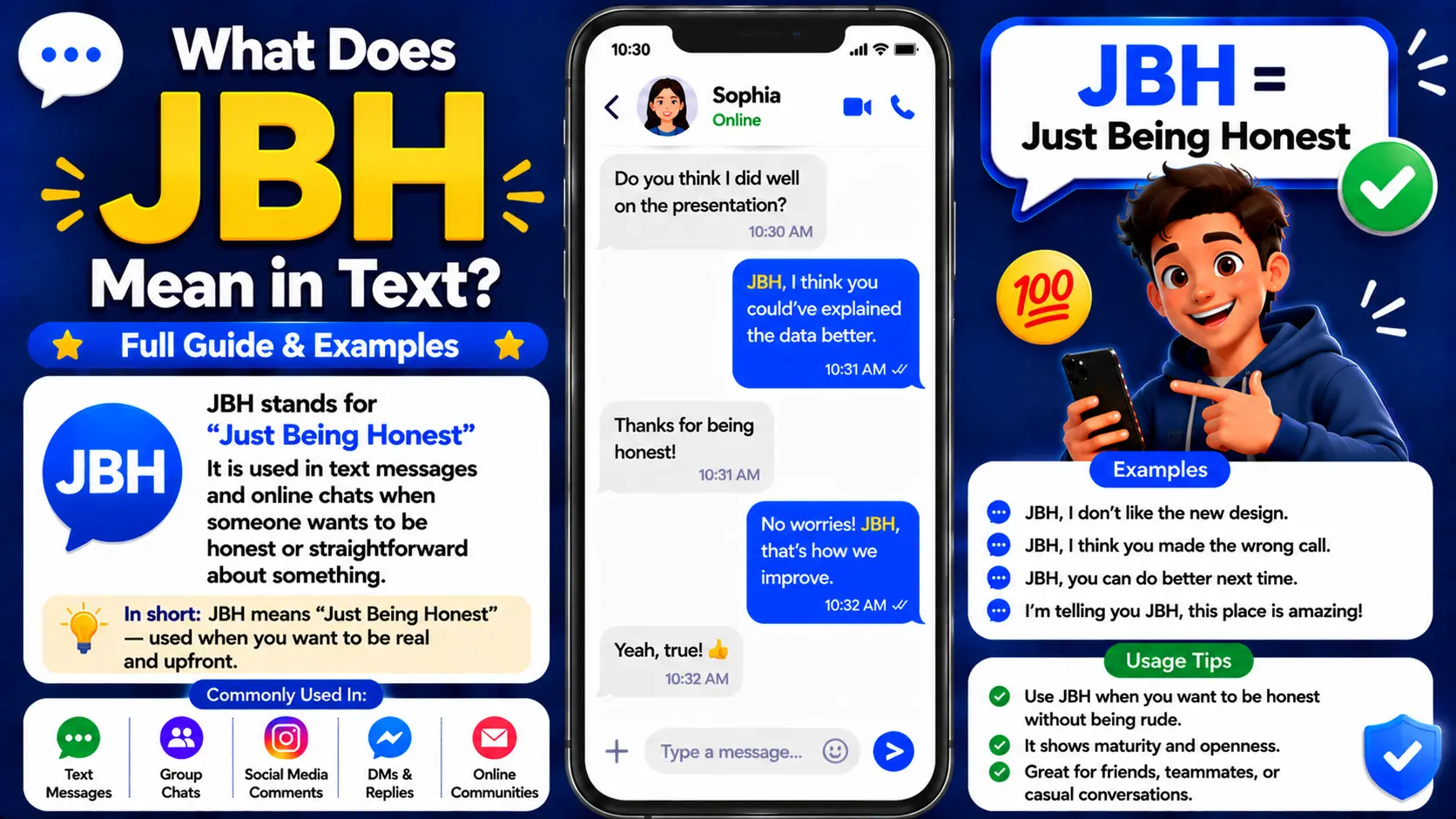
JBH most commonly stands for:
“Just Being Honest”
It is used when someone wants to express a genuine opinion or feeling, often after saying something blunt or sensitive.
Simple meaning:
- A way to show honesty in conversation
- Used to soften direct or blunt statements
- Signals transparency or emotional sincerity
Examples:
- “I didn’t like the movie, JBH.”
- “You looked a bit upset today, JBH.”
- “That outfit is not your best, JBH.”
In all these cases, JBH adds a tone of honesty without sounding too harsh.
Origin & Background
JBH comes from the rise of internet slang and text messaging culture, especially during the early growth of SMS communication and social media platforms.
As people started communicating in shorter formats, abbreviations became essential. Words like “LOL,” “BRB,” and “TBH” became popular, and JBH naturally evolved in the same environment.
How it developed:
- Text messaging encouraged shorter expressions
- Social media platforms increased slang usage
- People needed quick ways to express honesty
- “Just being honest” was shortened for convenience
Over time, JBH became part of casual digital communication, especially among younger users who value fast and expressive texting styles.
Social media influence:
Platforms like Instagram and Snapchat played a major role in spreading JBH. Short captions and comment sections encouraged users to express opinions quickly, often with emotional clarity.
Today, JBH is not formal language. It belongs to everyday conversations where tone matters more than grammar.
Real-Life Conversations (MANDATORY)
WhatsApp Chat Example
On WhatsApp:
Person A: Do you think I should post this picture?
Person B: It is nice but a bit too filtered, JBH.
Person A: Hmm I was unsure too. Thanks for telling me honestly.
Instagram DM Example
On Instagram:
Person A: How do you like my new hairstyle?
Person B: It suits you, but I liked your old one more, JBH.
Person A: At least you are honest 😂
TikTok Comment Section
On TikTok:
User A: This dance trend is getting boring.
User B: True, it is overused now, JBH.
User A: Finally someone said it.
Casual Text Message
Person A: Did I handle that situation well?
Person B: You were a bit harsh, JBH, but your point was valid.
Person A: I needed that honesty.
Emotional & Psychological Meaning
JBH is more than just an abbreviation. It reflects how people manage honesty in modern communication.
What emotion it expresses:
- Honesty without aggression
- Careful criticism
- Emotional transparency
- Social caution
People often use JBH when they want to be truthful but also avoid hurting someone’s feelings too directly.
Why people use it:
- To soften criticism
- To sound respectful while being direct
- To show sincerity
- To avoid misunderstandings
What it reveals about modern communication:
Today’s digital conversations are sensitive. People want honesty, but they also want emotional safety. JBH bridges that gap by allowing truth to be delivered gently.
Personal-style scenario:
Imagine a friend asks if their presentation was good. You notice it was slightly unorganized. Instead of sounding harsh, you say, “It was good, but it needs better structure, JBH.” This keeps the relationship balanced while still being honest.
Usage in Different Contexts
1. Social media
Used in comments or captions to express opinions quickly.
Example:
“Nice outfit, but not my style, JBH.”
2. Friends & relationships
Used in casual conversations where honesty is expected.
Example:
“I miss hanging out, JBH.”
3. Work / professional settings
Rare and generally not recommended, but sometimes appears in informal workplace chats.
Example:
“Report is okay, but needs more detail, JBH.”
4. Casual vs serious tone
- Casual: Friendly honesty among peers
- Serious: Can sound blunt or inappropriate depending on context
JBH works best in relaxed conversations, not formal communication.
When NOT to Use It
Even though JBH is widely used, it is not suitable for every situation.
Avoid using JBH in:
- Formal emails or professional reports
- Sensitive emotional conversations
- Situations involving grief or serious conflict
- Communication with elders or authority figures
Cultural sensitivity:
In some cultures, direct honesty can be seen as rude if not softened properly. JBH may still sound blunt even with its “just being honest” intention.
Risk of misunderstanding:
The phrase can sometimes make criticism feel less polite than intended if the tone is not clear.
Common Misunderstandings
JBH is often confused with other slang or misinterpreted.
1. Thinking it is aggressive
Some people assume it is used to insult, but it usually is not meant that way.
2. Confusing it with similar acronyms
People often mix it with:
- TBH (To Be Honest)
- NGL (Not Gonna Lie)
3. Taking it too literally
JBH is not a command or formal statement. It is a conversational softener.
4. Assuming sarcasm
Without tone indicators, JBH can sometimes feel sarcastic even when it is not.
Comparison Table
| Term | Meaning | Tone | Usage |
|---|---|---|---|
| JBH | Just Being Honest | Neutral to slightly direct | Soft honesty in casual chat |
| TBH | To Be Honest | Reflective | Sharing real opinion |
| NGL | Not Gonna Lie | Informal | Surprise or confession |
| IMO | In My Opinion | Neutral | Personal viewpoint |
| FR | For Real | Strong agreement | Emphasis or truth |
Key Insight
JBH is unique because it combines honesty with emotional cushioning. It is less about stating facts and more about delivering truth in a socially gentle way.
Variations / Types (8–10)
- JBH (Just Being Honest)
Direct truth with mild softness. - TBH (To Be Honest)
More reflective and common variation. - FR (For Real)
Stronger agreement or emphasis. - NGL (Not Gonna Lie)
Used for surprising honesty. - IMO (In My Opinion)
Opinion-based expression. - IMHO (In My Honest Opinion)
Polite and softened opinion. - REAL TALK
Stronger, more serious honesty. - STRAIGHT UP
Very direct statement. - NO CAP
Modern slang for truthfulness. - FACTS
Agreement with something true.
Each variation changes the emotional tone slightly, even if the meaning overlaps.
How to Respond When Someone Uses It
Casual replies:
- “Fair enough 😄”
- “I get what you mean”
- “Thanks for being honest”
Funny replies:
- “JBH hit harder than expected 😂”
- “Okay, honesty level maxed out”
Mature replies:
- “I appreciate your honesty”
- “That feedback helps, thank you”
Respectful replies:
- “I understand your point”
- “Thanks for sharing your honest view”
Regional & Cultural Usage
Western culture
Widely used in casual texting, especially among Gen Z. JBH is part of everyday slang.
Asian culture
Used in online chats but less common in formal communication. Often seen in social media comments.
Middle Eastern culture
Used mainly by younger users familiar with global internet slang.
Global internet usage
Spread through messaging apps and social platforms, especially among English-speaking users worldwide.
Generational differences
- Gen Z: Uses JBH naturally in chats
- Millennials: Understand it but use it less frequently
- Older generations: May find it confusing or unnecessary
Is It Safe for Kids?
Yes, JBH is generally safe. It is not offensive or harmful. However, children should be guided on when honesty in digital communication can affect feelings. Teaching context awareness is more important than the acronym itself.
FAQs
1. What does JBH mean in texting?
It means “Just Being Honest,” used to express sincere opinions.
2. Is JBH rude?
Not usually, but it depends on tone and context.
3. Is JBH the same as TBH?
Similar, but JBH feels more direct and personal.
4. Where is JBH commonly used?
Mostly in casual chats and social media conversations.
5. Can JBH be used professionally?
It is not recommended in formal or professional communication.
6. Is JBH popular on social media?
Yes, especially on messaging apps and comment sections.
7. Does JBH always mean honesty?
Yes, but the level of softness depends on how it is used.
Conclusion
JBH, meaning “Just Being Honest,” is a small but powerful expression in modern digital communication. It helps people express truth in a softer, more socially aware way.
Whether used in chats with friends or casual social media comments, it reflects how language has evolved in the age of fast messaging. It balances honesty with emotional sensitivity, which is why it continues to be used widely.
Understanding JBH helps you read between the lines in conversations and respond more naturally in everyday texting situations.