

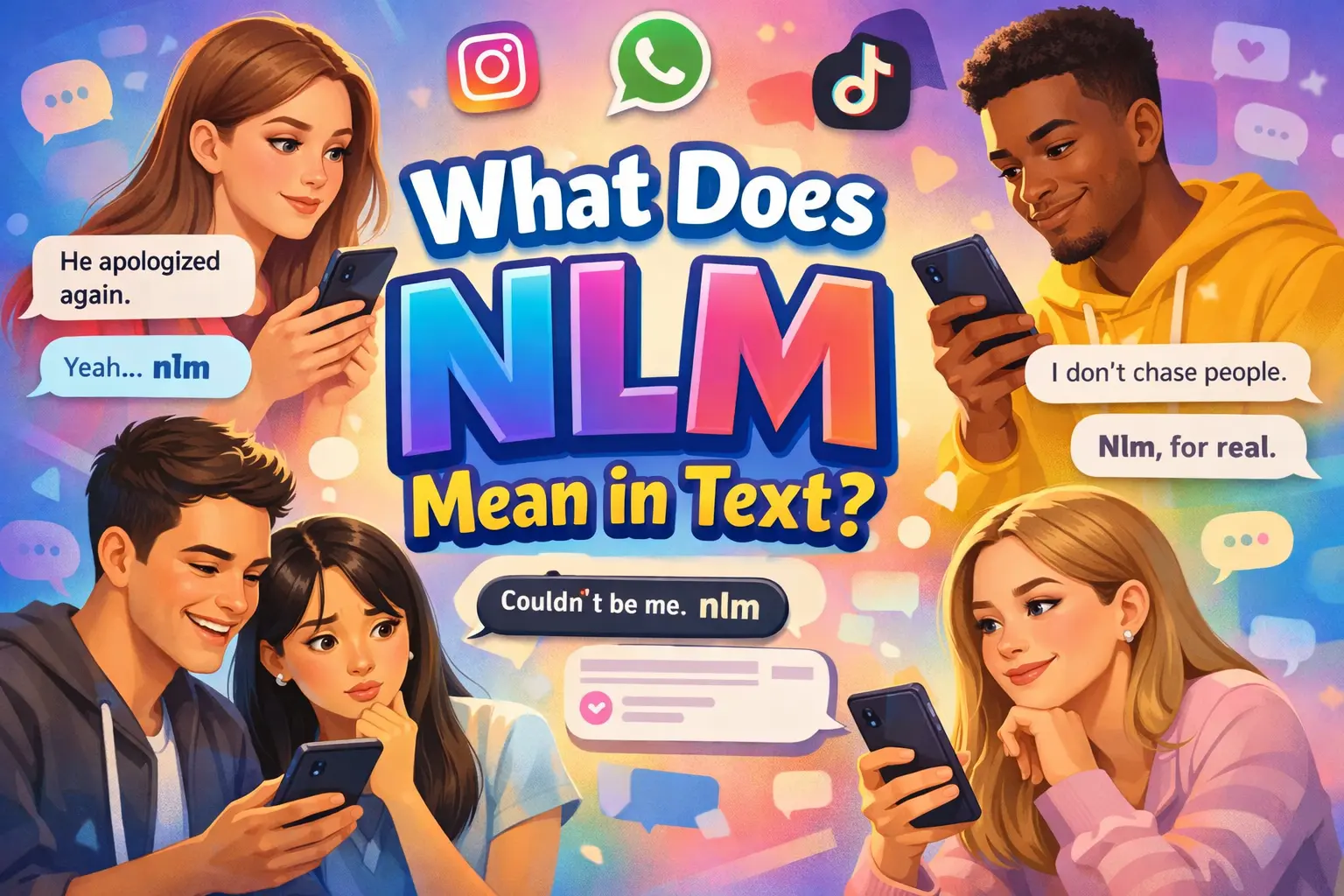
If you’ve seen “nlm” in a message, comment, or caption and felt unsure about its tone or intent, you’re not alone. Modern texting slang evolves fast, and small abbreviations often carry big emotional meaning.
People search what does nlm mean in text because the phrase shows up in different contexts. Sometimes it feels dismissive. Other times it signals independence or confidence. Without context, it can sound cold or confusing.
This guide clears that up. You’ll learn exactly what nlm means, how people actually use it in real conversations, and when it can backfire. By the end, you’ll understand both the words and the emotion behind them.
NLM – Quick Meaning
NLM stands for:
- “Not Like Me”
It’s usually used to compare behavior, personality, or standards.
The tone often implies contrast, pride, or emotional distance.
Simple meaning:
I’m different from that.
I wouldn’t act that way.
That’s not how I am.
Examples:
- “He plays games with everyone. nlm.”
- “I don’t chase people. NLM.”
- “She tolerates disrespect. nlm.”
Origin & Background
NLM comes from conversational shorthand culture, especially within youth texting and social media spaces. It grew from everyday speech patterns like:
- “That’s not like me”
- “I’m not like that”
- “That’s not how I move”
As messaging became faster and more visual, people started compressing identity statements into short forms. NLM fit perfectly because it expresses individuality in just three letters.
Social media accelerated its spread. On platforms like TikTok and Instagram, captions often emphasize uniqueness or self-worth. NLM became a compact way to say:
I’m different.
I have standards.
I don’t behave that way.
Over time, tone diversified. In some circles it signals confidence. In others it carries subtle judgment. Context determines which.
Real-Life Conversations
Person A: He stopped replying after two days
Person B: That’s messy behavior
Person A: Exactly. nlm
Instagram DMs
Person A: Why didn’t you text him first?
Person B: I don’t chase energy. nlm
TikTok Comments
Commenter 1: I would’ve forgiven him
Commenter 2: Couldn’t be me. nlm
Text Messages
Person A: She kept apologizing even though he cheated
Person B: Yeah… nlm
These examples show a pattern. NLM rarely stands alone. It usually follows a behavior the speaker rejects.
Emotional & Psychological Meaning
At its core, NLM expresses self-distinction.
People use it to signal boundaries, identity, or personal standards. It often carries one of three emotional tones:
- Self-respect
- Detachment
- Mild judgment
In digital communication, identity is constantly compared. Users see others’ choices and quickly position themselves relative to them. NLM is a linguistic shortcut for that positioning.
There’s also a protective aspect. Saying “nlm” distances the speaker from behavior they see as weak, desperate, or out of character.
Personal-style scenario:
I once saw a friend repeatedly forgive someone who treated her poorly. Another friend simply replied, “nlm.” It sounded blunt, but underneath was concern. She meant, “I’d never accept that because I value myself.”
So while the wording can feel sharp, the underlying message is often self-worth.
Usage in Different Contexts
Social Media
On TikTok or Instagram, NLM appears in captions or comments about relationships, self-respect, or lifestyle choices.
Example:
“Begging for attention? nlm.”
Tone: confident, performative, identity-driven.
Friends & Relationships
Among friends, NLM can be teasing or supportive depending on delivery.
Example:
“You’d go back to him?”
“Please. nlm.”
Tone: playful or protective.
Work / Professional Settings
In professional communication, NLM is inappropriate. It sounds dismissive and informal.
Example to avoid:
“That’s not my responsibility, nlm.”
Tone: disrespectful or arrogant.
Casual vs Serious Tone
Casual: light contrast
Serious: moral judgment
“Late again? nlm” can be joking.
“Tolerating disrespect. nlm” feels serious.
Context decides intensity.
When NOT to Use It
Professional communication
It undermines collaboration and respect.
Sensitive conversations
When someone shares vulnerability, NLM can sound dismissive.
Cultural differences
Some cultures value humility. NLM may seem boastful.
Conflict situations
It can escalate tension by implying superiority.
Common Misunderstandings
1. Thinking it always means confidence
Sometimes it expresses judgment, not empowerment.
2. Assuming hostility
Among friends it can be harmless teasing.
3. Interpreting literally
It’s rarely about personality. It’s about behavior.
4. Missing emotional tone
Delivery changes meaning. Dry text feels harsher.
Comparison Table
| Expression | Meaning | Tone | Relationship to NLM |
|---|---|---|---|
| Not like me (full) | I wouldn’t do that | Neutral | Original form |
| Couldn’t be me | I’d never do that | Playful | Very similar |
| That’s not me | Not my style | Calm | Softer |
| I’m different | Identity claim | Neutral | Broader |
| That’s you, not me | Separation | Defensive | Sharper |
| I’d never | Moral stance | Judgmental | Stronger |
| Same here | Agreement | Friendly | Opposite |
| Me too | Similarity | Warm | Opposite |
Key Insight:
NLM sits between playful contrast and subtle judgment. Its impact depends less on words and more on relationship and context.
Variations / Types
1. “nlm fr”
Not like me, for real.
Adds emphasis and sincerity.
2. “nlm at all”
Complete contrast.
Stronger rejection of behavior.
3. “nlm lol”
Playful distancing.
Softens tone with humor.
4. “nlm idc”
Detached independence.
Signals emotional distance.
5. “nlm sorry”
Gentle disagreement.
Adds politeness.
6. “nlm tho”
Casual contrast.
Light conversational tone.
7. “nlm respectfully”
Polite boundary.
Used in debates or opinions.
8. “nlm personally”
Subjective framing.
Reduces judgment tone.
9. “nlm ever”
Absolute identity claim.
Strongest form.
10. “nlm tbh”
Honest self-positioning.
Adds authenticity.
How to Respond When Someone Uses It
Casual Replies
- “Fair enough 😂”
- “You’re built different”
- “Okay, I see you”
Funny Replies
- “We know, you’re elite”
- “Main character energy”
- “Built in another factory”
Mature Replies
- “Different boundaries, I respect that”
- “We all handle things differently”
- “That makes sense for you”
Respectful Replies
- “I understand your perspective”
- “That’s valid for you”
- “Thanks for being honest”
Regional & Cultural Usage
Western Culture
In Western digital spaces, individuality is emphasized. NLM often signals personal standards or independence. It aligns with self-identity messaging common on social platforms.
Asian Culture
In many Asian contexts, group harmony is valued. Direct self-distinction can sound boastful. NLM may feel blunt or socially awkward unless used jokingly among close friends.
Middle Eastern Culture
Respect and humility are highly valued in communication. NLM can sound prideful if used seriously. Among youth online, though, it appears more often with Westernized tone.
Global Internet Usage
Online culture blends influences. NLM now appears worldwide in memes, captions, and comment culture. Meaning remains consistent, but tone varies by community norms.
Generational Differences
Gen Z:
Uses NLM confidently. Signals boundaries and identity.
Millennials:
Use less frequently. Prefer full phrases like “that’s not me.”
Younger users see it as empowerment. Older users may perceive it as judgment.
Is It Safe for Kids?
Yes, NLM itself is harmless. It simply expresses difference or personal standards.
However, context matters. If used to mock or exclude others, it can encourage comparison or superiority. Teaching respectful tone and empathy helps ensure healthy use.
FAQs
What does NLM mean in texting?
It means “Not Like Me,” expressing that someone wouldn’t behave the same way.
Is NLM rude?
It can sound rude if used judgmentally or in sensitive situations.
Is NLM positive or negative?
Neutral by itself. Tone depends on context and relationship.
Do girls use NLM more than guys?
Usage varies by community. It’s common in youth social media regardless of gender.
Is NLM the same as couldn’t be me?
Yes, they’re very similar in meaning and tone.
Can NLM be used jokingly?
Yes. Among friends it often signals playful contrast.
Should I use NLM at work?
No. It’s informal and may sound dismissive.
Conclusion
NLM may be just three letters, but it carries identity, boundaries, and self-expression. At its best, it communicates confidence and personal standards. At its worst, it can sound dismissive or superior.
Understanding tone and context makes all the difference. When used thoughtfully among the right audience, NLM simply means:
I know who I am.
I act differently.
That’s not like me.
Once you grasp that emotional layer, you can read and use the phrase with clarity and confidence.