
If you have ever received a message like “IDC” and wondered whether the person was being rude, careless, or simply casual, you are not alone. Many people search “what dose idc mean in text” because short internet expressions can carry different emotions depending on the situation.
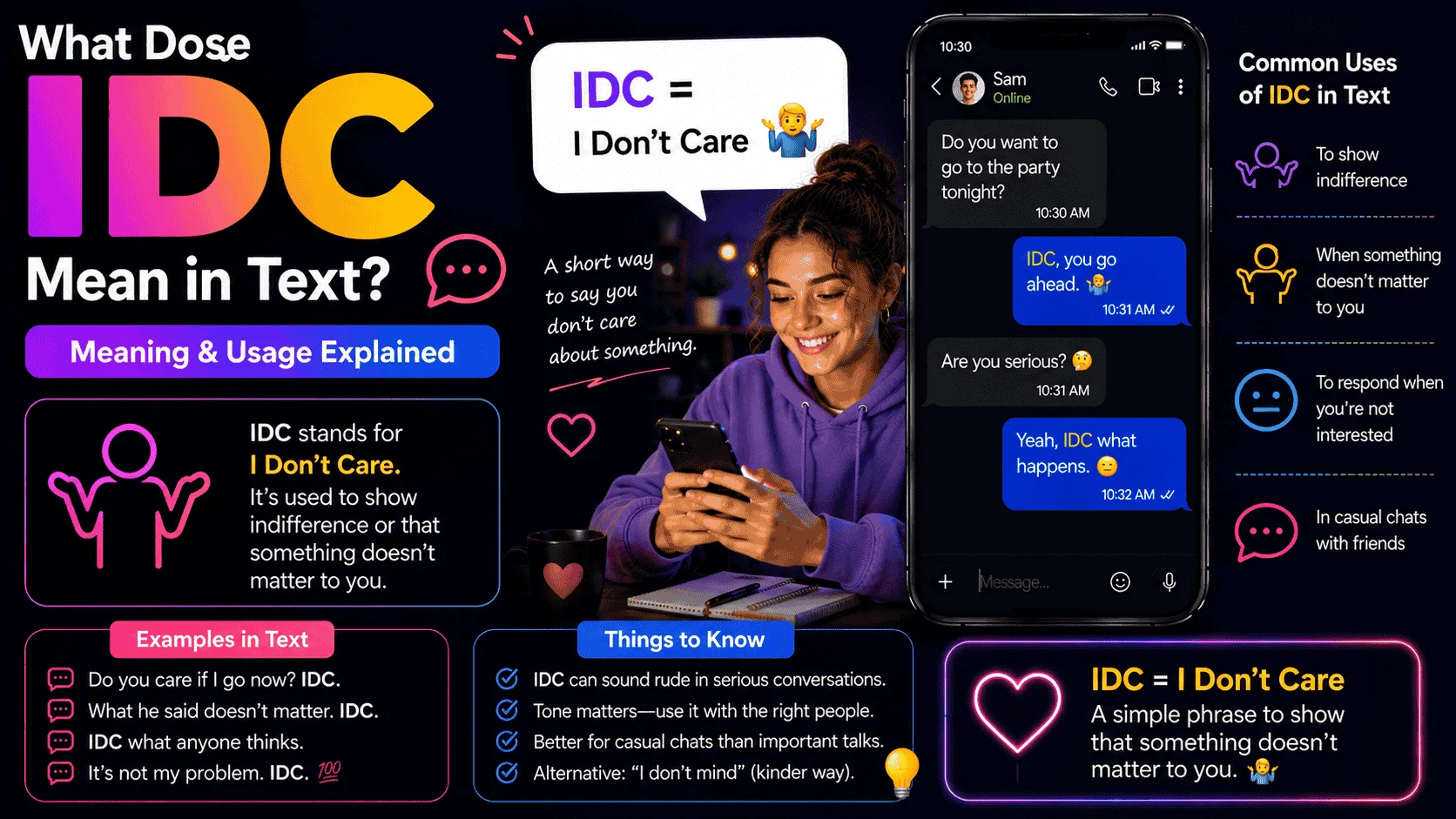
In texting, IDC means “I Don’t Care.” It is commonly used in online conversations, social media comments, and everyday chats to show that someone is not interested, does not have a preference, or does not want to worry about something.
However, the meaning is not always negative. Sometimes “IDC” can sound relaxed, playful, or confident. Other times, it can feel dismissive or cold. Understanding the tone behind it is the key to using and interpreting it correctly.
Modern communication depends heavily on short forms. A simple three-letter phrase can express attitude, emotion, and even personality. This guide explains the real meaning of IDC, how people use it, and what it reveals about digital conversations.
IDC Meaning in Text: Quick Explanation
IDC stands for “I Don’t Care.”
It means:
- Someone is not concerned about something
- Someone has no strong preference
- Someone does not want to spend energy discussing a topic
- Someone is showing emotional distance from a situation
Examples:
“Which movie should we watch?”
“IDC, you choose.”
Meaning: The person has no preference.
“People are judging my outfit.”
“IDC, I like it.”
Meaning: The person does not care about others’ opinions.
“IDC what they say.”
Meaning: The person is ignoring criticism or outside opinions.
The feeling behind IDC depends on the relationship and the conversation.
Origin and Background of IDC
The phrase “I Don’t Care” existed long before texting became popular. People used it in spoken conversations to express indifference or a lack of interest.
When online messaging became common, especially through platforms like chat rooms, forums, and instant messaging services, users started shortening phrases to save time.
IDC became popular because:
- Text conversations moved quickly
- People wanted shorter replies
- Internet culture encouraged abbreviations
- Social media made slang spread globally
Platforms such as messaging apps and social networks helped IDC become a normal part of digital language.
Over time, its meaning became more flexible. A teenager saying “IDC 😂” to a friend may mean “I’m chill about it,” while someone replying “IDC” during an argument may sound emotionally distant.
The words stayed the same, but the emotional meaning changed with context.
Real-Life Conversations Using IDC
WhatsApp Conversation
Person A:
“Should we order pizza or burgers tonight?”
Person B:
“IDC 😂 You pick.”
Here, IDC means the person is relaxed and does not mind either option.
Instagram DM Conversation
Person A:
“Someone commented something negative on my photo.”
Person B:
“IDC what they think. You look great.”
Here, IDC shows confidence and emotional support.
TikTok Comment Conversation
Person A:
“People are saying this trend is boring.”
Person B:
“IDC, I still enjoy it.”
Here, IDC means ignoring public opinion.
Text Message Conversation
Person A:
“Are you upset that I went without you?”
Person B:
“IDC.”
Here, IDC may sound colder and could suggest emotional distance.
Emotional and Psychological Meaning of IDC
IDC is not just an abbreviation. It often communicates a person’s emotional state.
Sometimes it represents confidence:
“I know what I like, and other people’s opinions do not control me.”
Sometimes it represents avoidance:
“I do not want to discuss this topic anymore.”
Sometimes it represents frustration:
“I am tired of explaining myself.”
Digital communication removes facial expressions and voice tone, so short phrases like IDC can become confusing.
A personal example many people experience: imagine telling a friend about a problem and receiving only “IDC.” The same letters could feel hurtful. But if a close friend says “IDC 😂 let’s just have fun,” it feels completely different.
The surrounding words create the real meaning.
IDC Usage in Different Contexts
Social Media
On social platforms, IDC is often used to show confidence.
Examples:
- “IDC about trends. I wear what I like.”
- “IDC about online drama.”
It can create a bold or independent personality.
Friends and Relationships
Among close friends, IDC is often casual.
Example:
“Where do you want to eat?”
“IDC, anywhere works.”
It simply means there is no preference.
However, during emotional conversations, it can feel dismissive.
Work and Professional Settings
IDC is usually not suitable for professional communication.
Writing:
“I IDC about this project”
sounds disrespectful and careless.
A professional alternative:
“I do not have a strong preference.”
or
“I am open to different options.”
Casual vs Serious Tone
Casual:
“IDC 😂 You choose.”
Serious:
“IDC.”
The second version may feel harsh because it lacks warmth.
When NOT to Use IDC
Although IDC is common online, it is not appropriate everywhere.
Avoid using IDC when:
- Someone is sharing personal feelings
- You are responding to a serious problem
- You are communicating with a manager or client
- The situation requires empathy
For example:
Friend:
“I have been feeling really stressed lately.”
Reply:
“IDC.”
This can hurt the other person because it sounds like their feelings do not matter.
Culture also matters. Some people see direct language as honest, while others see it as disrespectful.
Common Misunderstandings About IDC
IDC Always Means Someone Is Rude
Not true.
A person saying “IDC” may simply mean they are flexible.
Example:
“Tea or coffee?”
“IDC.”
This is not rude.
IDC Always Means No Emotion
Not always.
Someone may say IDC because they are trying to appear confident.
Example:
“People hate my new style.”
“IDC.”
This may actually mean:
“I am happy with myself.”
Literal Meaning vs Emotional Meaning
The literal meaning is:
“I do not care.”
But emotionally it can mean:
- “I am okay with anything.”
- “I am not worried.”
- “I do not want to argue.”
- “Your opinion does not affect me.”
IDC Comparison Table
| Expression | Meaning | Tone |
|---|---|---|
| IDC | I Don’t Care | Neutral or dismissive |
| IDK | I Don’t Know | Uncertain |
| IDGAF | I Don’t Give A F*** | Strong, aggressive |
| Whatever | No strong opinion | Casual |
| I’m fine with anything | Flexible | Polite |
| I care | Shows interest | Positive |
Key Insight:
IDC is not just about the words. The relationship, timing, and emotional situation decide whether it sounds relaxed or disrespectful.
Variations and Types of IDC
1. Casual IDC
Meaning: No preference.
Example:
“IDC where we eat.”
2. Confident IDC
Meaning: Ignoring judgment.
Example:
“IDC what people think.”
3. Defensive IDC
Meaning: Pretending something does not matter.
Example:
“IDC if they leave.”
4. Angry IDC
Meaning: Showing frustration.
Example:
“IDC anymore.”
5. Playful IDC
Meaning: Used jokingly.
Example:
“IDC 😂 I’m still doing it.”
6. Relationship IDC
Meaning: Can show emotional distance.
Example:
“IDC about us.”
7. Online Drama IDC
Meaning: Avoiding arguments.
Example:
“IDC about comments.”
8. Decision-Making IDC
Meaning: Giving someone else control.
Example:
“IDC, choose the restaurant.”
9. Self-Expression IDC
Meaning: Being comfortable with personal choices.
Example:
“IDC, I love my style.”
10. Short Reply IDC
Meaning: Quick emotional response.
Example:
“IDC.”
This version needs careful interpretation.
How to Respond When Someone Uses IDC
Casual Replies
- “Haha okay, I’ll decide.”
- “Cool, I’ll pick then.”
- “No problem.”
Funny Replies
- “Your famous IDC moment again 😂”
- “Translation: you want me to choose.”
- “IDC detected 😆”
Mature Replies
- “Alright, I understand.”
- “Thanks for letting me know.”
- “I’ll consider that.”
Respectful Replies
If IDC feels hurtful:
- “I’m not sure if you mean that seriously or casually.”
- “I’d like to understand what you mean.”
Regional and Cultural Usage of IDC
Western Culture
In many Western online conversations, IDC is common and often casual. Friends may use it without negative meaning.
Asian Culture
In many Asian communication styles, direct phrases like “I don’t care” may sound stronger because politeness and indirect expressions are often valued.
People may prefer:
“Anything is okay.”
instead of:
“IDC.”
Middle Eastern Culture
Communication often places importance on respect and emotional connection. IDC may sometimes sound too direct, especially with elders or serious topics.
Global Internet Usage
Online culture has made IDC widely understood across countries. Social media, gaming communities, and messaging apps have helped spread it.
Gen Z vs Millennials
Gen Z often uses IDC casually, especially with humor, memes, and online conversations.
Millennials may also use it but may interpret it more literally depending on context.
Is IDC Safe for Kids?
IDC itself is not harmful. It is simply a slang abbreviation.
However, children should understand that tone matters.
A child using IDC with friends may be harmless, but using it during emotional conversations can appear disrespectful.
Teaching kids communication skills helps them understand when short slang is appropriate.
Frequently Asked Questions About IDC
What does IDC mean in texting?
IDC means “I Don’t Care.” It shows that someone is not concerned or does not have a preference.
Is IDC rude?
Sometimes. It depends on the situation, tone, and relationship between people.
What does IDC mean from a girl?
It has the same meaning as anyone else using it. Context matters more than the person saying it.
What is the difference between IDC and IDGAF?
IDC is softer. IDGAF is a much stronger and sometimes offensive version.
Can IDC be positive?
Yes. It can mean confidence, relaxation, or not worrying about unnecessary opinions.
Should I use IDC at work?
Usually no. Professional communication should use clearer and more polite wording.
Why do people use IDC?
People use IDC because it is quick, familiar, and expresses feelings in a short way.
Conclusion
Understanding what dose idc mean in text helps you read online conversations more accurately. IDC means “I Don’t Care,” but its emotional meaning depends on the situation.
It can show confidence, flexibility, humor, frustration, or distance. The same three letters can feel friendly in one conversation and hurtful in another.
Good communication is not only about the words people type. It is about understanding the emotion behind them. Once you recognize the context, IDC becomes much easier to understand and use confidently.