
If you have ever received a message containing “JP” and wondered what it means, you are not alone. Short forms and abbreviations have become a natural part of online conversations, but many of them can have different meanings depending on the situation.
The phrase “what is jp mean in text” is commonly searched because people often see it in chats, social media comments, gaming conversations, or messages from friends. Without context, it can feel confusing because two simple letters can represent different ideas.
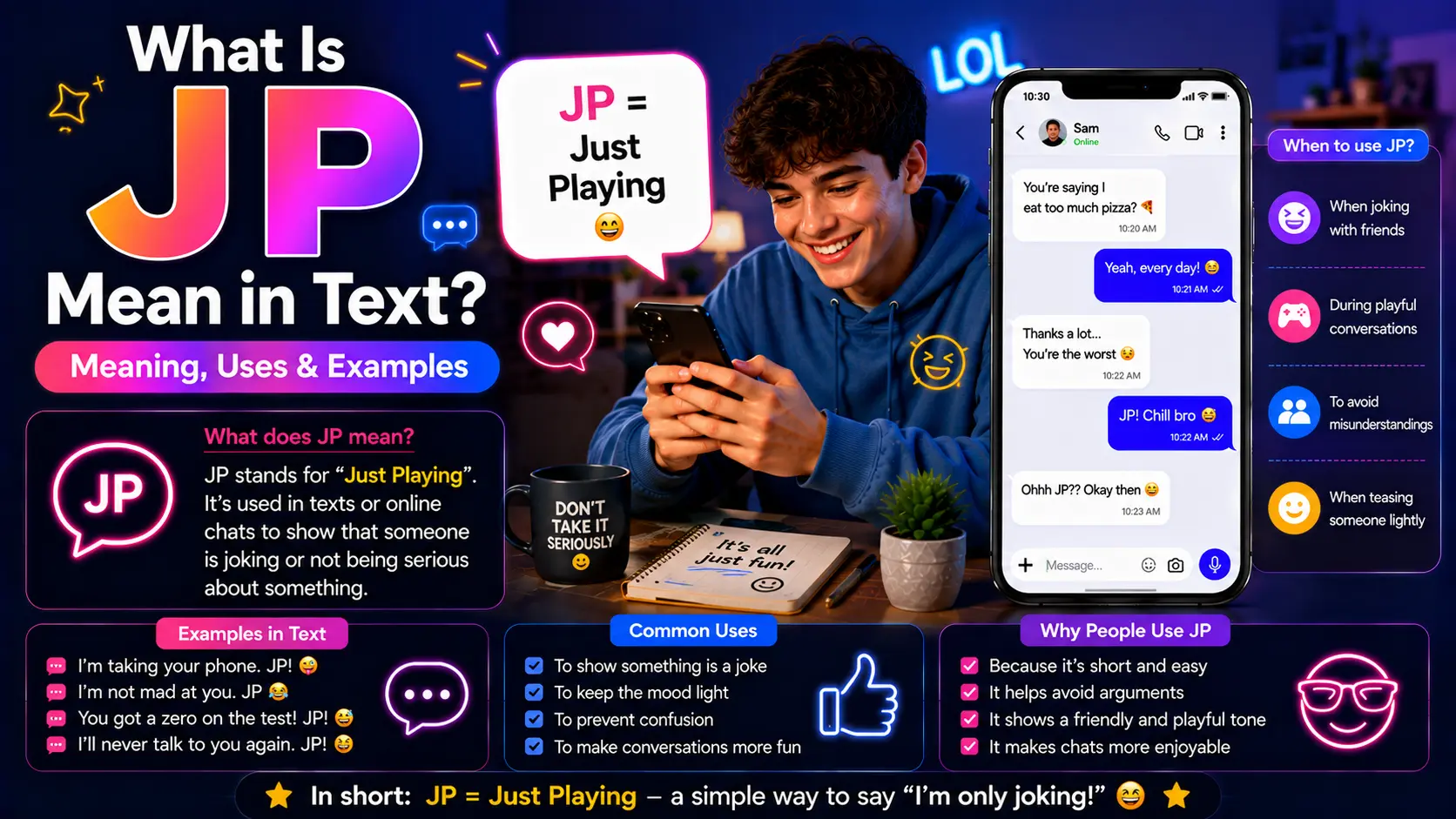
In most casual online conversations, JP usually means “just playing” or “just kidding”, especially when someone wants to show that they are joking and not being serious. However, JP can also have other meanings, such as “Japan” or “Japanese,” depending on the conversation.
Understanding the context behind JP helps you avoid misunderstandings. Digital communication often removes facial expressions, voice tone, and body language, so small abbreviations carry more emotional meaning than they appear to.
This guide explains the different meanings of JP, where it came from, how people use it today, and how to respond naturally when someone sends it.
JP Meaning in Text: Quick Meaning
The meaning of JP in text messages depends on the conversation, but the most common meanings are:
- JP = Just Playing
Used when someone is joking, teasing, or pretending to be serious. - JP = Just Playing around
A softer way of saying that something was not meant seriously. - JP = Japan / Japanese
Often used in discussions about countries, culture, language, food, or travel.
Examples:
“I’m going to tell everyone your secret 😂 JP”
Meaning: “I’m just playing. I’m joking.”
“You actually believed that? JP!”
Meaning: “I was only kidding.”
“I’m learning JP because I love anime.”
Meaning: “I’m learning Japanese.”
The correct meaning always depends on the surrounding words and the relationship between the people chatting.
Origin & Background of JP
The abbreviation JP became popular through the growth of online messaging culture. As texting became faster and more casual, people started shortening common phrases to save time and make conversations feel more natural.
The use of JP meaning “just playing” comes from everyday spoken English. People have long used phrases like “I’m just playing” or “I’m only kidding” after making a joke or teasing someone.
Online communities transformed this longer phrase into a quick abbreviation.
Social media platforms, gaming chats, and instant messaging apps helped spread JP because users often communicate quickly and rely on short expressions.
For example, a gamer might tease a friend after winning a match and add “JP” to show there are no hard feelings. Similarly, friends may use it after making a dramatic statement to create humor.
The meaning of JP has also expanded globally. In many online spaces, people use English-based abbreviations even when English is not their first language. This has made JP part of international internet communication.
At the same time, JP has another widely recognized meaning: Japan or Japanese. Travel communities, language learners, anime fans, and cultural discussions often use JP as a simple abbreviation.
This shows an important rule of digital language: the same abbreviation can carry completely different meanings depending on the community using it.
Real-Life Conversations Using JP
WhatsApp Conversation
Person A:
I accidentally sent my boss a message meant for my friend.
Person B:
No way 😭 What did you send?
Person A:
“Let’s skip work and go shopping.”
Person B:
Your career is over 😂
Person A:
Haha JP, I didn’t actually send it.
Person B:
You scared me for a second!
Here, JP means “just playing” and shows that the person was joking.
Instagram DM Conversation
Person A:
Your new haircut looks terrible.
Person B:
Wow, thanks for the honesty 😒
Person A:
JP! It actually looks amazing 🔥
Person B:
You almost ruined my day 😂
In this situation, JP softens the teasing and shows friendly humor.
TikTok Comment Conversation
Person A:
This recipe looks so easy. Even I could make it.
Person B:
You would probably burn water.
Person A:
That’s rude 😂
Person B:
JP, I know you can cook.
The abbreviation helps communicate that the comment was playful rather than insulting.
Text Message Conversation
Person A:
I think I’m moving to another country tomorrow.
Person B:
Wait, seriously??
Person A:
No, JP. I just need a vacation.
Person B:
You had me worried for a moment.
Here, JP prevents the message from being misunderstood as a serious announcement.
Emotional & Psychological Meaning of JP
Although JP looks like a simple abbreviation, it often carries an emotional purpose. People use it to manage the tone of a conversation.
When someone makes a joke through text, the receiver cannot hear their voice or see their facial expression. A playful statement can accidentally sound rude, aggressive, or confusing.
Adding JP helps signal:
- “I’m not being serious.”
- “I’m teasing you.”
- “We are still friendly.”
- “Don’t take this personally.”
In many cases, JP works as a social safety signal. It allows people to joke while protecting the emotional connection between them.
For example, imagine a friend saying:
“You are the worst cook I know.”
In person, their smile and voice might make it obvious that they are joking. In a text message, it could sound hurtful. Adding “JP” changes the emotional meaning.
A personal example many people can relate to is joking with a close friend about something small, such as their messy room or funny habits. The goal is not criticism. The goal is connection and shared laughter.
Modern texting has created a need for these small emotional signals because written words alone do not always show intention.
Usage of JP in Different Contexts
JP on Social Media
On platforms like Instagram, TikTok, and online forums, JP is often used in comments and private messages.
People use it after:
- playful insults
- exaggerated statements
- surprising jokes
- fake announcements
Example:
“I’m deleting my account forever. JP 😂”
The person usually means they are joking.
JP Among Friends and Relationships
Among friends, JP creates a relaxed and playful atmosphere.
Close relationships often involve teasing, and abbreviations like JP help maintain a friendly tone.
A person might write:
“You are officially the most dramatic person ever. JP ❤️”
The message is humorous rather than negative.
JP in Work or Professional Settings
Using JP at work requires caution.
While some workplaces have relaxed communication styles, JP may not always be understood professionally.
A manager, client, or unfamiliar coworker may not recognize the abbreviation.
Instead of:
“Your presentation was confusing. JP.”
A professional communicator might write:
“Just kidding, your presentation was excellent.”
Clear communication is usually better in professional environments.
Casual vs Serious Tone
JP is mainly a casual expression.
It works well in:
- friendships
- online communities
- personal chats
- gaming conversations
It is less suitable for:
- formal emails
- official announcements
- serious discussions
- sensitive topics
The relationship between the people matters more than the abbreviation itself.
When NOT to Use JP
Although JP is usually harmless, there are situations where it can create problems.
During Sensitive Conversations
If someone is discussing:
- personal struggles
- health issues
- family problems
- emotional experiences
adding JP after a serious statement may appear insensitive.
Example:
“I lost my job today. JP.”
Even if intended as humor, it could confuse or upset someone.
With People Who May Not Understand It
Not everyone knows internet abbreviations.
Older family members, new coworkers, or people from different cultures may misunderstand JP.
Clear language is better when communication needs to be precise.
After Hurtful Comments
JP does not automatically erase offensive words.
A person cannot say something genuinely harmful and expect “JP” to fix it.
The emotional impact of words matters more than the abbreviation.
Common Misunderstandings About JP
1. Thinking JP Always Means Japan
Because JP is also used for Japan, some people assume that is the only meaning.
Example:
“I want to visit JP next year.”
Here, JP likely means Japan.
But:
“You are terrible at this game, JP.”
Here, it probably means “just playing.”
2. Assuming Every Joke Is Harmless
JP indicates joking, but humor depends on the situation.
A joke that feels funny to one person may feel uncomfortable to another.
Context and relationships are important.
3. Confusing JP With Similar Abbreviations
Some people mix JP with other short forms like:
- JK = Just kidding
- J/K = Just kidding
- LOL = Laughing out loud
While they can have similar purposes, they are not always interchangeable.
JP Meaning in Text: Comparison Table
| Expression | Meaning | How It Is Used |
|---|---|---|
| JP | Just Playing | Used to show that a joke or teasing comment is not serious |
| JK | Just Kidding | A common alternative used after jokes |
| LOL | Laughing Out Loud | Shows amusement or that something is funny |
| LMFAO | Laughing Very Hard | Used for stronger reactions to humor |
| Seriously | Genuine or truthful statement | Opposite of joking expressions like JP |
| No cap | Telling the truth | Used to emphasize honesty |
| For real | Actually serious | Shows that someone means what they say |
Key Insight
The main difference between JP and similar expressions is that JP focuses on playful intention. It tells the other person that the message should not be interpreted seriously. However, the meaning depends on the relationship, tone, and situation.
Variations and Types of JP Meaning
Because online language changes quickly, JP can appear in different forms and situations.
1. JP = Just Playing
This is the most common meaning in casual conversations.
It tells someone that a statement was a joke or playful comment.
Example:
“I’m never talking to you again. JP.”
2. JP = Just Playing Around
This version emphasizes harmless fun.
People use it when they are teasing without negative intention.
Example:
“I’m taking all your snacks. JP.”
3. JP = Just Pretending
Sometimes JP explains that someone was acting or creating a fake situation.
Example:
“I’m quitting my hobby today. JP.”
4. JP = Joke Protection
Although not an official meaning, some people use JP like a signal that protects a joke from being misunderstood.
It works as a quick way to show friendly intention.
5. JP = Japan
In travel, culture, and language discussions, JP commonly refers to Japan.
Example:
“I’m planning a trip to JP.”
6. JP = Japanese
Language learners often use JP as a short form for Japanese.
Example:
“I’m studying JP vocabulary.”
7. JP in Gaming Communities
Gamers may use JP after teasing teammates or opponents.
It helps keep competition friendly.
Example:
“You got lucky that round, JP.”
8. JP in Fan Communities
Anime, manga, and Japanese culture communities often use JP to discuss Japanese content.
Example:
“This JP version has different features.”
9. JP as a Personal Initial
Sometimes JP simply refers to someone’s initials.
Example:
“Ask JP about the project.”
The meaning has nothing to do with slang.
10. JP as Community-Specific Language
Certain online groups may create their own meanings for abbreviations.
Always consider the conversation before deciding what JP means.
How to Respond When Someone Uses JP
Your response depends on the relationship and the mood of the conversation.
Casual Replies
When a friend uses JP casually, you can respond naturally:
- “Haha, you got me 😂”
- “I knew you were joking.”
- “You almost scared me.”
- “Good one!”
- “I believed you for a second.”
Funny Replies
If the conversation is playful, try:
- “Too late, I already got offended 😂”
- “I’m keeping that evidence.”
- “Nice attempt, but I saw that coming.”
- “Your jokes need a warning label.”
- “You almost caused a crisis.”
Mature Replies
For calmer communication:
- “I figured you were joking.”
- “Thanks for clarifying.”
- “I understand what you meant.”
- “No worries, I know you were playing.”
Respectful Replies
If you are unsure about the tone:
- “I wasn’t sure if you were serious or joking.”
- “Thanks for explaining.”
- “Got it, I understand now.”
These responses keep communication positive.
Regional & Cultural Usage of JP
The meaning of JP can change depending on location, language habits, and online communities.
Western Culture
In many Western online spaces, JP commonly means “just playing.”
Friends often use it after sarcasm or teasing.
Humor is frequently expressed through exaggeration, and abbreviations like JP help clarify intention.
Asian Culture
In many Asian online communities, JP is more commonly associated with Japan or Japanese.
For example, someone discussing anime, language learning, or travel may use JP to refer to Japanese culture.
However, younger internet users familiar with English slang may also understand JP as “just playing.”
Middle Eastern Culture
Among younger social media users in Middle Eastern countries, English abbreviations are widely used in digital conversations.
JP may appear in mixed-language chats, especially among people who communicate in English online.
The meaning usually depends on whether the topic is humor or Japanese culture.
Global Internet Usage
The internet has created a shared digital language.
People from different countries often use the same abbreviations, but their interpretations may differ.
A person discussing anime may read JP as Japanese, while someone joking with a friend may understand it as just playing.
Generational Differences: Gen Z vs Millennials
Gen Z Usage
Gen Z users often rely heavily on short expressions, emojis, and internet slang.
They may use JP casually in fast conversations.
Millennials Usage
Millennials are familiar with abbreviations but may use them less frequently.
Many prefer clearer expressions like “just kidding” or “haha.”
Both groups understand digital humor, but their communication styles can differ.
Is JP Safe for Kids?
Yes, JP is generally safe for kids when used appropriately.
The expression itself is harmless and usually means someone is joking.
However, children should understand that context matters.
A child may think adding JP makes every joke acceptable, but words can still hurt feelings.
Parents and educators can encourage children to:
- understand the difference between teasing and bullying
- consider other people’s feelings
- use humor respectfully
- avoid joking about sensitive topics
Learning digital communication skills helps children become more thoughtful online users.
Frequently Asked Questions About JP Meaning in Text
1. What does JP mean in texting?
In texting, JP most commonly means “just playing”, which tells someone that a statement was a joke and not serious.
2. Is JP the same as JK?
JP and JK have similar meanings, but they are not exactly the same.
JP means “just playing,” while JK means “just kidding.” Both are used to show humor.
3. Does JP always mean just playing?
No. JP can also mean Japan or Japanese, especially in travel, language, or cultural discussions.
4. Can I use JP in professional messages?
It is better to avoid JP in formal communication because some people may not understand it.
Clear words are usually more professional.
5. Why do people use JP after jokes?
People use JP to show their intention and prevent misunderstandings.
It helps the reader know that the comment was playful.
6. Is JP rude?
No, JP is usually not rude.
However, the joke before it can still be inappropriate depending on the situation.
7. How do I know which meaning of JP someone intends?
Look at the context.
If the conversation involves humor, JP probably means “just playing.” If the topic involves countries, language, or culture, it may mean Japan or Japanese.
Conclusion
The meaning of JP in text depends on the conversation, but it most often means “just playing” in casual online communication. People use it to show humor, soften teasing, and make their messages feel more friendly.
At the same time, JP can also refer to Japan or Japanese in cultural and language-related conversations. The surrounding words, relationship between people, and topic usually reveal the correct meaning.
Digital communication works best when we pay attention not only to abbreviations but also to emotions behind the words. Understanding expressions like JP helps conversations become clearer, kinder, and more enjoyable.
Using slang confidently is not about memorizing every abbreviation. It is about understanding the human intention behind the message.