
If you have ever been chatting on WhatsApp, Instagram, or TikTok and suddenly seen the word “OBJ” in a message, you are not alone. Many people pause and wonder what it actually means in text conversations.
At first glance, it looks like a random abbreviation. Some think it is a typo. Others assume it is slang for something trendy. But in reality, its meaning depends heavily on context, and that is where most of the confusion comes from.
In modern digital communication, even small symbols or abbreviations can carry meaning, emotion, or technical explanations. “OBJ” is one of those terms that sits at the intersection of technology and texting culture.
In this article, you will learn exactly what “OBJ” means in text, where it comes from, how people use it in real conversations, and when you should or should not use it yourself.
Whats OBJ Mean in Text – Quick Meaning
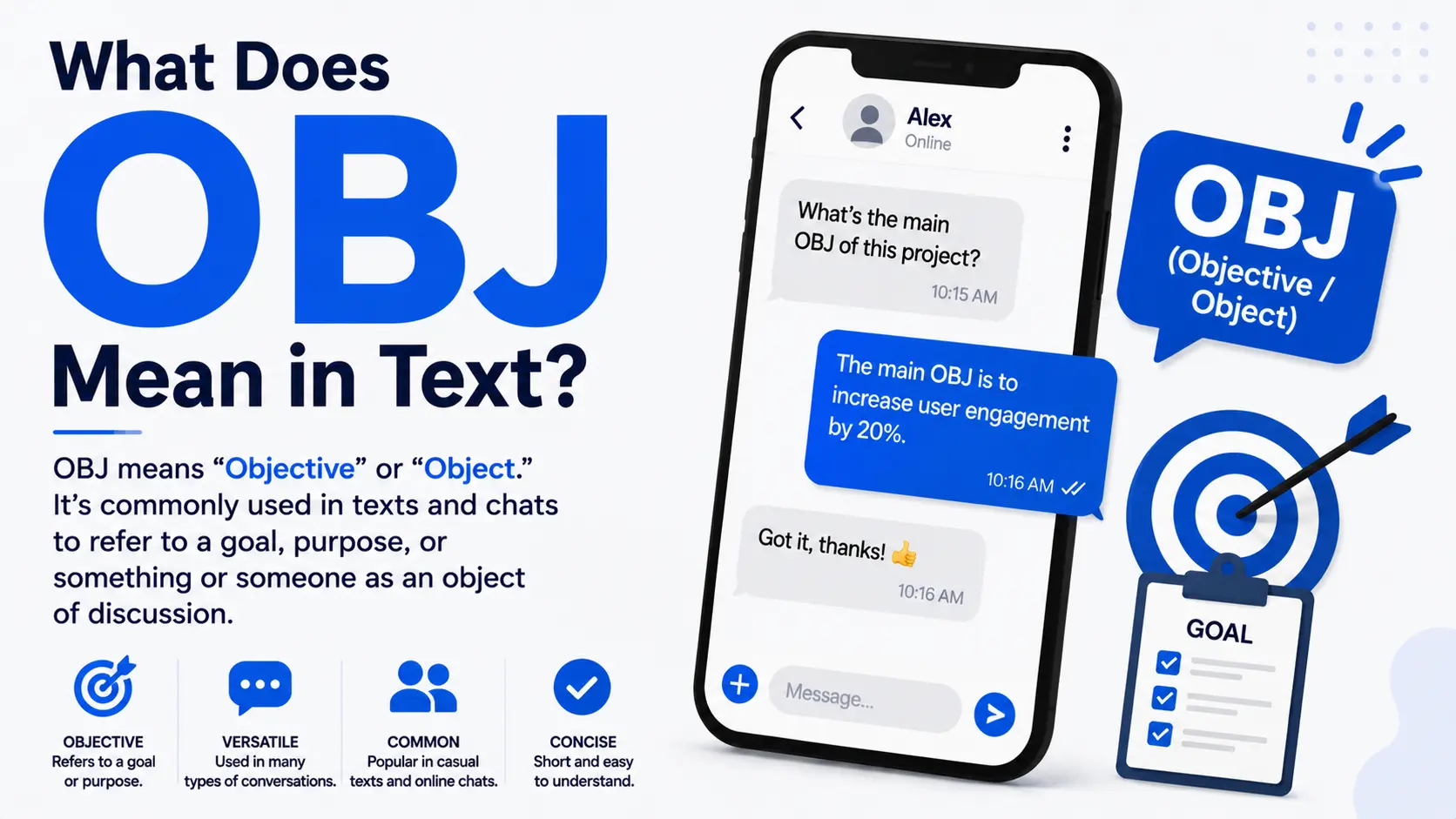
In most texting and social media contexts, OBJ means a placeholder for an unsupported character or emoji.
When your phone or app cannot display a symbol, emoji, or special character, it may replace it with “OBJ” or a similar placeholder.
Simple explanation:
- OBJ = Object placeholder
- It shows something is missing or not supported
- It is not intentional slang in most cases
Example interpretations:
- “I saw OBJ in your message” → A missing emoji or symbol appeared
- “Why does it show OBJ?” → Your device cannot display that character
- “Heart OBJ appeared” → The heart emoji failed to load
In short, OBJ is not usually a word people type intentionally. It is something that appears automatically.
Origin & Background of OBJ in Text
The term “OBJ” comes from computing and digital encoding systems.
When a device cannot recognize a character, it replaces it with a fallback symbol. In many systems, this is linked to “object replacement character,” which is technically used in Unicode processing.
Over time, mobile apps and messaging platforms simplified this failure display into something users could see, and “OBJ” became one of the visible placeholders.
Why it appears:
- Unsupported emojis from older devices
- Corrupted message encoding
- Cross-platform compatibility issues (Android vs iPhone)
- App glitches or outdated software
Social media influence:
As messaging apps like WhatsApp, Instagram, Snapchat, and TikTok became global, users from different devices started seeing “OBJ” more often. Naturally, people began wondering if it was slang, which led to its viral curiosity.
Real-Life Conversations (MANDATORY SECTION)
Here is how “OBJ” appears in real chats and why people get confused.
Conversation 1: WhatsApp Chat
Person A:
I sent you a message with ❤️ but it shows OBJ on your phone
Person B:
Oh wait, I only see OBJ there, no heart emoji
Person A:
Maybe your phone needs an update
Conversation 2: Instagram DM
Person A:
Why did your caption have OBJ in it?
Person B:
I think Instagram replaced my emoji, it was supposed to be a fire symbol
Person A:
Yeah I saw OBJ instead, thought it was some new slang
Conversation 3: TikTok Comment Section
User 1:
What does OBJ mean in this comment?
User 2:
It is not a word, it is just a missing emoji showing as OBJ
User 3:
Ohhh I thought it was a code or something
Conversation 4: Text Message Error
Friend A:
Your message says “I am so happy OBJ”
Friend B:
That was supposed to be a laughing emoji 😂
Friend A:
Now it just looks confusing
These examples show how easily technical glitches can be mistaken for slang in everyday communication.
Emotional & Psychological Meaning
Although “OBJ” is not an emotional word itself, the reaction people have to it is very interesting.
When someone sees “OBJ” in a message, they often feel:
- Confusion
- Curiosity
- Slight frustration
- Humor when they realize it is a glitch
Why people react strongly:
Modern texting relies heavily on emojis to express emotion. When an emoji disappears and turns into “OBJ,” the emotional tone of the message gets lost.
For example:
- A heart emoji becomes “OBJ” → affection feels missing
- A laughing emoji becomes “OBJ” → humor disappears
- A sad emoji becomes “OBJ” → emotional tone feels unclear
Real-life scenario:
Imagine someone sends you “I miss you ❤️” but it shows “I miss you OBJ.” The emotional meaning weakens instantly, even though the sender intended warmth.
This shows how digital communication depends not only on words but also on symbols.
Usage in Different Contexts
1. Social Media
- Appears in comments or captions when emojis fail
- Common on Instagram, TikTok, and Snapchat
2. Friends & Relationships
- Can cause confusion in personal chats
- Often leads to follow-up explanations like “that was an emoji”
3. Work / Professional Settings
- Rare but may appear in marketing posts or automated systems
- Usually fixed quickly to avoid confusion
4. Casual vs Serious Tone
- Casual chats: often ignored or laughed about
- Serious messages: can cause misunderstanding or misinterpretation
When NOT to Use It
You should not use “OBJ” intentionally in communication because:
- It is not real slang or a meaningful word
- It can confuse the receiver
- It looks like a system error, not expression
- It may reduce clarity in emotional messages
Avoid it in:
- Professional emails
- Important announcements
- Emotional conversations
- Academic or formal writing
Instead, always ensure your emojis and symbols display correctly.
Common Misunderstandings
Many people misinterpret “OBJ” in different ways:
1. Thinking it is slang
Some believe OBJ means a coded word or Gen Z slang. It is not.
2. Thinking it is a person or name
Others confuse it with “OBJ” the nickname of NFL player Odell Beckham Jr.
3. Thinking it is intentional
Most users assume the sender typed it, but it is usually automatic.
4. Thinking it has hidden meaning
There is no secret meaning behind OBJ in texting. It is purely technical.
Comparison Table
| Term | Meaning | Usage | Clarity |
|---|---|---|---|
| OBJ | Missing emoji or object placeholder | Appears automatically | Low clarity |
| Emoji | Visual emotion symbol | Manually used | High clarity |
| LOL | Laugh out loud | Text slang | Medium clarity |
| [ ] or ? | Missing character indicator | System fallback | Low clarity |
| Text slang (e.g., BRB) | Acronyms in chat | Intentional use | High clarity |
Key Insight:
“OBJ” is not part of slang culture. It is a technical fallback, unlike intentional abbreviations like LOL or BRB, which carry meaning.
Variations / Types of OBJ Appearance
Here are common ways OBJ shows up in digital communication:
- Single OBJ
- One missing emoji or character
- Multiple OBJ
- Several unsupported symbols in one message
- OBJ in middle of sentence
- Breaks readability of text
- OBJ at the end of sentence
- Often replaces emoji sentiment
- Broken emoji OBJ
- Emoji not supported on older devices
- App-generated OBJ
- Messaging platform compatibility issue
- System encoding OBJ
- Data formatting error
- Cross-device OBJ
- Android to iPhone message issue
- Font-based OBJ
- Missing font support
- Update-related OBJ
- Outdated software problem
How to Respond When Someone Uses It
Casual replies:
- “I think that was supposed to be an emoji 😄”
- “Your OBJ is showing again lol”
- “Update your phone, it is acting up”
Funny replies:
- “That OBJ looks mysterious 😂”
- “New emoji unlocked: OBJ”
- “Is OBJ the new Gen Z language?”
Mature replies:
- “It seems like the emoji did not load properly”
- “I can resend it with correct symbols”
Respectful replies:
- “I think your device is not displaying it correctly”
- “Let me re-send the message clearly”
Regional & Cultural Usage
Western culture:
Mostly understood as a technical glitch, not slang.
Asian culture:
Younger users often think it is new internet slang before learning the technical meaning.
Middle Eastern culture:
Common confusion in WhatsApp chats due to mixed device usage.
Global internet usage:
Widely recognized as a placeholder error in messaging systems.
Generational differences:
- Gen Z: initially thinks it is slang, then learns technical meaning
- Millennials: more likely to recognize it as a system issue
Is It Safe for Kids?
Yes, “OBJ” is completely safe for kids.
It is not a word with harmful meaning. It is simply a technical placeholder that appears when emojis or symbols do not load correctly.
Parents may notice it in messages, but it does not carry any negative or inappropriate content.
FAQs
1. What does OBJ mean in text messages?
It usually means a missing or unsupported emoji or symbol.
2. Is OBJ slang?
No, it is not slang. It is a technical placeholder.
3. Why do I see OBJ instead of emojis?
Your device or app may not support that emoji or character.
4. Does OBJ have a hidden meaning?
No, it does not have any secret meaning.
5. Can I remove OBJ from messages?
Yes, by updating your app or device or resending emojis.
6. Is OBJ related to social media slang?
No, it is not part of internet slang culture.
7. Is OBJ the same as an emoji?
No, it appears when an emoji fails to display.
Conclusion
Understanding what “OBJ” means in text helps you avoid confusion in everyday digital conversations. While it may look like slang at first, it is actually a simple technical placeholder used when emojis or symbols cannot be displayed properly.
In a world where communication relies heavily on visual emotion, even a small glitch like “OBJ” can change the tone of a message. That is why knowing its real meaning helps you stay confident and clear in your chats.
Next time you see OBJ in a message, you will know it is not a secret code or new slang. It is just your device saying, “Something did not load correctly.