
If you have received a message saying “KMSL” and had no idea what it meant, you are not alone. Text messaging slang changes quickly, and many abbreviations can be confusing when you first encounter them.
People often search for “kmsl mean in text message” because they see it in WhatsApp chats, TikTok comments, Instagram DMs, Snapchat conversations, or online gaming communities. At first glance, it can look strange or even concerning, especially if you are unfamiliar with internet slang.
The good news is that in most situations, KMSL is simply a humorous expression people use when something is extremely funny. Understanding its meaning helps you interpret conversations correctly and respond naturally.
In this guide, you’ll learn exactly what KMSL means, where it came from, how people use it today, and when it may be best to avoid using it.
KMSL – Quick Meaning
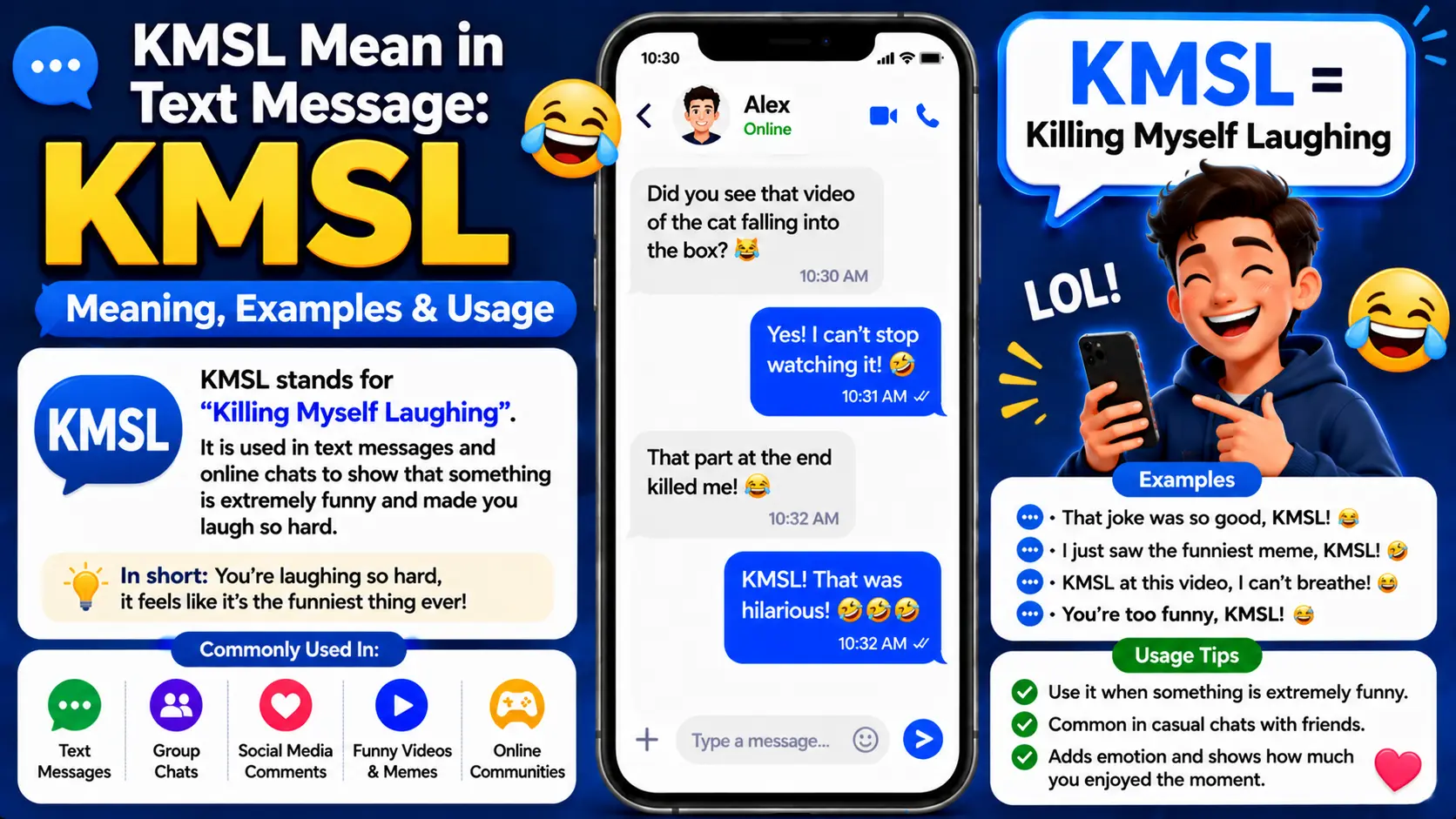
KMSL stands for:
“Killing Myself Laughing”
It is used to express intense laughter or amusement, similar to saying:
- That’s hilarious!
- I’m laughing so hard.
- That made me crack up.
- I can’t stop laughing.
People typically use it when something feels funnier than a simple “LOL.”
Quick Examples
“That video was so funny, KMSL 😂”
“You really fell into the pool? KMSL!”
“I just read your message and I’m KMSL right now.”
In modern texting, KMSL is usually not intended literally. It functions as an exaggerated expression of laughter.
Origin & Background
Like many internet abbreviations, KMSL emerged from online chat culture.
Before social media became dominant, people communicated through forums, instant messaging platforms, and chat rooms. To type faster, users created shortened expressions for common reactions.
As internet culture evolved, abbreviations such as:
- LOL (Laughing Out Loud)
- LMAO (Laughing My Ass Off)
- ROFL (Rolling On the Floor Laughing)
became widespread.
KMSL developed as another way to express stronger laughter than a simple LOL. The phrase gained popularity through texting culture and later spread across social media platforms.
The rise of platforms such as Instagram, TikTok, Snapchat, and online gaming communities helped slang terms travel globally. Today, KMSL is recognized in many English-speaking online spaces.
Over time, its meaning shifted from a dramatic phrase into a casual expression of amusement. Most users now view it as internet humor rather than a literal statement.
Real-Life Conversations
WhatsApp Conversation
Person A: Did you see Uncle Ahmed trying to dance at the wedding?
Person B: Yes! He almost slipped.
Person A: Someone recorded it.
Person B: Send it now, I’m KMSL already 😂
Instagram DM
Person A: Why did your cat steal your sandwich?
Person B: Because apparently it belongs to him now.
Person A: KMSL 😂 that’s the most cat thing ever.
TikTok Comments
Person A: I tried to impress my crush and walked into a glass door.
Person B: KMSL, that’s something I would do too.
Text Message
Person A: I set five alarms and still woke up late.
Person B: KMSL. At that point, the alarms gave up on you.
Emotional & Psychological Meaning
KMSL does more than show laughter.
It communicates emotional connection.
When someone uses KMSL, they are often trying to tell another person:
- I find this genuinely funny.
- I’m enjoying this conversation.
- I feel connected to your humor.
- Your story entertained me.
Digital communication lacks facial expressions and body language. Slang helps fill that gap.
Instead of typing a long explanation, people use abbreviations like KMSL to instantly communicate a strong emotional reaction.
A Real-Life Style Scenario
Imagine a friend sends you an embarrassing story about accidentally waving back at someone who was greeting another person.
You immediately laugh because you’ve experienced something similar.
Rather than writing a full paragraph explaining your reaction, you simply reply:
“KMSL 😂😂”
Your friend instantly understands that you found the story hilarious and relatable.
This efficiency is one reason internet slang remains so popular.
Usage in Different Contexts
Social Media
KMSL frequently appears in:
- TikTok comments
- Instagram comments
- Facebook posts
- Snapchat messages
- Meme pages
People use it when reacting to humorous content.
Friends and Relationships
Among friends, KMSL is common because it creates a relaxed and playful atmosphere.
Example:
“You wore mismatched shoes all day? KMSL 😂”
It often strengthens social bonding through shared humor.
Work and Professional Settings
Using KMSL in professional communication is generally not recommended.
Business emails, client messages, and formal workplace conversations usually require clearer and more professional language.
Instead of KMSL, you might write:
“That’s very funny.”
or
“That made me laugh.”
Casual vs Serious Tone
KMSL works best in casual conversations.
In serious discussions involving grief, conflict, health concerns, or important life events, it can appear insensitive or inappropriate.
Understanding context is essential.
When NOT to Use It
Although KMSL is common online, there are situations where it may create problems.
During Serious Discussions
Avoid using it when discussing:
- Family emergencies
- Personal struggles
- Emotional conflicts
- Sensitive topics
Professional Communication
It may appear unprofessional in:
- Job applications
- Work emails
- Academic communication
- Client interactions
Around People Who Don’t Know Internet Slang
Some individuals may misunderstand the abbreviation.
They might not recognize that it refers to laughter.
Cross-Cultural Situations
Internet slang does not always translate well between cultures and age groups.
A phrase that seems harmless to one person may confuse another.
Common Misunderstandings
Several misconceptions surround KMSL.
Mistaking It for a Literal Statement
Most users do not mean it literally.
It is generally used as exaggerated internet humor.
Assuming Everyone Knows It
KMSL is less universally recognized than LOL.
Some people may need clarification.
Confusing It With Other Acronyms
Because many abbreviations begin with similar letters, users sometimes mistake KMSL for unrelated slang terms.
Tone Misinterpretation
Without emojis or context, some readers may struggle to determine whether the sender is joking or serious.
Comparison Table
| Expression | Meaning | Strength of Laughter | Common Usage |
|---|---|---|---|
| LOL | Laughing Out Loud | Low | Everyday texting |
| LMAO | Laughing Very Hard | Medium | Casual conversations |
| ROFL | Rolling On the Floor Laughing | High | Internet humor |
| KMSL | Killing Myself Laughing | High | Social media and texting |
| 😂 | Laughing Emoji | Varies | Universal online use |
| SMH | Shaking My Head | Opposite reaction | Disappointment or disbelief |
Key Insight
KMSL belongs to the family of laughter-based internet slang. It usually signals stronger amusement than LOL but functions similarly by expressing an emotional reaction to something funny.
Variations / Types
Here are some related expressions often seen online:
1. LOL
Laughing Out Loud.
2. LMAO
Expresses stronger laughter than LOL.
3. LMFAO
An intensified version of LMAO.
4. ROFL
Suggests uncontrollable laughter.
5. ROFLMAO
Combines ROFL and LMAO for extra emphasis.
6. XD
Represents a laughing facial expression.
7. 😂
The most common laughter emoji.
8. 💀
Often means “I’m dead from laughing.”
9. I’m Crying
Indicates something is extremely funny.
10. Dead
Used to show overwhelming amusement.
How to Respond When Someone Uses It
Casual Replies
- “I know, right? 😂”
- “Glad you found it funny.”
- “That made my day too.”
Funny Replies
- “Please survive.”
- “I’ll send backup laughter.”
- “You’re laughing harder than I expected.”
Mature Replies
- “Happy that made you smile.”
- “I was hoping you’d enjoy that.”
- “Glad it brightened your day.”
Respectful Replies
- “Thank you, I appreciate that.”
- “I’m happy you liked it.”
- “Glad you enjoyed the story.”
Regional & Cultural Usage
Western Culture
KMSL is often used casually among younger internet users. It is generally interpreted as an exaggerated expression of laughter.
Asian Culture
Many young social media users understand KMSL due to exposure to global internet trends. However, local slang often remains more common.
Middle Eastern Culture
Among English-speaking online communities, KMSL may appear in texting and social media conversations, though regional expressions are often preferred in everyday communication.
Global Internet Usage
The internet has created a shared digital language. KMSL can now be found in conversations between users from many different countries.
Generational Differences
Gen Z
Gen Z users tend to understand internet slang quickly and often combine KMSL with emojis, memes, and other abbreviations.
Millennials
Many Millennials recognize KMSL, although they may use LOL, LMAO, or emojis more frequently.
Older generations are generally less familiar with the term.
Is It Safe for Kids?
In most cases, KMSL is used as a harmless expression of laughter.
However, parents and educators should encourage children to understand context when using internet slang.
Because the phrase contains dramatic wording, younger users should learn that not everyone interprets abbreviations the same way.
Teaching digital communication awareness helps prevent misunderstandings.
FAQs
What does KMSL mean in text messages?
KMSL usually means “Killing Myself Laughing,” an expression used to show intense amusement.
Is KMSL the same as LOL?
Not exactly. Both express laughter, but KMSL generally indicates a stronger reaction.
Is KMSL rude?
No. It is typically friendly and humorous, though context matters.
Can I use KMSL at work?
It is best avoided in professional communication because not everyone understands internet slang.
Is KMSL popular on TikTok?
Yes. It often appears in comments, captions, and direct messages when users react to funny content.
Do younger people use KMSL more often?
Generally yes. Younger internet users tend to adopt and understand slang more quickly.
Should I use emojis with KMSL?
Many people do. Emojis such as 😂 or 💀 often help clarify that the message is meant humorously.
Conclusion
Understanding KMSL meaning in text message conversations can make online communication much easier. The abbreviation stands for “Killing Myself Laughing“ and is commonly used to express strong amusement in texts, social media comments, and direct messages.
While it is usually lighthearted and harmless, context remains important. KMSL works best in casual conversations with friends, family members, and online communities that understand internet slang. In professional or sensitive situations, clearer language is often the better choice.
As digital communication continues to evolve, expressions like KMSL show how people use creativity, humor, and brevity to connect with one another. Once you know the meaning, you’ll be able to recognize it instantly and use it confidently whenever a conversation becomes genuinely funny.