
If you have recently received a message containing “FTF” and found yourself wondering what it means, you’re not alone. Texting abbreviations continue to evolve, and many people encounter unfamiliar acronyms in conversations, social media comments, or online communities.
The meaning of FTF can vary depending on the context, which is exactly why it creates confusion. In one conversation, it may refer to meeting someone in person. In another, it could have a completely different interpretation based on the platform or community using it.
Understanding what FTF means in text helps prevent misunderstandings and allows you to communicate more confidently in today’s fast-paced digital world. Whether you saw it on WhatsApp, Instagram, TikTok, or in a text message, this guide explains everything you need to know.
FTF Meaning in Text – Quick Meaning
The most common meaning of FTF in text is:
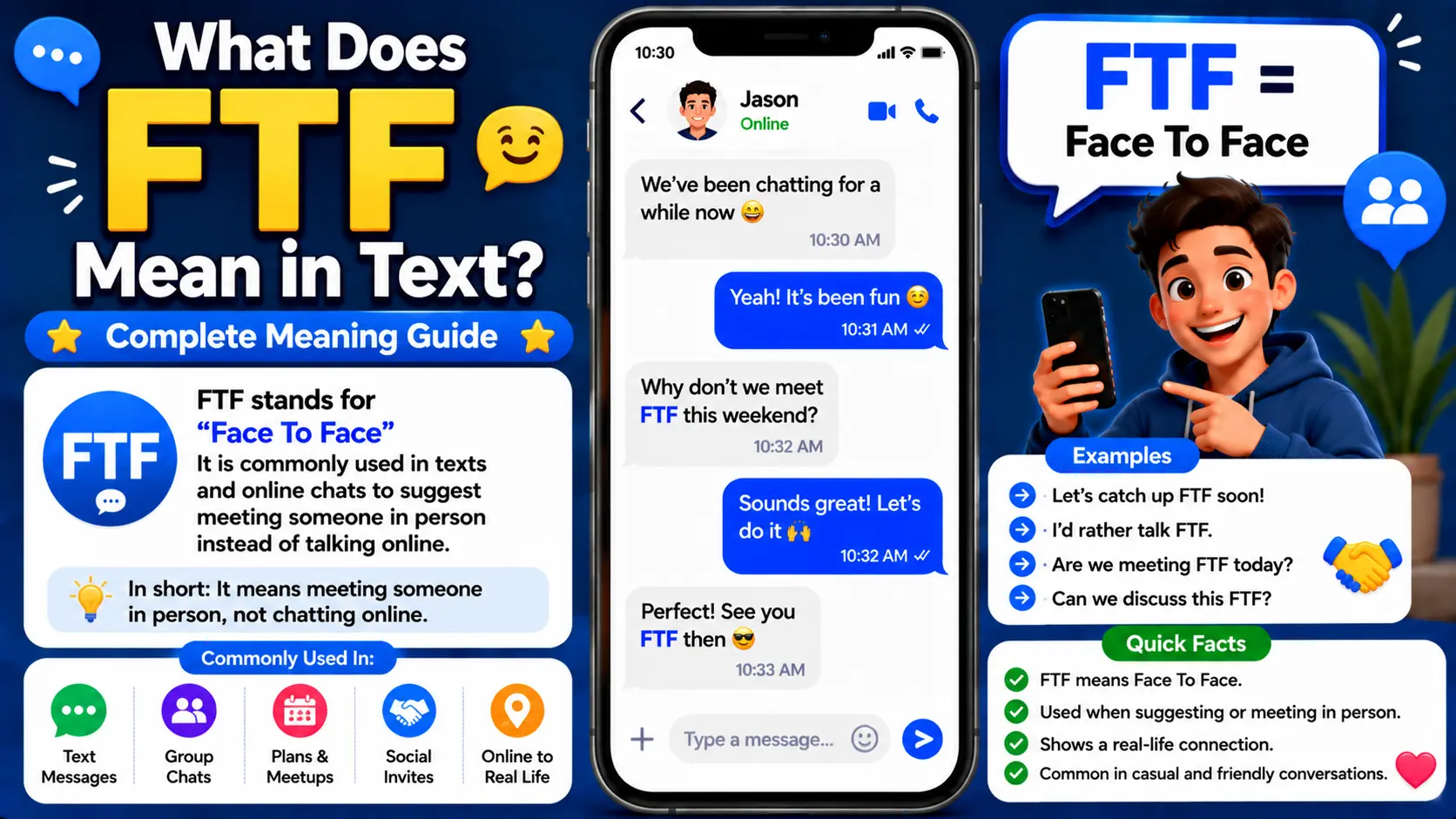
Face to Face
People use it when talking about meeting someone in person rather than communicating online, through text, or over a phone call.
Quick Definition
- FTF = Face to Face
- Refers to an in-person meeting
- Often used in texting, business communication, and social media
- Emphasizes direct human interaction
Examples
“We should discuss this FTF tomorrow.”
“I’d rather talk FTF than argue through messages.”
“Can we meet FTF after work?”
In all these examples, FTF simply means meeting and talking in person.
Origin & Background
FTF emerged during the rise of internet communication in the late 1990s and early 2000s. As online chats, forums, and instant messaging became popular, people needed quick ways to distinguish between digital communication and real-world interaction.
The phrase “face to face” already existed long before the internet. However, shortening it to FTF made typing faster, especially when character limits and slower keyboards were common.
Cultural Influence
As society became increasingly connected through technology, people began valuing the distinction between online and offline interactions.
FTF became a useful shorthand because it highlighted something many people still consider important: genuine human connection.
Social Media Impact
Platforms like Instagram, Snapchat, TikTok, and WhatsApp accelerated the use of abbreviations. Users wanted quick, efficient communication, and acronyms like FTF fit naturally into that environment.
Evolution of Meaning
While FTF still primarily means “Face to Face,” some niche communities may use alternative meanings. However, in everyday texting and social media conversations, “Face to Face” remains the dominant interpretation.
Real-Life Conversations
WhatsApp Conversation
Person A: Are we still talking about the project tonight?
Person B: Yeah, but let’s do it FTF tomorrow. It’ll be easier.
Person A: Sounds good.
Instagram DM
Person A: We’ve been chatting for months.
Person B: I know! Maybe we should finally meet FTF.
Person A: I’d love that.
TikTok Comments
Person A: Social media friendships are cool.
Person B: True, but nothing beats an FTF conversation.
Person A: Totally agree.
Text Message
Person A: Something important came up.
Person B: Is everything okay?
Person A: Yeah, but I’d rather explain FTF.
Person B: Sure, let’s meet later.
Emotional & Psychological Meaning
Although FTF is a simple abbreviation, it often carries emotional significance.
When someone suggests talking face to face, they usually want a more authentic conversation. Text messages can sometimes hide emotions, create misunderstandings, or feel impersonal.
Why People Use It
People often use FTF when they:
- Want clarity
- Need emotional connection
- Prefer direct communication
- Want to avoid misunderstandings
- Need to discuss sensitive topics
What It Reveals About Modern Communication
The popularity of FTF highlights an interesting reality: despite living in a digital world, many people still value personal interaction.
Technology makes communication easier, but face-to-face conversations often provide emotional cues, body language, and genuine connection that texting cannot fully replace.
Personal-Style Scenario
Imagine having a disagreement with a close friend through text. Messages become shorter, misunderstandings increase, and emotions start building. Eventually, one person says, “Let’s talk FTF.”
That suggestion often signals a desire to repair the relationship rather than continue the conflict online.
Usage in Different Contexts
Social Media
On social media, FTF often refers to meeting online friends in person.
Example:
“After following each other for years, we finally met FTF.”
Friends & Relationships
Among friends and romantic partners, FTF usually indicates a more meaningful conversation.
Example:
“We need an FTF conversation about our future plans.”
Work & Professional Settings
In workplaces, FTF is commonly used to distinguish in-person meetings from virtual meetings.
Example:
“The manager requested an FTF meeting next Monday.”
Casual vs Serious Tone
Casual Usage
- Meeting friends
- Social gatherings
- Everyday plans
Serious Usage
- Relationship discussions
- Important decisions
- Workplace negotiations
- Conflict resolution
The seriousness depends on the conversation rather than the acronym itself.
When NOT to Use It
While FTF is widely understood, there are situations where using it may not be appropriate.
Formal Business Documents
Avoid using abbreviations in official reports, contracts, or legal documents.
Conversations with Unfamiliar Audiences
Some people may not know what FTF means, especially if they are less familiar with internet slang.
Cross-Cultural Communication
International audiences may interpret abbreviations differently. Writing “face to face” may provide greater clarity.
Sensitive Situations
When discussing highly emotional matters, clarity is often more important than brevity.
Common Misunderstandings
Assuming Everyone Knows It
Not everyone recognizes texting abbreviations. Using FTF without explanation can confuse some readers.
Thinking It Is Always Romantic
Some people mistakenly believe FTF implies dating or romantic interest. In reality, it simply means meeting in person.
Tone Confusion
An FTF request can sound serious even when it is not.
Example:
“We need to talk FTF.”
This may create anxiety, even if the topic is something positive.
Literal vs Figurative Meaning
Most of the time, FTF literally means meeting face to face. However, some communities may use it more loosely to emphasize direct communication.
Comparison Table
| Expression | Meaning | Similarity to FTF |
|---|---|---|
| FTF | Face to Face | Direct in-person interaction |
| IRL | In Real Life | Similar but broader |
| DM | Direct Message | Online communication |
| VC | Voice Chat | Audio interaction |
| Video Call | Online face interaction | Partial substitute |
| Texting | Written communication | Opposite communication style |
| Online Only | Digital interaction | Contrasts with FTF |
| In Person | Face-to-face meeting | Nearly identical |
Key Insight
FTF is unique because it emphasizes personal presence. While many modern communication methods connect people digitally, FTF specifically highlights real-world interaction and human connection.
Variations and Related Types
1. Face-to-Face Meeting
An in-person discussion between individuals.
2. FTF Interview
A job interview conducted in person.
3. FTF Conversation
Direct personal communication.
4. FTF Discussion
A meeting focused on exchanging ideas.
5. FTF Appointment
An in-person scheduled meeting.
6. FTF Consultation
Professional advice provided in person.
7. FTF Training
Training delivered physically rather than online.
8. FTF Networking
Building relationships through personal interaction.
9. FTF Presentation
Presenting information before a live audience.
10. FTF Resolution
Solving problems through direct communication.
How to Respond When Someone Uses FTF
Casual Replies
- “Sure, let’s meet up.”
- “Sounds good to me.”
- “When are you free?”
Funny Replies
- “FTF? So we’re leaving the comfort of texting?”
- “Wow, real human interaction?”
- “Guess I’ll have to wear actual clothes.”
Mature Replies
- “I think that’s a good idea.”
- “An in-person conversation would help.”
- “Let’s schedule a time that works for both of us.”
Respectful Replies
- “I’d be happy to discuss it face to face.”
- “Thank you, that sounds appropriate.”
- “Let me know a convenient time.”
Regional & Cultural Usage
Western Culture
In North America and Europe, FTF is commonly understood as face-to-face communication and often appears in professional and personal messaging.
Asian Culture
Many Asian countries place strong value on direct personal relationships. FTF interactions are often associated with trust, respect, and relationship building.
Middle Eastern Culture
Face-to-face communication frequently carries significant importance because personal relationships and trust are highly valued in many social and business settings.
Global Internet Usage
Across the internet, FTF remains one of the most recognized abbreviations for in-person interaction.
Generational Differences
Gen Z
- Uses many abbreviations naturally
- Comfortable switching between online and offline communication
- Often uses FTF casually
Millennials
- Familiar with internet acronyms
- Frequently use FTF in work and personal contexts
- Often view face-to-face communication as important for meaningful discussions
Is It Safe for Kids?
Yes, FTF is generally safe for kids because it usually means “Face to Face.”
However, context matters. Parents should encourage children and teenagers to be cautious when discussing in-person meetings with people they only know online.
Teaching safe internet habits remains important regardless of the abbreviation being used.
Frequently Asked Questions
What does FTF mean in texting?
FTF most commonly means “Face to Face,” referring to an in-person meeting or conversation.
Is FTF positive or negative?
Neither. Its tone depends entirely on the context of the conversation.
Does FTF mean meeting in person?
Yes. In most cases, FTF specifically means meeting someone face to face.
Is FTF used on social media?
Yes. It is commonly used on Instagram, TikTok, WhatsApp, Snapchat, and text messaging platforms.
What is the difference between FTF and IRL?
FTF specifically refers to face-to-face interaction, while IRL (In Real Life) has a broader meaning related to offline reality.
Can FTF be used professionally?
Yes. Many workplaces use FTF to refer to in-person meetings or discussions.
Why do people prefer FTF conversations?
Face-to-face communication often provides better clarity, stronger emotional connection, and fewer misunderstandings.
Conclusion
Understanding what FTF means in text is relatively simple once you know the context. In most situations, FTF stands for Face to Face, indicating an in-person conversation or meeting rather than communication through messages or calls.
Its continued popularity reflects something important about modern life. Even with endless digital communication options, people still value genuine human interaction. Whether discussing friendships, relationships, work matters, or important decisions, FTF often signals a desire for clarity, trust, and authentic connection.
The next time someone says, “Let’s talk FTF,” you’ll know exactly what they mean and how to respond with confidence.