
If you’ve ever come across “ope” in a text message, social media comment, or casual conversation, you may have wondered what it actually means. Unlike many internet abbreviations, ope is not an acronym. Instead, it’s a short, spontaneous expression people use when they make a small mistake, bump into someone, or react to an unexpected moment.
The popularity of online conversations has brought many everyday spoken expressions into written messages. As a result, words like ope now appear on platforms such as TikTok, Instagram, Snapchat, Facebook, X, and even in work chats between close colleagues.
Many people search for “ope mean in text” because they see it in conversations without understanding the emotion behind it. Is it an apology? A surprise? A joke? The answer depends on the situation, and that’s exactly what this guide explains.
By the end of this article, you’ll understand what ope means, where it came from, how people use it naturally, and when it fits into everyday conversations.
OPE Mean in Text – Quick Meaning
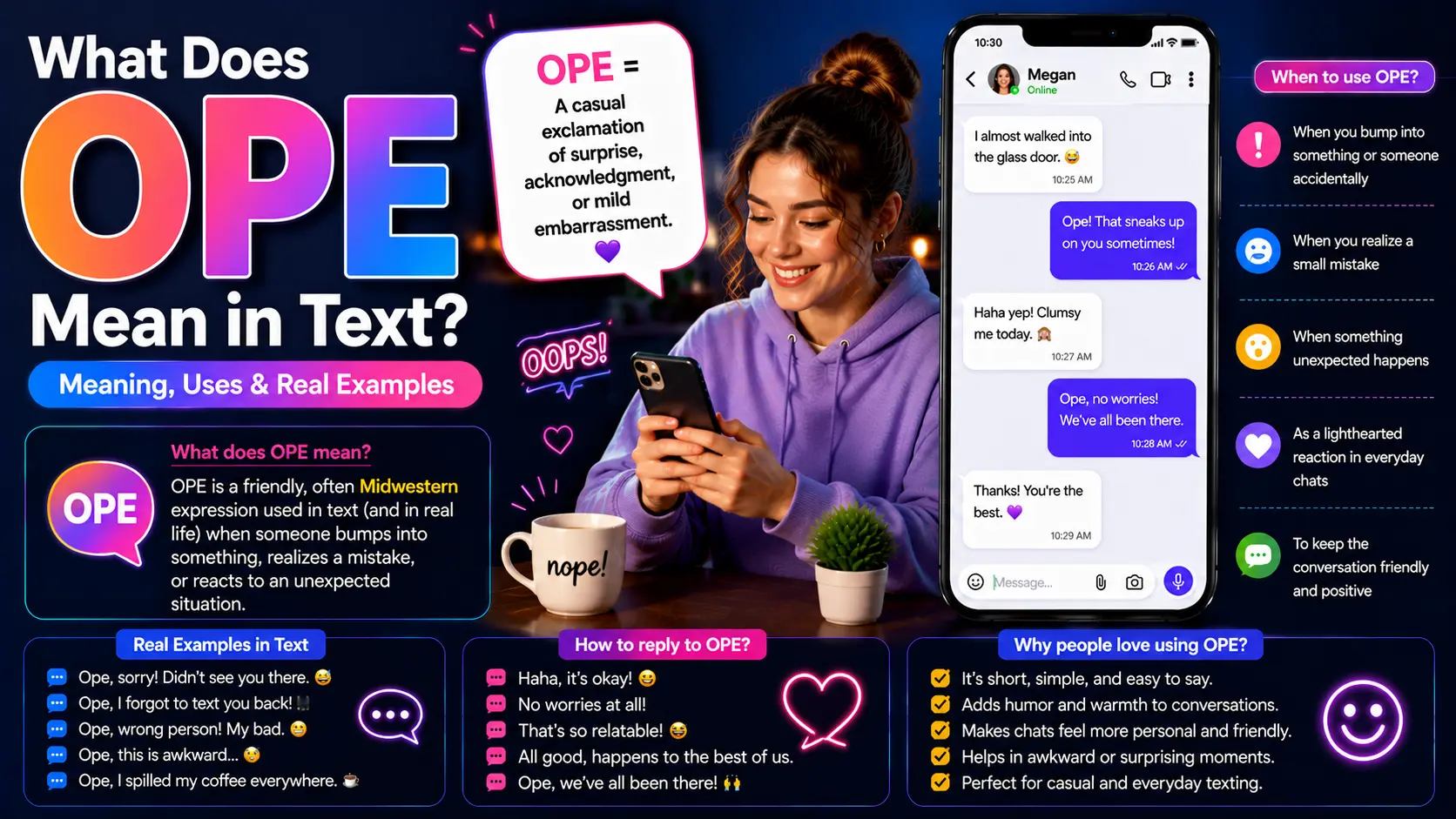
In texting, ope is a brief expression of surprise, embarrassment, or a minor accident. It usually appears when something unexpected happens or when someone realizes they made a small mistake.
Rather than carrying a specific dictionary definition, ope reflects a quick emotional reaction.
Quick Definition
OPE means:
- A small expression of surprise.
- A gentle way to acknowledge a mistake.
- A lighthearted reaction to an unexpected situation.
- A friendly substitute for expressions like “Oops!” or “Oh!”
People often type it because it feels casual, genuine, and conversational.
Simple Examples
“Ope, I sent that to the wrong group.”
“Ope! Didn’t see you there.”
“Ope… forgot my wallet again.”
In each example, ope softens the situation and makes the speaker sound approachable rather than overly serious.
Origin & Background
Unlike many internet expressions that began online, ope has existed in spoken English for decades. It became especially associated with the American Midwest, where people often say it instinctively after a tiny accident or awkward moment.
Imagine reaching for the same grocery item as someone else.
Instead of saying a full apology, many people naturally respond with:
“Ope, sorry!”
That tiny reaction became part of everyday speech across several Midwestern communities. Over time, internet users started writing it exactly as they heard it spoken.
Cultural Influence
The rise of memes introduced ope to people outside the Midwest.
Online jokes often describe Midwestern manners as extremely polite, and ope became one of the most recognizable examples of that stereotype.
Soon, creators on TikTok, Reddit, Instagram, and X began using it in captions and comments because readers instantly understood the awkward yet friendly feeling behind it.
Social Media Impact
Today, ope is no longer limited to one region.
People use it to express:
- Small mistakes
- Funny accidents
- Embarrassing moments
- Unexpected discoveries
- Playful apologies
Instead of sounding dramatic, it keeps conversations relaxed and relatable.
How the Meaning Has Evolved
Originally, ope was mostly spoken.
Now it appears in:
- Text messages
- TikTok captions
- Instagram comments
- Snapchat chats
- Discord servers
- Gaming communities
- Meme pages
Its meaning has remained remarkably consistent.
Whether spoken or typed, it still communicates a quick emotional reaction without needing a full sentence.
Real-Life Conversations
Seeing ope in realistic conversations makes its meaning much easier to understand.
WhatsApp Conversation
Person A: I accidentally deleted our vacation photos.
Person B: Ope… did you check the recycle folder?
Person A: Wait, they’re still there!
Person B: Crisis officially avoided.
Instagram DMs
Person A: Just liked your photo from three years ago.
Person B: Ope 😂
Person A: Pretend that never happened.
Person B: Too late. I’m telling everyone.
TikTok Comments
Person A: I watched this recipe five times and still burned dinner.
Person B: Ope, that’s exactly what happened to me yesterday.
Person A: Glad I’m not alone.
Text Messages
Person A: I thought today was Friday.
Person B: Ope… it’s only Wednesday.
Person A: That somehow made my day worse.
Person B: At least the weekend is getting closer.
These examples show that ope usually adds warmth, humor, or self-awareness rather than criticism.
Emotional & Psychological Meaning
Although ope is only three letters long, it communicates much more than surprise.
It often signals humility.
Instead of pretending nothing happened, the speaker openly acknowledges a small mistake in a relaxed way.
That honesty helps conversations feel more comfortable.
People also use ope because it reduces social tension.
Imagine accidentally interrupting someone during a meeting with friends.
Rather than making a formal apology, saying:
“Ope, sorry, go ahead.”
immediately softens the interruption.
The other person usually recognizes that the mistake wasn’t intentional.
Why People Use It
People naturally choose ope because it:
- Sounds friendly.
- Reduces awkwardness.
- Makes mistakes feel less serious.
- Creates a casual atmosphere.
- Shows self-awareness without overexplaining.
In many conversations, these tiny emotional signals help build stronger connections.
What It Reveals About Modern Communication
Digital conversations move quickly.
Instead of typing long explanations, people often rely on short emotional expressions that instantly communicate tone.
Words like ope, oops, whoops, and oh make text messages feel closer to face-to-face conversations.
They help readers imagine the speaker’s voice, making written communication feel more natural.
A Personal-Style Scenario
Imagine you’re chatting with a close friend while rushing to catch a train.
You send them a screenshot that was meant for someone else.
For a second, you feel embarrassed.
Instead of writing a long explanation, you simply type:
“Ope 😂 Wrong chat!”
Your friend laughs, and the conversation moves on.
That tiny expression turns what could have been an awkward moment into a shared joke.
Usage in Different Contexts
The meaning of ope changes slightly depending on where it’s used, but its friendly tone remains the same.
Social Media
On platforms like TikTok, Instagram, and X, ope often appears in captions, replies, and comments.
Examples include:
- “Ope… didn’t expect this video to go viral.”
- “Ope, I watched the whole series in one night.”
- “Ope, that’s painfully relatable.”
Here, it expresses surprise or playful self-awareness.
Friends and Relationships
Among friends, ope feels relaxed and conversational.
Examples:
- “Ope, forgot your birthday was today.”
- “Ope… you caught me checking your profile.”
- “Ope, I almost spoiled the ending.”
It helps soften mistakes while keeping the mood light.
In close relationships, it often reflects honesty rather than embarrassment.
Work and Professional Settings
Although ope is common in casual communication, it should be used carefully at work.
It may fit in informal chats between coworkers who already know each other well.
For example:
“Ope, attached the wrong file. Here’s the correct one.”
The expression acknowledges the mistake without making the message overly dramatic.
However, in formal emails, client communication, reports, or professional announcements, it’s better to choose more polished language such as:
- “My apologies.”
- “I attached the incorrect document.”
- “Thank you for your patience.”
Professional communication usually benefits from clarity and formality rather than conversational slang.
Casual vs. Serious Tone
One reason ope has remained popular is its ability to make everyday conversations feel more relaxed.
In casual situations, it works naturally because the stakes are low.
Examples include forgetting someone’s coffee order, sending a message to the wrong chat, or accidentally stepping in front of someone at the store.
In serious situations, however, ope can seem too lighthearted.
If you’re discussing an important misunderstanding, expressing sympathy, or addressing a significant mistake, a more direct and sincere response is the better choice.
Understanding the tone of the conversation is the key to using ope appropriately.
When NOT to Use It
Even though ope is friendly and widely recognized in casual conversations, it is not appropriate for every situation. Understanding when to avoid it helps you communicate with clarity and respect.
Formal Business Communication
Avoid using ope in professional emails, official reports, client messages, or job applications.
Instead of:
“Ope, I forgot to attach the document.”
Write:
“I apologize. I forgot to attach the document. Please find it attached now.”
A professional tone creates a stronger impression in formal settings.
Serious Emotional Conversations
If someone is sharing difficult news or expressing grief, ope may sound dismissive.
For example, avoid using it when responding to:
- A family emergency
- The loss of a loved one
- Health-related discussions
- Sensitive personal problems
Empathy is more important than casual humor in these moments.
Cultural Sensitivity
Because ope is strongly associated with informal American English, some international readers may not recognize it.
When speaking with people from different cultural backgrounds, choose language that everyone can understand.
High-Stakes Situations
If a mistake has serious consequences, a simple “ope” is not enough.
A sincere apology and clear explanation are much more appropriate.
Common Misunderstandings
Although ope is simple, people sometimes misunderstand its purpose.
Mistaking It for an Acronym
One of the biggest misconceptions is that OPE stands for a phrase.
In most text conversations, it is not an abbreviation. It is simply a written version of a quick spoken reaction.
Assuming It Always Means “Oops”
While oops and ope are similar, they are not always identical.
Oops usually emphasizes making a mistake.
Ope can express:
- Surprise
- Mild embarrassment
- Accidentally interrupting someone
- Suddenly noticing something
- A polite acknowledgment
Confusing the Tone
Some readers think ope sounds sarcastic.
In reality, it is usually genuine and lighthearted.
The intended tone depends on the surrounding conversation.
Taking It Literally
Because it has no formal dictionary-style meaning, trying to translate ope word for word often causes confusion.
It is better understood as an emotional reaction than as a vocabulary word.
Comparison Table
| Expression | Meaning | Typical Emotion | Common Situation |
|---|---|---|---|
| Ope | Small surprise or acknowledgment | Friendly, awkward | Minor mistakes or unexpected moments |
| Oops | Made a mistake | Embarrassed | Accidents and errors |
| Whoops | Bigger accident or surprise | Playful | Dropping or breaking something |
| Oh | General realization | Neutral | Understanding new information |
| Uh-oh | Something may go wrong | Concern | Recognizing a problem |
| My bad | Taking responsibility | Apologetic | Admitting fault |
| Sorry | Direct apology | Respectful | More serious situations |
Key Insight
The biggest difference is emotional tone. Ope feels spontaneous and gentle. It makes everyday conversations sound warmer and less formal, while expressions like sorry or my bad carry a stronger sense of responsibility.
Variations and Related Expressions
Although ope itself has one core meaning, people often use similar expressions depending on the situation.
1. Ope!
A quick reaction to a surprise or small mistake.
2. Ope, sorry.
A polite way to apologize after accidentally interrupting or bumping into someone.
3. Ope, my bad.
Acknowledges responsibility while keeping the conversation relaxed.
4. Ope… forgot.
Used after suddenly remembering an overlooked task.
5. Ope lol
Adds humor to an awkward or embarrassing situation.
6. Ope 😂
Combines the expression with laughter to show the mistake is harmless.
7. Oops
A close alternative that focuses more directly on making a mistake.
8. Whoops
Usually suggests a slightly bigger accident than ope.
9. Uh-oh
Signals concern that something might be wrong.
10. My bad
A more direct admission of responsibility, especially among friends.
How to Respond When Someone Uses It
The best response depends on the mood of the conversation.
Casual Replies
- “You’re good!”
- “No worries.”
- “It happens.”
- “Don’t worry about it.”
Funny Replies
- “Caught in 4K.”
- “Nice save!”
- “Smooth move!”
- “We’ve all been there.”
Mature Replies
- “Thanks for letting me know.”
- “I appreciate your honesty.”
- “Let’s fix it together.”
- “No problem at all.”
Respectful Replies
- “It’s completely understandable.”
- “Thank you for explaining.”
- “Everything is fine.”
- “Let’s move forward.”
Regional and Cultural Usage
Although ope began as a spoken habit in one part of the United States, it has spread far beyond its original roots.
Western Culture
In North America, especially the Midwest, ope is instantly recognizable.
People often say it without thinking whenever they experience a small moment of surprise or awkwardness.
Asian Culture
Many English-speaking young people in Asian countries recognize ope through TikTok, YouTube, gaming communities, and online memes.
However, it is generally less common in everyday offline conversations.
Middle Eastern Culture
Among English-speaking internet users, ope may appear in online chats, but local expressions are still more common in daily communication.
Its meaning is usually understood through exposure to global social media.
Global Internet Usage
Memes have helped ope become part of internet culture.
Today, users from different countries often recognize it even if they have never heard it spoken in real life.
Gen Z vs. Millennials
Gen Z
- Uses ope more frequently in texts and memes.
- Often pairs it with emojis or reaction GIFs.
- Enjoys its playful and relatable tone.
Millennials
- More likely to recognize ope from spoken conversations.
- Often use it naturally in daily life rather than as an internet trend.
Both generations understand its meaning, but they may use it in slightly different ways.
Is It Safe for Kids?
Yes. Ope is generally considered safe for children and teenagers.
It contains no offensive language, inappropriate meaning, or harmful content.
Even so, children should learn that casual expressions like ope are best suited for conversations with friends and family. In school assignments or formal communication, standard English remains the better choice.
Frequently Asked Questions
What does ope mean in text?
It is a casual expression of surprise, mild embarrassment, or a small mistake. It is often similar to saying “oops.”
Is ope an acronym?
No. In everyday texting, ope is not an abbreviation. It is simply a written version of a spoken reaction.
Why do people say ope?
People use it to acknowledge minor accidents, unexpected moments, or harmless mistakes in a friendly and natural way.
Is ope rude?
No. It is generally considered polite and lighthearted.
Can I use ope in professional emails?
It is better to avoid it in formal workplace communication. Professional language is more appropriate in business settings.
Is ope popular on social media?
Yes. It appears frequently on TikTok, Instagram, Reddit, X, Discord, and other online communities where casual conversation is common.
Is ope the same as oops?
Not exactly. Both express small mistakes, but ope often carries a softer, more conversational tone and can also signal surprise or an awkward moment.
Conclusion
Understanding ope makes modern digital conversations much easier to follow. While it may look unusual at first, its meaning is surprisingly simple. It is a friendly expression that communicates surprise, mild embarrassment, or the acknowledgment of a small mistake without adding unnecessary drama.
What makes ope unique is its warmth. It reflects the way people naturally speak when life takes an unexpected turn, whether they send a message to the wrong chat, bump into someone, or realize they forgot something. Instead of sounding overly formal, it keeps conversations relaxed and genuine.
As online communication continues to evolve, expressions like ope help written messages feel more human. Knowing when to use it, and when to choose more formal language instead, allows you to communicate confidently across different situations. Whether you see it in a text, a meme, or a social media comment, you’ll now understand the emotion behind those three simple letters.