
If you’ve spent even a little time on social media lately, you’ve probably seen the term “POV” pop up everywhere. It shows up in captions, TikTok videos, Instagram reels, and even casual text messages. But for many people, especially those new to online slang, it can feel confusing.
So what does “POV” actually mean in text?
At its core, it’s simple. But the way people use it today has evolved into something more expressive, creative, and even emotional.
People search for this term because they want to understand not just the definition, but how it’s used in real conversations. Sometimes it’s used correctly. Other times, it’s used loosely or even incorrectly. That’s where the confusion begins.
In this guide, you’ll get a clear, real-world understanding of “POV” so you can recognize it instantly and use it naturally in your own conversations.
POV Mean in Text – Quick Meaning
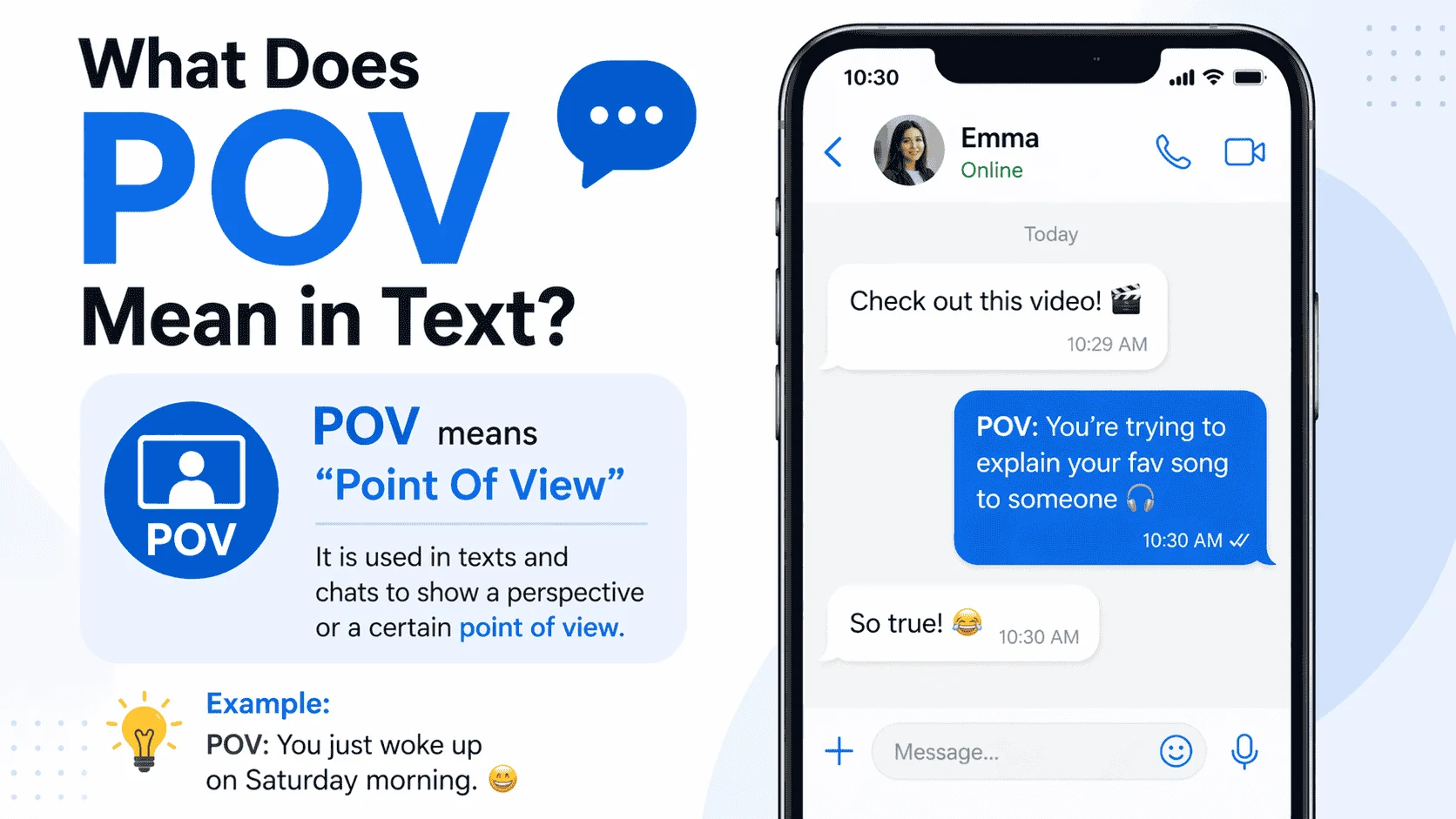
POV stands for “Point of View.”
In texting and online content, it refers to a specific perspective or scenario that the viewer or reader is meant to imagine themselves in.
Simple breakdown:
- POV = Point of View
- It puts you inside a situation
- Often used for storytelling or emotional expression
Quick examples:
- “POV: You finally text your crush and they reply instantly.”
- “POV: It’s Friday night and you have no plans.”
- “POV: You wake up early and feel productive for once.”
In each example, the writer is creating a mini experience and inviting you into it.
Origin & Background
The term “POV” didn’t start on social media. It originally comes from film and literature.
In movies, a “point of view shot” shows exactly what a character is seeing. It puts the audience in their eyes.
Writers have also used “point of view” for centuries to describe who is telling the story.
But things changed when social media platforms like TikTok and Instagram took over.
Creators began using “POV” in captions to:
- Create relatable scenarios
- Tell short emotional stories
- Make content feel personal
Over time, its meaning shifted from a technical storytelling term to something more casual and expressive.
Today, it’s less about strict perspective and more about vibe, relatability, and imagination.
Real-Life Conversations
Here’s how “POV” actually shows up in everyday chats.
WhatsApp Chat
Person A: POV: You study all night and still fail the test
Person B: Stop, that’s literally me 😭
Instagram DMs
Person A: POV: You see your ex in public and pretend not to notice
Person B: Why is this so accurate 😅
TikTok Comments
Person A: POV: You finally get your life together
Person B: Still waiting for this POV to happen 💀
Text Messages
Person A: POV: It’s raining and you’re just sitting with tea
Person B: That actually sounds peaceful
These examples show something important. “POV” is rarely used in isolation. It’s used to trigger a feeling or shared experience.
Emotional & Psychological Meaning
“POV” is more than just a phrase. It’s a way of connecting emotionally.
When someone uses “POV,” they are:
- Inviting you into a moment
- Asking you to imagine a feeling
- Sharing something relatable
It works because humans naturally respond to stories and scenarios.
Instead of saying, “I felt awkward seeing my ex,” someone writes:
“POV: You run into your ex and don’t know where to look.”
That shift makes the experience feel universal.
A simple real-life scenario:
You’re scrolling late at night and see:
“POV: Everyone is asleep and you’re overthinking everything.”
You pause. Not because it’s complex, but because it feels personal.
That’s the power of “POV.” It turns ordinary emotions into shared moments.
Usage in Different Contexts
Social Media
This is where “POV” thrives.
It’s used in:
- TikTok videos
- Instagram captions
- Reels and short-form content
It helps creators build instant relatability.
Friends & Relationships
Among friends, it’s playful and expressive.
Example:
“POV: You forgot my birthday.”
It can be teasing, emotional, or even sarcastic.
Work / Professional Settings
Here, it’s less common.
Using “POV” in formal emails or meetings can feel unprofessional unless used creatively in marketing or content creation.
Casual vs Serious Tone
- Casual: Funny, relatable, light
- Serious: Emotional, reflective, sometimes deep
The tone depends on the situation, not the word itself.
When NOT to Use It
Even though “POV” is popular, there are moments where it doesn’t fit.
Avoid using it:
- In formal writing or academic work
- In serious professional communication
- When clarity is more important than creativity
- In sensitive topics where humor may seem inappropriate
Using “POV” incorrectly can make your message feel confusing or out of place.
Common Misunderstandings
1. Thinking it always means “your perspective”
Not always. Sometimes it’s just a scenario, not a true point of view.
2. Using it without a clear situation
“POV: Life is weird”
This feels incomplete because there’s no specific moment.
3. Confusing tone
Some people use “POV” for serious emotions, others for humor. Without context, it can be misunderstood.
4. Overusing it
When every post starts with “POV,” it loses impact.
Comparison Table
| Expression | Meaning | How It Differs from POV |
|---|---|---|
| POV | Point of view scenario | Creates an immersive experience |
| IMO | In my opinion | Direct opinion, not a scenario |
| Storytime | Sharing a real story | More detailed and personal |
| Imagine this | Asking you to visualize | Similar, but less trendy |
| IRL | In real life | Focuses on reality, not perspective |
Key Insight
“POV” stands out because it blends storytelling with imagination. It doesn’t just tell you something. It places you inside it.
Variations / Types of POV
Here are common variations you’ll see online:
- POV: You just…
A relatable moment setup - POV: When you…
Describes a common experience - POV: Me…
Personal but still relatable - POV: They…
Observational or storytelling - POV: We…
Shared group experience - POV: It’s 3AM…
Emotional or reflective tone - POV: Nobody understands…
Dramatic or expressive - POV: Your mom…
Humor or family-related - POV: First day…
Situational and specific - POV: You realize…
Insight or emotional realization
How to Respond When Someone Uses It
Casual Replies
- “That’s so true”
- “I felt that”
- “Why is this me?”
Funny Replies
- “Delete this, it’s too real 😂”
- “I’m in this and I don’t like it”
- “Caught me off guard”
Mature Replies
- “That actually makes a lot of sense”
- “I can relate to that feeling”
Respectful Replies
- “I understand what you mean”
- “That sounds meaningful”
Regional & Cultural Usage
Western Culture
Highly popular, especially on TikTok and Instagram. Often used for humor and relatability.
Asian Culture
Used widely in online communities, often with emotional or aesthetic content.
Middle Eastern Culture
Growing in popularity, especially among younger users. Often mixed with local humor and expressions.
Global Internet Usage
“POV” has become a universal digital language. Even non-native English speakers use it comfortably.
Generational Differences
- Gen Z: Uses it creatively and frequently
- Millennials: Understand it but may use it less
- Older generations: May find it confusing or unnecessary
Is It Safe for Kids?
Yes, in general, “POV” is safe.
It’s simply a storytelling format. However, the content attached to it matters.
Parents should be aware that some “POV” posts may include:
- Emotional themes
- Humor that isn’t age-appropriate
The word itself is harmless. Context is key.
FAQs
1. What does POV mean in texting?
It means “point of view” and is used to describe a scenario you should imagine yourself in.
2. Is POV always used correctly online?
No. Many people use it loosely, sometimes without a true perspective.
3. Can I use POV in formal writing?
It’s better to avoid it in formal or professional contexts.
4. Why is POV so popular?
Because it makes content relatable and emotionally engaging.
5. Is POV only used on TikTok?
No. It’s also common on Instagram, WhatsApp, and text messages.
6. Can POV be serious?
Yes. It can express deep emotions, not just humor.
Conclusion
“POV” might look like just another internet abbreviation, but it carries a deeper purpose.
It allows people to share experiences in a way that feels immediate and personal. Instead of explaining emotions, it lets others step into them.
That’s why it resonates so strongly across cultures and platforms.
Once you understand how it works, using it becomes natural. You don’t need to force it. Just think in moments, not explanations.
Next time you see “POV,” you won’t just read it. You’ll feel it.