
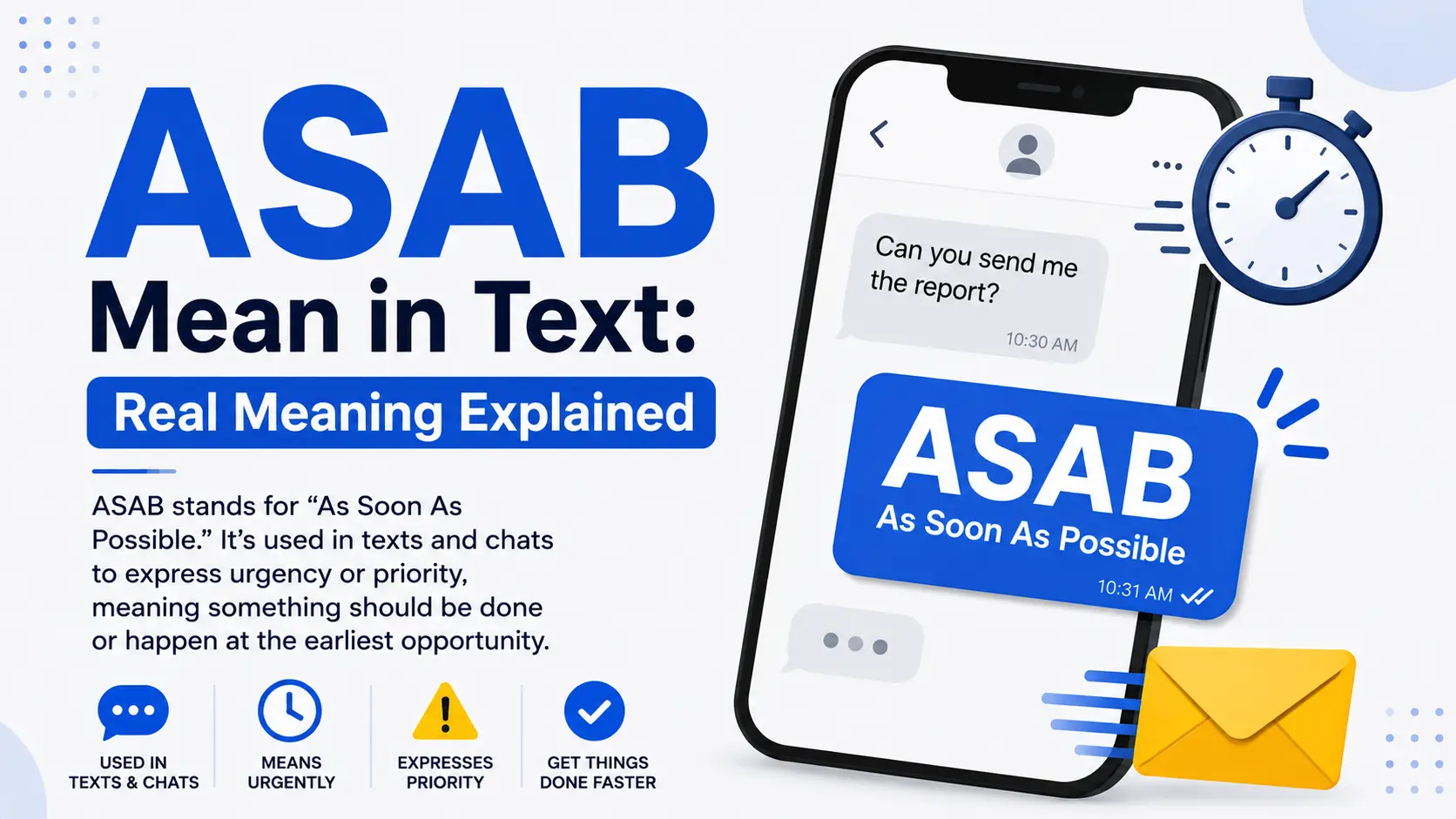
If you’ve seen “ASAB” in a text message, TikTok comment, Snapchat caption, or Instagram DM, you’re probably wondering what it actually means. The term looks simple, but depending on the context, it can carry different emotional tones and cultural meanings online.
People often search for “asab mean in text” because slang changes quickly on social media. One abbreviation can suddenly appear everywhere, leaving many users confused about whether it’s funny, serious, rude, or just another internet trend.
The good news is that ASAB is not as complicated as it seems. Once you understand where it comes from and how people use it in conversations, the meaning becomes much clearer.
In this guide, you’ll learn:
- The real meaning of ASAB in texting
- Where the term came from
- How Gen Z uses it online
- Emotional and cultural meanings behind it
- Real conversation examples
- When you should avoid using it
Let’s break it down naturally and clearly.
ASAB Mean in Text – Quick Meaning
In texting and online slang, ASAB commonly means:
“All Students Are Beautiful”
or
“As A B…” depending on unfinished slang phrasing and context.
However, on social media, ASAB is more often interpreted as a playful or stylized abbreviation connected to internet culture, identity jokes, or meme language.
In many cases, people use it casually without expecting a deep meaning. Tone and platform matter a lot.
Quick Understanding
- Mostly seen on TikTok, Instagram, Snapchat, and group chats
- Often used ironically, humorously, or emotionally
- Meaning can change depending on the sentence
- Popular among younger users and meme communities
Example Uses
“ASAB honestly, nobody deserved the hate.”
“She said ASAB and everyone in the comments got confused.”
“Bro typed ASAB and disappeared for 3 hours 😭”
The exact interpretation usually becomes obvious once you read the full conversation.
Origin & Background of ASAB
Like many internet abbreviations, ASAB did not grow from one official source. It spread through online communities where people shorten phrases to save time, sound funny, or create insider language.
Internet slang evolves fast because users constantly remix language. A short acronym can start in one community and later gain completely different meanings elsewhere.
ASAB became more visible through:
- TikTok captions
- Twitter/X posts
- Meme pages
- Discord chats
- Gaming communities
- Instagram comment sections
Part of its popularity comes from curiosity. People see unfamiliar abbreviations and immediately want to decode them.
That curiosity helps slang spread even faster.
Social Media Influence
Modern communication rewards short, fast, emotionally loaded language. Instead of typing long explanations, users prefer abbreviations that carry attitude, humor, or emotion in a compact form.
ASAB fits perfectly into that style.
It feels:
- Quick
- Cryptic
- Trendy
- Slightly mysterious
That mystery is exactly why terms like this become viral.
How the Meaning Evolved
Originally, many slang abbreviations had one clear definition. Today, meanings shift depending on:
- Age group
- Platform
- Online community
- Country
- Tone of conversation
That’s why one person may use ASAB jokingly while another uses it seriously.
Real-Life Conversations
Here’s how ASAB might appear in everyday online conversations.
WhatsApp Conversation
Person A:
Why are you ignoring the group chat?
Person B:
ASAB honestly 😭 I needed peace for one day.
Instagram DM
Person A:
That outfit was fire.
Person B:
ASAB vibes only 😂
TikTok Comments
Person A:
This generation creates new slang every week.
Person B:
ASAB because nobody understands anything anymore 💀
Text Message
Person A:
You still mad at me?
Person B:
Nah, ASAB. I just overreacted earlier.
These examples show how flexible internet slang can become. The exact tone depends heavily on emojis, context, and relationship dynamics.
Emotional & Psychological Meaning
Internet slang is rarely just about saving time. It also helps people express emotion indirectly.
ASAB often carries:
- Humor
- Sarcasm
- Emotional exaggeration
- Social belonging
- Casual confidence
People use slang because it creates connection. When someone understands your abbreviations, it feels like shared culture.
That’s especially true among younger internet users.
Why People Use It
Many users prefer slang because it:
- Feels less formal
- Sounds emotionally lighter
- Adds personality to conversations
- Creates group identity
- Makes communication faster
A teenager texting friends may use ASAB naturally because everyone in their circle already understands the vibe behind it.
A Realistic Scenario
Imagine someone posting a dramatic TikTok after a breakup. Instead of writing a long emotional paragraph, they simply comment:
“ASAB rn.”
That short phrase can communicate exhaustion, irony, sadness, or emotional chaos without needing a full explanation.
Modern internet language often works this way. Emotion is compressed into short expressions.
Usage in Different Contexts
Social Media
On TikTok, Snapchat, and Instagram, ASAB is usually playful or emotional.
People use it:
- In captions
- Comment sections
- Meme replies
- Reaction posts
Tone here is often casual and humorous.
Friends & Relationships
Among friends, ASAB may appear during:
- Jokes
- Emotional conversations
- Group chat drama
- Random reactions
Because friendships rely on shared context, people usually understand the intended meaning quickly.
Work or Professional Settings
Using ASAB at work is generally not recommended.
Professional communication values:
- Clarity
- Precision
- Universal understanding
Many coworkers may not understand newer internet slang, which can create confusion or make messages seem immature.
Casual vs Serious Tone
ASAB usually sounds casual.
In serious discussions, unclear slang may:
- Reduce clarity
- Cause misunderstandings
- Make emotions harder to interpret
Always consider your audience before using internet abbreviations.
When NOT to Use It
Even harmless slang can become awkward in the wrong setting.
Avoid using ASAB in:
- Job interviews
- Professional emails
- Academic writing
- Serious family discussions
- Sensitive emotional conversations
Cultural Sensitivity Matters
Some abbreviations can accidentally resemble controversial phrases or internet subcultures. If your audience may misunderstand the term, it’s safer to use full words instead.
Not everyone spends time in the same online spaces.
Common Misunderstandings
One major problem with slang is that people assume everyone understands it the same way.
That rarely happens online.
Confusion About Tone
ASAB can sound:
- Funny to one person
- Rude to another
- Confusing to someone else
Without emojis or context, tone becomes difficult to read.
Literal vs Figurative Meaning
Some users try to decode abbreviations literally, while others treat them like emotional expressions rather than exact definitions.
That creates confusion quickly.
For example:
“ASAB 😂”
This likely feels emotional or humorous rather than strictly literal.
Platform Differences
TikTok slang may not make sense on LinkedIn or Facebook.
Different platforms create different communication cultures.
Comparison Table
| Expression | Meaning | Tone | Similarity to ASAB |
|---|---|---|---|
| LOL | Laughing Out Loud | Funny | Similar casual energy |
| TBH | To Be Honest | Honest/confessional | Similar emotional use |
| FR | For Real | Emphatic | Similar conversational style |
| IDC | I Don’t Care | Dismissive | More emotionally distant |
| IMO | In My Opinion | Thoughtful | More formal |
| SMH | Shaking My Head | Frustrated | Similar reaction-based slang |
| BRB | Be Right Back | Practical | Less emotional |
| NPC | Non-Player Character | Meme insult/joke | Similar internet culture vibe |
Key Insight
Most modern slang is less about strict dictionary meaning and more about emotional atmosphere. ASAB works similarly. The feeling behind the message often matters more than the exact wording.
Variations / Types of ASAB Usage
1. Funny ASAB
Used jokingly in memes or dramatic reactions.
2. Emotional ASAB
Used during emotionally overwhelming moments.
3. Sarcastic ASAB
Expresses irony or playful frustration.
4. TikTok ASAB
Appears in trends, edits, and viral captions.
5. Group Chat ASAB
Used casually among close friends.
6. Relationship ASAB
Appears during romantic teasing or emotional conversations.
7. Meme ASAB
Used without a clear meaning purely for humor.
8. Cryptic ASAB
Intentionally vague to create curiosity.
9. Trend-Based ASAB
Temporary usage connected to viral trends.
10. Irony ASAB
Used in exaggerated online storytelling.
How to Respond When Someone Uses It
Casual Replies
- “Fair enough 😂”
- “I get what you mean.”
- “Mood honestly.”
Funny Replies
- “Bro speaks in encrypted slang 😭”
- “I need subtitles at this point.”
- “TikTok has ruined communication 💀”
Mature Replies
- “Can you explain what you mean?”
- “I think I understand your point.”
- “That actually makes sense.”
Respectful Replies
- “Thanks for explaining.”
- “I hadn’t heard that before.”
- “Interesting, I learned something new.”
The best response depends on your relationship with the person and the tone of the conversation.
Regional & Cultural Usage
Western Culture
In Western online spaces, ASAB is usually treated casually and humorously.
Younger users especially enjoy cryptic slang because it feels exclusive and trendy.
Asian Culture
In many Asian digital communities, English abbreviations are often mixed with local slang.
ASAB may appear more stylistically than literally.
Middle Eastern Culture
Internet slang spreads rapidly through global platforms like TikTok and Instagram.
Users may adopt terms like ASAB for humor even if the original meaning shifts locally.
Global Internet Usage
Online language no longer belongs to one country.
A slang term can:
- Start in one region
- Become viral globally
- Change meaning multiple times
That’s exactly why internet slang feels unpredictable today.
Gen Z vs Millennials
Gen Z
- Uses slang rapidly
- Adapts meanings quickly
- Enjoys irony and ambiguity
Millennials
- Prefer slightly clearer abbreviations
- More likely to ask for explanations
- Use fewer trend-based acronyms
This generational difference explains why younger users often understand internet slang instantly while older users feel confused.
Is It Safe for Kids?
Generally, ASAB itself is not considered dangerous or explicit.
However, parents should still pay attention to:
- The platform
- Conversation context
- Associated slang trends
Internet language changes quickly, and meanings can shift across communities.
Open communication matters more than policing every abbreviation.
FAQs
What does ASAB stand for in text?
It usually refers to an internet slang phrase whose meaning depends heavily on context, tone, and platform.
Is ASAB a bad word?
Not usually. In most cases, it’s casual internet slang rather than offensive language.
Why do people use ASAB online?
People use it to sound expressive, humorous, trendy, or emotionally relatable in fast digital conversations.
Is ASAB popular on TikTok?
Yes. TikTok helps spread short abbreviations and meme-style slang very quickly.
Can ASAB mean different things?
Absolutely. Like many online abbreviations, meaning changes depending on the community and conversation.
Should I use ASAB professionally?
No. It’s better to avoid unclear internet slang in professional communication.
Why is internet slang so confusing now?
Because online language evolves rapidly across platforms, cultures, and generations. Meanings shift faster than traditional slang ever did.
Conclusion
Understanding “asab mean in text” is really about understanding modern internet communication itself.
Today’s slang is emotional, fast-moving, and deeply connected to online culture. Terms like ASAB spread because they create curiosity, humor, and social connection in just a few letters.
The most important thing to remember is context.
A phrase that feels funny in a TikTok comment might feel confusing in a work message. Tone, emojis, audience, and platform all shape meaning.
If you see ASAB online again, you probably won’t feel lost anymore. Instead, you’ll recognize it as part of the constantly evolving language of digital communication.
And honestly, that’s what makes internet culture so fascinating.