

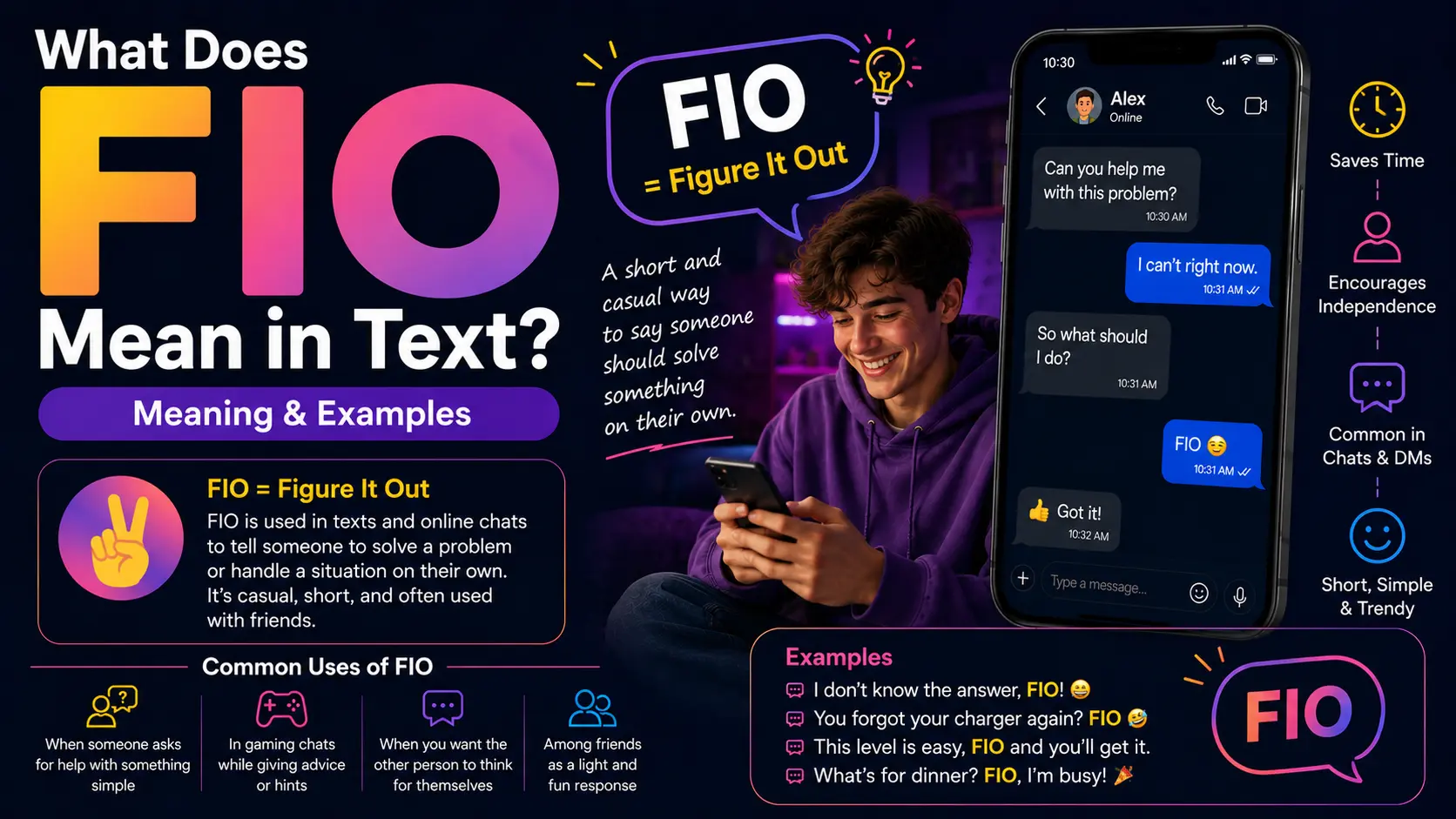
If you have ever received a message containing “FIO” and wondered what the person meant, you are not alone. Short forms and internet abbreviations change quickly, and many expressions have meanings that depend on the situation, platform, and relationship between people.
So, what does FIO mean in text? In most online conversations, FIO means “Figure It Out.” It is usually used when someone wants another person to solve something themselves instead of explaining everything.
People often search for this phrase because texting removes many emotional clues. A simple “FIO” can sound playful, encouraging, annoyed, or even slightly rude depending on the tone behind it.
Understanding these small digital expressions helps people communicate better, especially in modern conversations where short messages carry a lot of meaning.
FIO Meaning in Text: Quick Meaning
FIO means “Figure It Out” in text messages, chats, and online conversations.
It is used when someone tells another person to find the answer, solution, or explanation on their own.
Common meanings include:
- Figure It Out: Solve the problem yourself.
- Find the answer independently: Try before asking.
- A playful challenge: A teasing way to encourage someone.
- A short response: A quick way to avoid a long explanation.
Examples:
“Where did I put my keys?”
“FIO 😂”
Meaning: Try to figure it out.
“I don’t know how this app works.”
“Just FIO, you got this.”
Meaning: Try learning it yourself.
“Why did she react that way?”
“FIO.”
Meaning: Think about it and find the reason.
Origin and Background of FIO
The phrase “Figure It Out” existed long before texting became popular. People used it in everyday speech when encouraging someone to solve a problem independently.
As digital communication grew, especially through messaging apps and social media, longer phrases became shortened. Similar to expressions like LOL, BRB, and IDK, people started creating faster ways to communicate.
FIO became useful because it carries a complete idea in only three letters. It fits the fast style of online conversations where people often prefer quick replies.
Social media culture also influenced how FIO is understood. Among friends, it may sound funny or motivating. Between strangers, it may appear cold or dismissive.
The meaning is not only in the letters. The relationship, timing, and emotional tone matter.
Real-Life Conversations Using FIO
WhatsApp Conversation
Person A:
“Can you explain how to edit this video?”
Person B:
“Watch a few tutorials and FIO 😄”
Person A:
“Okay okay, challenge accepted 😂”
Here, FIO feels playful and encouraging.
Instagram DM Conversation
Person A:
“How did you make this photo look so good?”
Person B:
“Try different filters and FIO ✨”
Person A:
“I’ll experiment.”
Here, FIO means learning through practice.
TikTok Comment Conversation
Person A:
“Does anyone know how to do this trend?”
Person B:
“FIO, it’s actually easy 😂”
Here, the meaning is casual and slightly teasing.
Text Message Conversation
Person A:
“What gift should I buy for my brother?”
Person B:
“FIO, you know him better than me.”
Here, it means the person should think about it personally.
Emotional and Psychological Meaning of FIO
The phrase “Figure It Out” is interesting because it reflects a common human desire for independence.
When someone uses FIO, they may be expressing confidence that the other person can handle the situation. It can be a form of encouragement.
However, emotions change the meaning.
A friendly “FIO 😄” may mean:
“You are smart, you can solve this.”
A serious “FIO.” may mean:
“I do not want to explain this.”
Modern texting often removes voice tone and facial expressions, so people sometimes misunderstand short phrases.
From personal communication experience, I have noticed that short replies between close friends often carry hidden meanings. A friend saying “FIO” may actually be motivating you, while the same word from someone upset may feel like rejection.
Usage in Different Contexts
Social Media
On platforms like comments, captions, and direct messages, FIO is usually casual.
People use it when:
- Responding to simple questions
- Teasing friends
- Encouraging creativity
- Avoiding long explanations
Example:
“Which outfit should I choose?”
“FIO, trust your style.”
Friends and Relationships
Among close friends, FIO can feel playful.
It may show:
- Trust
- Humor
- Confidence
- Friendly challenge
However, in emotional conversations, it may sound insensitive.
Example:
“I’m confused about my future.”
“FIO.”
This could feel dismissive.
Work and Professional Settings
Using FIO at work is usually not recommended.
Professional communication values clarity and support.
Instead of:
“FIO.”
A better option:
“Try checking the guide first, and let me know if you need help.”
Casual vs Serious Tone
Casual:
“FIO 😂”
Serious:
“FIO.”
The same letters can create completely different feelings.
When Not to Use FIO
Although FIO is common online, there are situations where it may create confusion.
Avoid using it when:
- Someone is genuinely asking for help
- The topic is emotional or sensitive
- You are communicating professionally
- The person may feel ignored
Cultural differences also matter. Some people see independent problem-solving as positive, while others may see it as unhelpful.
Choosing the right tone is more important than using trendy abbreviations.
Common Misunderstandings About FIO
Many people misunderstand FIO because they focus only on the literal meaning.
Some common mistakes include:
Thinking It Always Sounds Rude
Not always. Friends may use it jokingly.
Example:
“Who ate my snacks?”
“FIO 😂”
This is playful.
Thinking It Means Someone Does Not Care
Sometimes it means the opposite.
A person may say FIO because they believe you are capable.
Ignoring Context
A short message cannot show facial expressions or voice tone.
The relationship between people decides the real meaning.
FIO Comparison Table
| Expression | Meaning | Tone |
|---|---|---|
| FIO | Figure It Out | Casual, challenging |
| IDK | I Don’t Know | Neutral |
| IMO | In My Opinion | Sharing thoughts |
| DIY | Do It Yourself | Independent action |
| Help me | Asking directly | Support seeking |
| Explain please | Requesting clarity | Polite |
Key Insight
FIO is not just an abbreviation. It represents a communication style where people encourage independence, but the emotional tone decides whether it feels helpful or dismissive.
Variations and Types of FIO Usage
1. Friendly FIO
Meaning: A playful challenge.
Example:
“FIO, you’re smarter than this 😂”
2. Motivational FIO
Meaning: Encouraging someone to solve something.
Example:
“Try first and FIO.”
3. Teasing FIO
Meaning: A joke between friends.
Example:
“Who changed the settings?”
“FIO 😆”
4. Frustrated FIO
Meaning: Someone is tired of explaining.
Example:
“I already told you three times. FIO.”
5. Independent FIO
Meaning: Learn by yourself.
Example:
“Search it and FIO.”
6. Confident FIO
Meaning: The person believes you can handle it.
Example:
“You can do this. FIO.”
7. Short Reply FIO
Meaning: A quick answer during busy conversations.
Example:
“Where is the file?”
“FIO.”
8. Internet Humor FIO
Meaning: Used as a meme-style response.
Example:
“How do I become famous?”
“FIO 😂”
How to Respond When Someone Uses FIO
Casual Replies
- “Haha, I’ll try 😄”
- “Challenge accepted.”
- “Let me figure it out.”
Funny Replies
- “My brain is loading 😂”
- “Searching my last two brain cells.”
- “Give me a minute.”
Mature Replies
- “I’ll look into it and figure it out.”
- “Thanks, I’ll try solving it first.”
Respectful Replies
- “I understand. I’ll check and get back to you.”
- “I’ll try finding the answer.”
Regional and Cultural Usage
Western Culture
In many Western online spaces, FIO is often seen as casual and direct. Friends may use it jokingly.
Asian Culture
In many Asian communication styles, people may prefer softer wording. FIO can sometimes sound too direct depending on the relationship.
Middle Eastern Culture
Communication often values warmth and respect. The phrase may need a friendly tone to avoid sounding dismissive.
Global Internet Usage
Online culture has made FIO widely understandable, especially among younger users.
Gen Z vs Millennials
Gen Z often uses short abbreviations more naturally because digital communication is part of daily life.
Millennials may understand FIO but may use it less frequently in everyday chats.
Is FIO Safe for Kids?
Yes, FIO is generally safe for kids because it is not an inappropriate phrase.
However, children should understand that tone matters.
A child saying “FIO” to a friend may sound funny, but saying it to someone needing help may seem unkind.
Teaching children digital manners is just as important as teaching meanings.
Frequently Asked Questions About FIO
What does FIO mean in texting?
FIO usually means “Figure It Out.” It tells someone to solve something themselves.
Is FIO rude?
It depends on the situation. With friends it can be playful, but in serious situations it may sound dismissive.
What does FIO mean on social media?
On social media, FIO usually means “Figure It Out” and is often used casually.
Can FIO be positive?
Yes. It can encourage independence and confidence.
Is FIO professional?
Usually no. Professional conversations should use clearer and more polite wording.
What is the difference between FIO and DIY?
FIO means find the answer or solution. DIY means doing something yourself, often creating or fixing something.
Why do people use FIO?
People use FIO because it is short, quick, and communicates the idea of solving something independently.
Conclusion
Understanding what FIO means in text helps you communicate with more confidence in today’s fast-moving digital world.
The phrase usually means “Figure It Out,” but its real meaning depends on emotion, relationship, and situation.
A message from a close friend may feel like encouragement. The same message from someone distant may feel cold.
Digital language is constantly changing, but the most important skill remains the same: understanding the person behind the words.
Use FIO when the situation feels right, and remember that kindness and clarity always make communication stronger.