
If you’ve spent time on TikTok, Snapchat, Instagram, or texting friends, you’ve probably seen someone reply with “FR” and wondered what it actually means. At first glance, those two letters can seem confusing because they appear in many different conversations. Sometimes they show agreement, sometimes they express surprise, and other times they simply add emphasis.
The good news is that FR is one of the easiest internet abbreviations to understand once you know the context.
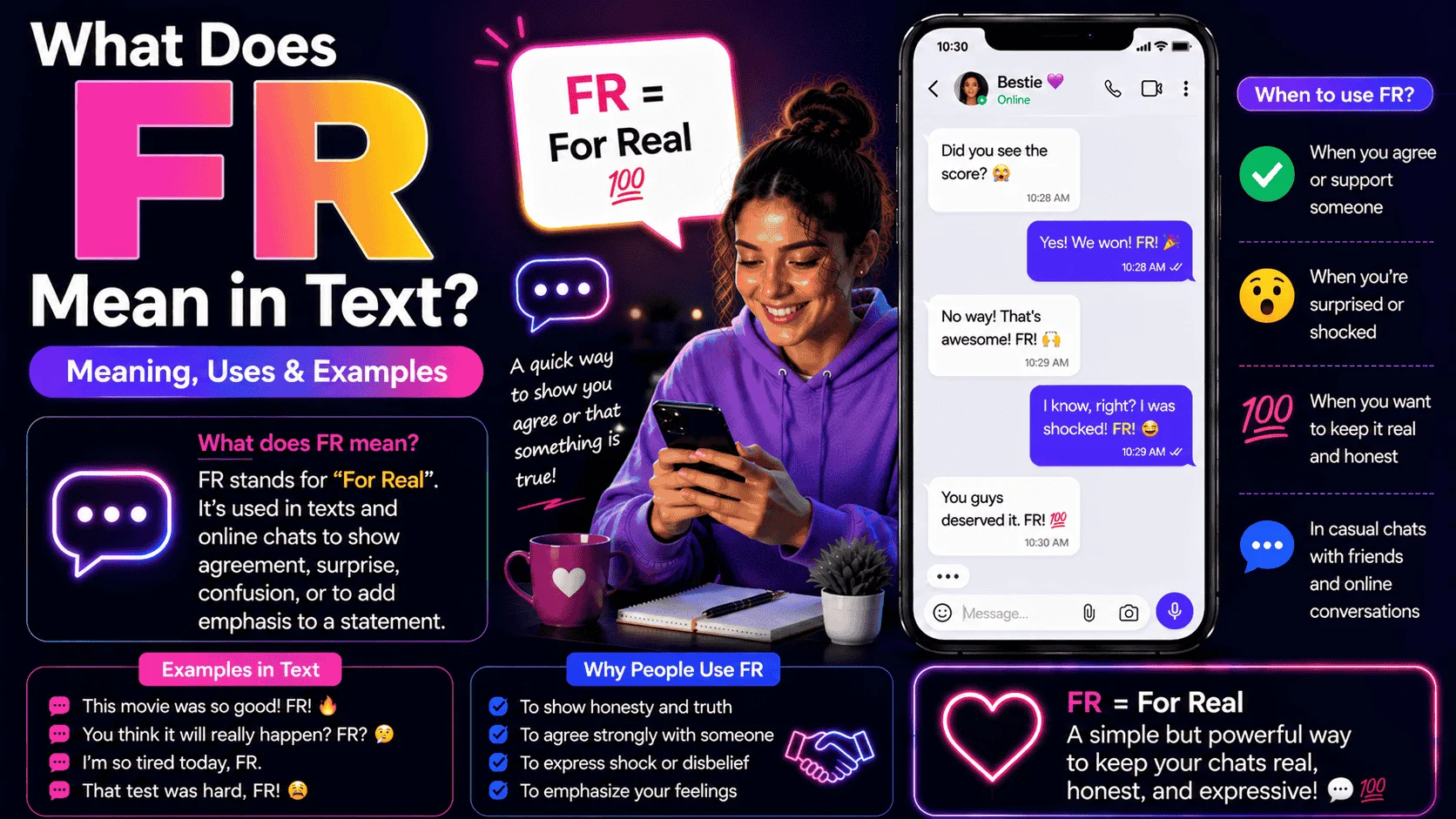
In most online conversations, FR means “For Real.” People use it to show honesty, agreement, sincerity, or to emphasize that they genuinely mean what they’re saying. Depending on the conversation, it can also mean, “Seriously?” or “I’m not joking.”
This guide explains exactly what FR means in text, where it came from, how people use it today, and when you should or shouldn’t use it.
FR Meaning in Text – Quick Meaning
The abbreviation FR most commonly stands for “For Real.”
People use it to:
- Show they are being honest.
- Strongly agree with someone.
- Emphasize an opinion.
- Express disbelief or surprise.
- Make a conversation sound casual and natural.
Simple examples
“That movie was amazing, FR.”
“FR, I couldn’t stop laughing.”
“You’re leaving already? FR?”
In each example, FR adds emotion without making the message longer.
Origin & Background
The phrase “for real” existed in spoken English long before smartphones and social media. People have used it for decades to mean “seriously,” “truthfully,” or “I’m not kidding.”
As texting became popular during the early 2000s, users naturally shortened longer expressions into abbreviations. Just as LOL, BRB, and OMG became everyday internet language, For Real became simply FR.
Social media accelerated its popularity.
Platforms like:
- TikTok
- Snapchat
- X
- Discord
helped spread the abbreviation across millions of conversations.
Today, Gen Z uses FR almost instinctively. Millennials also recognize it, although they may write out “for real” more often.
Instead of replacing emotions, FR helps people communicate sincerity in fast-moving digital conversations.
Real-Life Conversations
Person A: I finally passed my driving test!
Person B: FR? That’s awesome! Congratulations!
Instagram DM
Person A: Your vacation photos look unreal.
Person B: Thanks! It was beautiful, FR.
TikTok Comments
Person A: This song deserves way more attention.
Person B: FR. I’ve had it on repeat all week.
Text Messages
Person A: I forgot my wallet again.
Person B: FR? That’s the third time this month!
These conversations show that FR naturally fits everyday texting without sounding forced.
Emotional & Psychological Meaning
Although FR is only two letters, it carries emotional weight.
People often use it when they want their words to feel more genuine.
It can express:
- Excitement
- Surprise
- Agreement
- Honesty
- Frustration
- Support
Digital communication lacks facial expressions and tone of voice. Small abbreviations like FR help fill that emotional gap.
Imagine your friend texting:
“You’re one of the most supportive people I know, FR.”
Adding FR makes the compliment feel warmer and more sincere.
I’ve noticed that people often use FR when they want to reassure someone that their feelings or opinions are genuine. Instead of sounding dramatic, it creates a relaxed sense of honesty that feels natural in modern conversations.
Usage in Different Contexts
Social Media
On TikTok, Instagram, and X, FR often appears in captions, comments, and replies.
Examples:
- “This recipe actually works, FR.”
- “Best concert ever, FR.”
It adds authenticity and emphasis.
Friends & Relationships
Friends commonly use FR while joking, agreeing, or sharing feelings.
Example:
“I missed hanging out with you, FR.”
Here it strengthens emotional sincerity.
Work or Professional Settings
In professional communication, avoid using FR unless you’re chatting informally with close coworkers.
Instead, write:
- “Seriously”
- “Honestly”
- “I completely agree”
Professional emails benefit from complete words rather than texting abbreviations.
Casual vs Serious Tone
Casual conversations welcome FR.
Serious discussions, formal presentations, legal communication, or academic writing generally do not.
Understanding your audience matters more than the abbreviation itself.
When NOT to Use It
There are situations where FR may feel inappropriate.
Avoid using it:
- In business emails.
- During job interviews.
- In academic assignments.
- When communicating with someone unfamiliar with internet slang.
- During sensitive conversations that require careful wording.
For example, responding with “FR” to someone’s serious personal loss could seem dismissive if the relationship isn’t close enough.
Context always determines whether slang feels respectful.
Common Misunderstandings
Many people misunderstand FR because abbreviations can have multiple meanings.
Some assume it always means:
- France
- French
- Front
- Frame Rate
- Financial Report
In texting, however, FR almost always means “For Real.”
Another misunderstanding involves tone.
Someone might text:
“FR?”
This isn’t necessarily agreement.
Instead, it often means:
- “Really?”
- “Are you serious?”
- “You’re kidding, right?”
Reading the surrounding conversation helps reveal the intended meaning.
Comparison Table
| Expression | Meaning | Typical Tone |
|---|---|---|
| FR | For Real | Honest, sincere, casual |
| ONG | On God | Strong emphasis or promise |
| NGL | Not Gonna Lie | Honest opinion |
| TBH | To Be Honest | Genuine statement |
| IMO | In My Opinion | Personal viewpoint |
| JK | Just Kidding | Opposite of seriousness |
| Cap | A lie or exaggeration | Opposite meaning |
| No Cap | Completely truthful | Similar emphasis |
Key Insight
While many slang expressions communicate honesty, FR stands out because it feels simple, flexible, and natural. It works equally well when showing agreement, confirming sincerity, or reacting with surprise.
Variations and Types
1. FR
Standard abbreviation for For Real.
2. FR FR
Means “For real, seriously.” Adds stronger emphasis.
3. Fr
Lowercase version commonly used in texting.
4. frfr
A popular internet variation meaning completely serious.
5. FR?
Used to ask, “Really?”
6. FR!
Expresses excitement or strong agreement.
7. For Real
The full phrase without abbreviation.
8. No Cap FR
Combines two expressions to emphasize complete honesty.
9. FR Though
Adds extra sincerity after an opinion.
10. Like FR
Used conversationally for stronger emotional emphasis.
How to Respond When Someone Uses It
Casual Replies
- Same here.
- I know, right!
- Totally agree.
- You’re right.
Funny Replies
- You finally noticed?
- Took you long enough!
- Facts only.
- No arguments here.
Mature Replies
- I appreciate your honesty.
- Thanks for being genuine.
- I completely understand.
Respectful Replies
- That’s a fair point.
- I respect your opinion.
- Thank you for sharing honestly.
- I agree with your perspective.
Regional & Cultural Usage
Western Culture
In North America and much of Europe, FR is common among younger internet users. It signals authenticity and agreement in casual conversations.
Asian Culture
Many English-speaking young people in Asian countries understand FR through TikTok, gaming, and global social media. However, it may be less familiar to older generations.
Middle Eastern Culture
Among bilingual internet users, FR appears frequently in English conversations online. Offline communication often favors local languages, so the abbreviation is mainly seen on digital platforms.
Global Internet Usage
The internet has made FR nearly universal among English-speaking communities. Gamers, content creators, influencers, and students regularly use it regardless of location.
Gen Z vs Millennials
Gen Z
Uses FR naturally in daily texting, comments, and memes.
Millennials
Usually understand the abbreviation but may alternate between FR and writing out “for real.”
The difference is more about texting habits than meaning.
Is It Safe for Kids?
Yes.
FR is generally considered a safe and harmless internet abbreviation because it simply means “For Real.”
Parents should still encourage children to understand the context of online slang. While FR itself is appropriate, surrounding conversations on social media may not always be.
Teaching digital communication skills helps young users interpret online language responsibly.
Frequently Asked Questions
What does FR mean in text?
It usually means “For Real,” expressing honesty, agreement, or seriousness.
Does FR always mean For Real?
In texting and social media, yes, most of the time. In other fields, it may have different meanings depending on context.
What does FR FR mean?
It means “For real, for real,” adding extra emphasis that the speaker is completely serious.
Is FR positive or negative?
Neither. It depends on the conversation. It can express excitement, agreement, frustration, or surprise.
Can I use FR in professional emails?
It’s better not to. Professional writing is clearer when you use complete words like “seriously” or “honestly.”
Why do people type FR instead of For Real?
It’s faster, fits casual texting, and has become part of modern internet language.
Is FR popular on TikTok?
Yes. TikTok users frequently use FR in comments, captions, and replies to show agreement or emphasize genuine opinions.
Conclusion
Understanding what does FR mean in text makes modern online conversations much easier to follow. In most cases, FR simply means “For Real,” expressing honesty, agreement, or genuine emotion. Whether you’re chatting with friends, commenting on TikTok, or replying on Instagram, you’ll likely see it used to make a message feel more sincere and relatable.
The key is paying attention to context. A simple “FR” can strengthen a compliment, confirm an opinion, or express surprise depending on the conversation. Once you recognize how people use it naturally, you’ll feel much more confident reading and using this popular piece of internet slang in your own messages.