

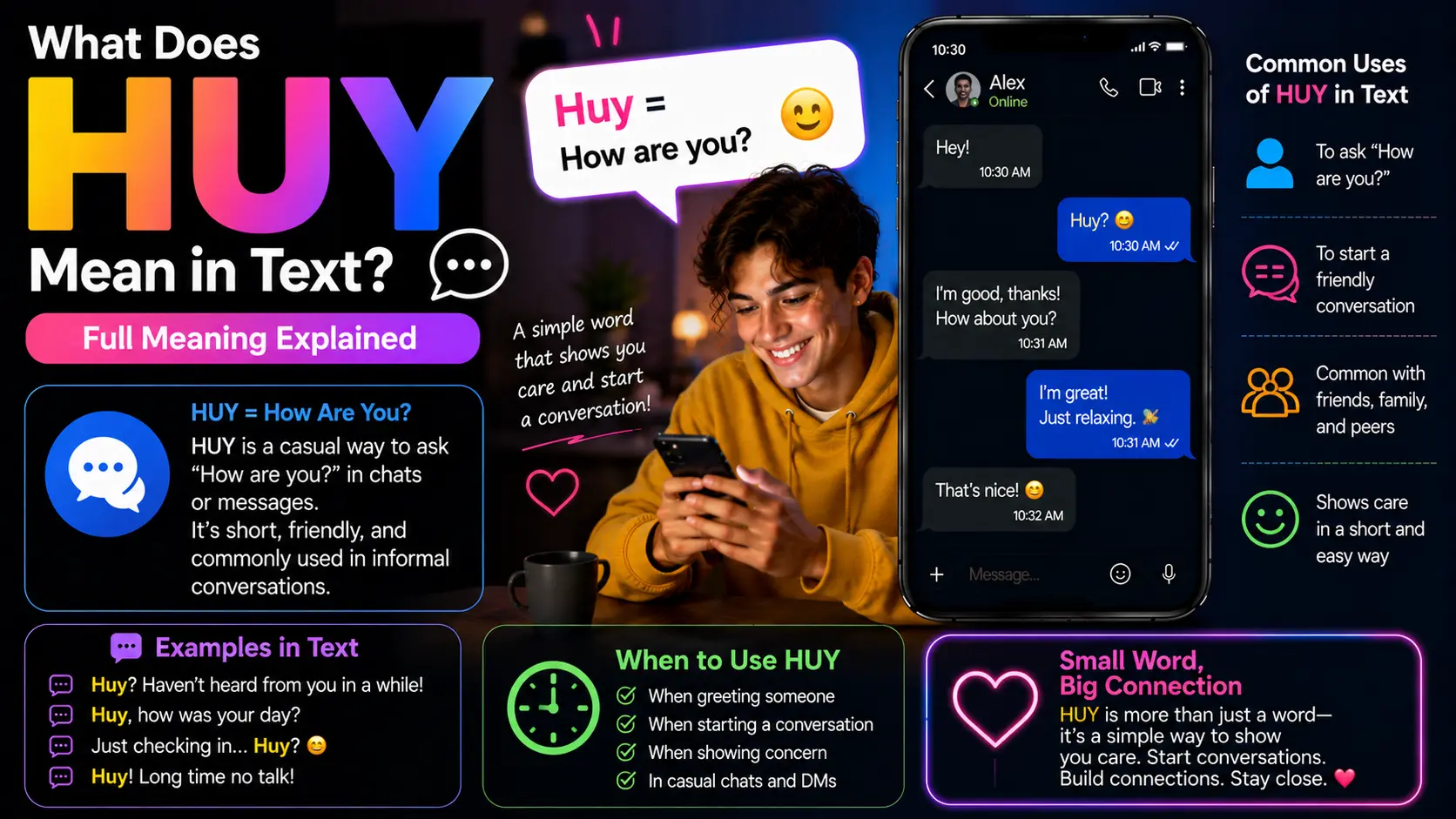
If you’ve seen someone type “huy” in a message and felt confused, you are not alone. This short, simple-looking word has been popping up in chats, comments, and social media conversations, especially among younger users.
At first glance, it looks like a typo. Maybe “hey” or “hi” gone wrong. But in reality, “huy” carries its own tone, emotion, and cultural flavor depending on how and where it is used.
People search “what does huy mean in text” because it often appears in casual conversations without explanation. It can sound playful, dramatic, teasing, or even slightly emotional depending on context. Understanding it helps you read between the lines in modern digital communication, where tone is often more important than grammar.
This article breaks down the meaning of “huy,” where it comes from, how people use it online, and what it really expresses in everyday conversations.
“HUY” – Quick Meaning
In simple terms, “huy” is an informal expression used in texting and social media to get attention, show surprise, or react emotionally.
It is most commonly used in casual communication and is often similar to saying:
- “Hey!”
- “Oi!”
- “Yo!”
- “Excuse me!”
- “Wait, what?”
Quick examples:
- “Huy! Seryoso ka?” → “Hey! Are you serious?”
- “Huy, ang ganda naman!” → “Wow, that’s so beautiful!”
- “Huy stop 😂” → Playful way to react or tease someone
In most cases, it is not meant to be serious or formal. It is expressive, emotional, and conversational.
Origin & Background
The slang “huy” is widely associated with Filipino digital communication, where it evolved as a casual attention-grabbing expression in chats and social media.
It is closely related to the word “uy,” which is already used in Filipino language to call someone’s attention. Over time, “huy” became a stronger, more expressive variation.
How it developed:
- “Uy” = casual attention grabber
- “Huy” = louder, more emotional version
- Social media amplified its usage in memes and comments
- Became popular in Facebook, TikTok, and Instagram culture
On platforms where conversations move fast and emotions are short-lived, “huy” became a perfect fit. It is short, expressive, and emotionally flexible.
Cultural influence
Even though it is rooted in Filipino slang, the internet has helped spread it globally. Now, people outside the Philippines also use it when they see it online, often without knowing its origin, simply because it “feels right” in context.
Real-Life Conversations (MANDATORY)
WhatsApp Chat
Person A:
I finally told him how I feel.
Person B:
Huy!!! What did he say??
Person A:
He said he feels the same.
Person B:
OMG I knew it 😭
Instagram DM
Person A:
Check my new profile pic
Person B:
Huy ang ganda mo sobra 🔥
Person A:
Stop it 😂 you’re exaggerating
Person B:
No joke, it’s giving main character energy
TikTok Comment Section
User 1:
I tried this hairstyle and it actually worked
User 2:
Huy I need to try this ASAP
User 3:
Same here, saving this video
Text Message
Friend 1:
I saw you at the mall yesterday
Friend 2:
Huy bakit di mo ako tinawag? (Hey why didn’t you call me?)
Friend 1:
You looked busy so I didn’t want to disturb you
These examples show how “huy” works as an emotional trigger word. It grabs attention instantly and adds personality to short messages.
Emotional & Psychological Meaning
“Huy” is not just a word. It carries emotional energy.
Most people use it to express:
- Surprise
- Shock
- Playful annoyance
- Excitement
- Affection
- Attention seeking in a friendly way
Psychologically, it works because short emotional words are easier for the brain to process in fast digital conversations. Instead of writing long sentences, users rely on expressive cues like “huy” to instantly communicate tone.
Why people use it
Modern communication is fast and informal. People want to react quickly without overthinking grammar or structure. “Huy” fills that gap perfectly.
It also creates a sense of closeness. When someone types “huy,” it often feels more personal than a formal response.
Personal-style scenario
Imagine you are scrolling through Instagram and your friend posts a sudden engagement announcement. Instead of writing a long sentence, you simply type:
“Huyyy I cannot believe this 😭😭”
That message alone carries excitement, surprise, and emotional support all at once.
Usage in Different Contexts
Social media
On platforms like TikTok, Instagram, and Facebook, “huy” is used as a reaction word.
- To comment on funny videos
- To react to surprising posts
- To express admiration or shock
Friends & relationships
In friendships, it is extremely common. It can show:
- Teasing tone
- Emotional reactions
- Casual bonding language
Example: “Huy bakit mo ginawa yun 😂”
Work / professional settings
It is not suitable for professional communication. Using “huy” in work emails or formal chats can appear unprofessional or immature.
Casual vs serious tone
- Casual: Perfect fit
- Emotional: Very expressive
- Serious: Not appropriate
When NOT to Use It
Even though “huy” is friendly and popular, there are situations where it should be avoided:
- Formal emails or workplace chats
- Academic writing or professional reports
- Sensitive or serious conversations
- Communication with someone unfamiliar or older in formal context
Using it in the wrong setting may lead to misunderstanding or make your message seem less respectful.
Common Misunderstandings
Many people misunderstand “huy” when they first see it.
What people get wrong:
- Thinking it is a typo of “hey”
- Assuming it is rude or aggressive
- Believing it has one fixed meaning
Tone confusion
The meaning changes depending on punctuation and context:
- “Huy” = neutral attention
- “Huy!” = surprise or urgency
- “Huy 😂” = playful reaction
- “HUY!!!” = strong shock or excitement
Literal vs figurative meaning
Literally, it has no dictionary meaning in English. Its meaning is entirely based on tone and usage.
Comparison Table
| Expression | Meaning | Tone | Usage |
|---|---|---|---|
| Huy | Attention, surprise, reaction | Casual, emotional | Chats, comments |
| Hey | Greeting | Neutral | General use |
| Oi | Call attention | Slightly informal | UK slang, casual talk |
| Yo | Greeting or attention | Cool, casual | Social chats |
| Oops | Mistake reaction | Light, playful | Errors, jokes |
Key Insight
“Huy” stands out because it is not just a greeting or reaction. It is emotionally flexible, which makes it ideal for fast, expressive digital conversations.
Variations / Types (Minimum 8–10)
Here are common variations of “huy” and how they are used:
- Huy – Basic attention grabber
Simple call or reaction word - Huy! – Surprise
Used when something unexpected happens - Huyyy – Emotional reaction
Shows excitement or affection - HUY!!! – Strong shock
Used for dramatic reactions - Huy 😂 – Funny reaction
Used in jokes or memes - Huy naman – Playful complaint
Light teasing tone - Huy grabe – Intense reaction
Expresses disbelief - Huy stop – Playful request
Used when teasing someone - Huy ano yun – Confused reaction
Asking for clarification - Huy teka – Wait moment
Used to pause conversation emotionally
How to Respond When Someone Uses It
Casual replies
- “What’s up?”
- “Haha why?”
- “Yes?”
Funny replies
- “Huy yourself 😂”
- “Don’t huy me like that”
- “What did I do now?”
Mature replies
- “Yes, I’m listening”
- “Tell me what happened”
- “Go on”
Respectful replies
- “I’m here, what’s going on?”
- “Please tell me more”
- “Is everything okay?”
Regional & Cultural Usage
Western culture
Not traditionally used, but adopted in online slang by younger users familiar with global internet culture.
Asian culture
Very common in Filipino digital communication and widely recognized in Southeast Asia online spaces.
Middle Eastern culture
Not culturally native, but sometimes used by younger internet users exposed to global slang.
Global internet usage
Spread through TikTok and meme culture, often used without understanding its origin.
Generational differences
- Gen Z: Uses it frequently in memes and chats
- Millennials: Understand it but use it less
- Older generations: Often confused by it
Is It Safe for Kids?
Yes, “huy” is generally safe for kids because it is harmless slang used for casual communication.
However, children should still learn when and where to use informal language, especially avoiding it in school or formal writing.
FAQs
1. What does huy mean in text?
It is a casual slang used to get attention or express surprise in chats.
2. Is huy a real English word?
No, it is informal internet slang, not a dictionary English word.
3. Is huy rude?
No, it is usually friendly and playful depending on context.
4. Where is huy commonly used?
It is popular in social media, especially among Filipino online communities.
5. Can I use huy in formal messages?
No, it is best for casual conversations only.
6. Is huy the same as hey?
Not exactly. It is more emotional and expressive than “hey.”
7. Why do people use huy online?
Because it quickly expresses emotion in a short, natural way.
Conclusion
The meaning of “huy” in text goes far beyond a simple word. It is a modern digital expression shaped by emotion, culture, and fast-paced online communication.
It can mean surprise, attention, excitement, or playful reaction depending on context. Its flexibility is what makes it so popular in chats and social media.
As digital language continues to evolve, words like “huy” show how people prioritize emotion over grammar and speed over structure.
Using it correctly helps you sound more natural in casual conversations and better understand online interactions where tone matters as much as words.