
If you have ever seen someone type “whn” in a message and felt confused, you are not alone. Many people search for “what does whn mean in text” because it looks like a typo at first glance.
But in modern texting culture, “whn” is actually a shorthand that people use to mean “when.” It shows up in chats, comments, and casual online conversations where speed matters more than perfect spelling.
This tiny three-letter form reflects how digital communication keeps evolving. People shorten words to type faster, express themselves quickly, and keep conversations flowing naturally.
In this guide, you will learn exactly what “whn” means, where it comes from, how people use it in real conversations, and when you should or should not use it.
3️⃣ WHN – Quick Meaning
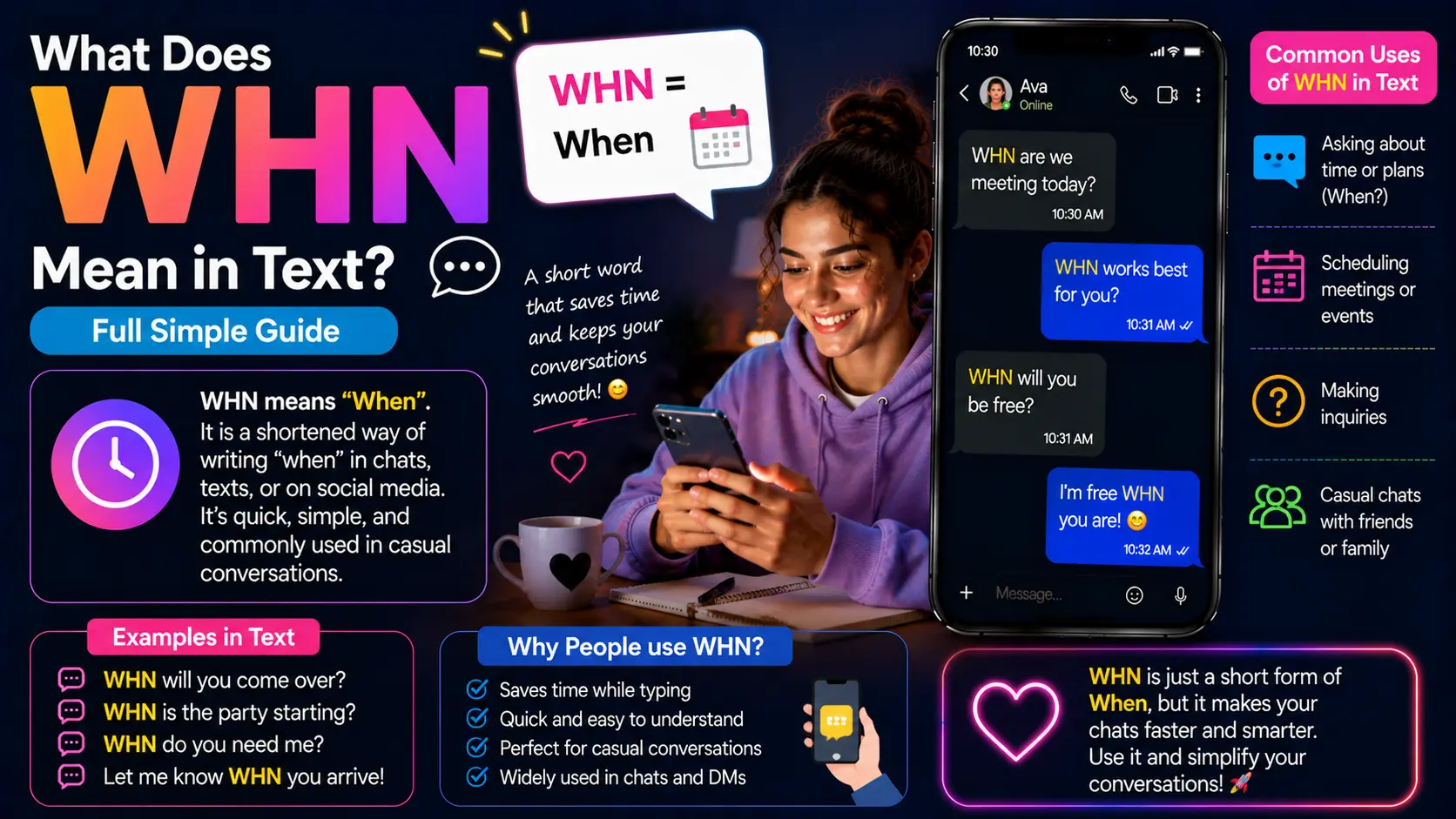
The term “whn” is a simple informal abbreviation of the word “when.”
Quick definition:
- “WHN” = “when”
- Used in casual texting and online chats
- Often appears in fast typing or informal speech-style writing
Examples:
- “whn are you coming?”
- “whn did that happen?”
- “whn will you be free?”
It is not a formal English word. It is purely digital shorthand.
4️⃣ Origin & Background
The abbreviation “whn” comes from the natural evolution of internet language. As texting and instant messaging became popular, people started shortening words to save time and effort.
Early platforms like SMS messaging, Yahoo Messenger, and early Facebook chats encouraged fast typing. Because of character limits and slow typing speeds on numeric keypads, users often removed vowels or unnecessary letters.
That is how shortcuts like:
- “whn” for “when”
- “pls” for “please”
- “tmrw” for “tomorrow”
became part of online communication.
Over time, this style of writing became normal in Gen Z texting culture. Even though smartphones now have full keyboards, the habit stayed because it feels quick and casual.
Social media platforms like Instagram, Snapchat, and TikTok further strengthened this style. People now use it not because they must, but because it feels informal and expressive.
5️⃣ Real-Life Conversations (MANDATORY)
WhatsApp Conversation
Ali:
whn are we meeting today?
Sara:
Around 6 pm. Don’t be late again 😅
Ali:
Ok I’ll try my best
Instagram DM
User1:
Hey, whn is your next post coming?
Influencer:
Probably tomorrow, working on it rn 🔥
TikTok Comment Section
Commenter:
whn did you start learning dance??
Creator:
About 2 years ago, still learning every day 💃
Text Message
Friend A:
whn will you send the notes?
Friend B:
Give me 10 minutes, I’m finishing them
These examples show how “whn” appears in natural, everyday digital conversations where speed and simplicity matter.
6️⃣ Emotional & Psychological Meaning
“WHN” may look like a simple abbreviation, but it reflects something deeper about modern communication.
It shows:
- Urgency in asking questions
- Casual tone between friends
- A desire for quick responses
- A relaxed attitude toward grammar in informal settings
People use “whn” when they feel comfortable with the other person. It creates a sense of closeness, like the conversation is private and informal.
A simple scenario:
Imagine you are waiting for your friend to confirm plans. Instead of typing “When will you arrive?”, you quickly send “whn u coming?”
It feels faster, more natural, and less formal. It also softens the tone, making the message feel friendly instead of strict.
Psychologically, this kind of shorthand reduces emotional distance. It makes digital conversations feel more like spoken language.
7️⃣ Usage in Different Contexts
Social Media
Used in comments, captions, or replies:
- “whn is this dropping?”
- “whn did this happen omg”
Friends & Relationships
Very common among close friends:
- “whn u free?”
- “whn we meeting again?”
Work / Professional Settings
Not appropriate in formal communication. However, sometimes appears in internal casual chats:
- “whn is the deadline?” (informal Slack chat only)
Casual vs Serious Tone
- Casual: Common and acceptable
- Serious: Not recommended
- Formal: Incorrect usage
8️⃣ When NOT to Use It
Even though “whn” is widely understood, there are situations where it should be avoided.
Do NOT use it:
- In job emails
- In academic writing
- In professional client communication
- In formal announcements
- When speaking to someone you do not know well
Why?
Because it can appear careless or unprofessional. In formal contexts, full spelling “when” should always be used.
9️⃣ Common Misunderstandings
Many people misunderstand “whn” because it looks like a typo.
Common confusion:
- Thinking it is a mistake
- Assuming it means something else
- Believing it is a different slang word
Tone confusion:
Sometimes “whn” can feel abrupt or impatient depending on context.
Example:
- “whn u coming?” can sound casual to friends
- but may sound slightly demanding to someone unfamiliar
Literal vs intended meaning:
- Literal: It is just “when” with missing letters
- Intended: A fast, informal version of asking time or timing
🔟 Comparison Table
| Expression | Meaning | Tone | Usage |
|---|---|---|---|
| whn | when | Very casual | Texting, chats |
| when | when | Neutral/formal | All contexts |
| wht | what | Casual | Informal chats |
| wen | when (slang typo) | Very casual | Internet slang |
| asap | as soon as possible | urgent | Work + casual |
| whn2go | when to go | ultra casual | group chats |
| when exactly | precise timing | formal | professional |
| at what time | full phrase | formal | all settings |
Key Insight:
“WHN” is not about changing meaning, but about speeding up communication in informal digital spaces where clarity and quickness matter more than spelling accuracy.
1️⃣1️⃣ Variations / Types
Here are common variations of “whn” seen online:
- whn → standard shorthand for when
- whn u → when you
- whn r u → when are you
- whn 2 go → when to go
- whn bck → when back
- whn comin → when coming
- whn free → when are you free
- whn start → when will it start
- whn meet → when to meet
- whn done → when will it be done
Each variation depends on how fast someone is typing and how casual the conversation is.
1️⃣2️⃣ How to Respond When Someone Uses It
Casual replies:
- “Soon, I’ll let you know”
- “In a bit”
- “Around 5 pm”
Funny replies:
- “whn I finish procrastinating 😂”
- “whn the universe aligns 🌌”
- “sooner than your patience allows 😆”
Mature replies:
- “I will confirm the exact time shortly”
- “I expect to be available by evening”
- “I’ll update you once it is fixed”
Respectful replies:
- “I appreciate your message, I’ll respond with timing soon”
- “Thank you for asking, I will confirm shortly”
1️⃣3️⃣ Regional & Cultural Usage
Western culture
Common in texting and social media among Gen Z and millennials. Mostly understood as informal slang.
Asian culture
Widely used in India, Pakistan, Philippines, and other regions where English texting blends with local languages. Often used in WhatsApp chats.
Middle Eastern culture
Used mainly among young people in online communication, especially in mixed-language chats (Arabic + English).
Global internet usage
Universal shorthand understood across platforms like Instagram, TikTok, and Snapchat.
Generational differences
- Gen Z: Uses it naturally and frequently
- Millennials: Understands and uses it occasionally
- Older generations: May see it as a typo
1️⃣4️⃣ Is It Safe for Kids?
Yes, “whn” is completely safe. It is just a shortened form of “when.”
However, children should also learn proper spelling for academic writing so they can switch between informal and formal English easily.
1️⃣5️⃣ FAQs
1. What does whn mean in text?
It means “when” in informal digital communication.
2. Is whn a real English word?
No, it is slang or shorthand used in texting.
3. Why do people write whn instead of when?
To type faster and keep conversations casual.
4. Can I use whn in school writing?
No, always use “when” in formal or academic work.
5. Does whn have different meanings?
No, it only means “when.”
6. Is whn rude?
Not usually, but tone depends on context.
7. Where is whn most commonly used?
In WhatsApp, Instagram, Snapchat, and casual chats.
1️⃣6️⃣ Conclusion
“WHN” is a small but powerful example of how language adapts in the digital world. It simply means “when,” but it carries the personality of fast, casual, and modern communication.
Understanding it helps you read messages more naturally and respond with confidence in everyday conversations.
As long as you use it in informal spaces, it fits perfectly into online chatting culture. In formal writing, just switch back to the full word “when.”
Language is flexible, and “whn” is proof of how people shape it to match real-life speed and emotion in communication.