
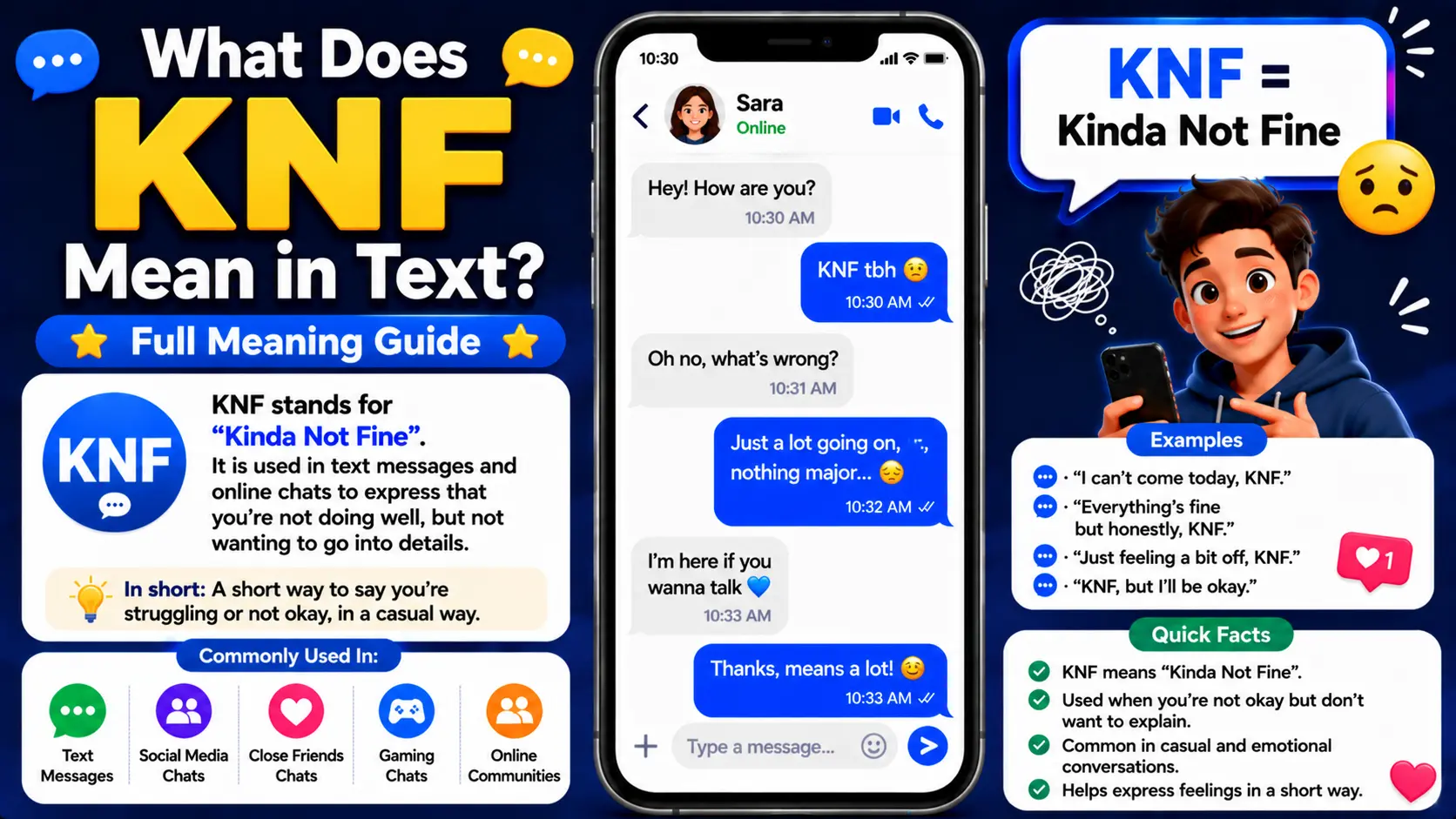
If you’ve recently come across “KNF” in a text message, social media comment, or online conversation, you may have wondered what it means. Like many internet abbreviations, KNF can be confusing because it is not as widely recognized as terms like LOL, BRB, or IMO.
People often search for “what does KNF mean in text” because the acronym can have different meanings depending on the context, platform, and group of people using it. In some conversations, it represents a casual expression among friends. In others, it may be a niche abbreviation used within a specific online community.
Understanding the meaning behind internet slang helps avoid misunderstandings and allows you to communicate more naturally in today’s digital world.
This guide explains the meaning of KNF, where it came from, how people use it in real conversations, and when you should or should not use it.
KNF Meaning in Text – Quick Meaning
In texting and online communication, KNF most commonly stands for “Okay, No Problem Friend” or a friendly variation expressing agreement and reassurance.
Because KNF is not a universally standardized abbreviation, some users create their own interpretations based on context. The key idea is usually friendliness, acknowledgment, or agreement.
Quick Definition
- A casual internet abbreviation
- Often used to show acceptance or understanding
- Typically appears in private chats and informal conversations
- Rarely used in formal communication
Examples
“Thanks for helping me out!”
“KNF 😊”
“Sorry I’m running late.”
“KNF, see you soon.”
“Can we reschedule?”
“KNF, tomorrow works.”
The surrounding conversation usually reveals the intended meaning.
Origin & Background
Unlike major internet abbreviations that became popular through early chat rooms, KNF appears to have emerged through smaller online communities and personal messaging habits.
Many internet slang terms develop organically when users shorten phrases to save time. As texting became more common, people began creating customized abbreviations that made sense within their friend groups.
Cultural Influence
Digital communication rewards speed and convenience. Short forms like KNF allow people to communicate reassurance with only a few characters.
Social Media Impact
Platforms such as:
- TikTok
- Snapchat
- Discord
have encouraged the spread of creative abbreviations. Some remain niche while others become mainstream.
KNF falls into the category of lesser-known acronyms that may be familiar within certain circles but not universally understood.
Evolution of Meaning
Over time, abbreviations often gain multiple interpretations. Different communities may assign slightly different meanings to KNF while keeping the same friendly or agreeable tone.
That flexibility is one reason people become confused when encountering it for the first time.
Real-Life Conversations
WhatsApp Conversation
Person A: Sorry, I forgot to reply yesterday.
Person B: KNF. I know you’ve been busy.
Person A: Thanks for understanding.
Person B: Anytime.
Instagram DM
Person A: I can’t make it to the event tonight.
Person B: KNF! We’ll catch up next time.
Person A: Appreciate it.
TikTok Comments
Person A: Sorry if my comment sounded rude.
Person B: KNF, I didn’t take it that way.
Person A: Glad to hear that.
Text Message
Person A: Can we move our meeting to Friday?
Person B: KNF, Friday actually works better.
Person A: Perfect!
Emotional & Psychological Meaning
At its core, KNF often communicates reassurance.
When people use abbreviations like this, they are not just saving time. They are also expressing a feeling.
Common emotions behind KNF include:
- Understanding
- Acceptance
- Patience
- Friendliness
- Emotional support
Digital conversations can sometimes feel cold or impersonal. Small expressions like KNF help soften communication and reduce tension.
Why People Use It
People enjoy language shortcuts that make conversations feel relaxed and familiar.
Using KNF can signal:
- “I’m not upset.”
- “Everything is okay.”
- “Don’t worry about it.”
- “We’re good.”
Personal-Style Scenario
Imagine a friend accidentally misses your birthday dinner and apologizes repeatedly.
Instead of writing a long explanation, you reply:
“KNF. We can celebrate another day.”
That short response immediately removes pressure and reassures the other person.
This illustrates how modern communication often values emotional efficiency alongside brevity.
Usage in Different Contexts
Social Media
On social media, KNF may appear in:
- Comment sections
- Direct messages
- Group chats
- Gaming communities
The tone is usually light and friendly.
Friends & Relationships
Among friends, KNF often functions as a quick acknowledgment.
Example:
“Sorry for texting so late.”
“KNF!”
The response communicates comfort and acceptance.
Work & Professional Settings
KNF is generally not recommended in professional communication.
Business emails and workplace messages typically benefit from clear language such as:
- “No problem.”
- “That’s fine.”
- “I understand.”
Using obscure abbreviations can create confusion.
Casual vs Serious Tone
Casual:
“KNF, don’t worry about it.”
Serious Situation:
A more complete response is often better than slang.
For emotionally sensitive conversations, clarity matters more than brevity.
When NOT to Use It
There are situations where KNF may not be appropriate.
Formal Business Communication
Avoid using KNF in:
- Professional emails
- Job applications
- Academic writing
- Client communications
Sensitive Situations
If someone is discussing:
- Grief
- Trauma
- Serious conflict
- Major life challenges
A short abbreviation may seem dismissive.
Cross-Cultural Conversations
Not everyone recognizes KNF.
Using unfamiliar slang can create confusion when speaking with international audiences.
New Relationships
When communicating with someone you barely know, plain language is usually safer.
Common Misunderstandings
Assuming Everyone Knows It
Many internet users have never encountered KNF.
Always consider your audience.
Misreading the Tone
Some people may interpret KNF as:
- Indifference
- Dismissiveness
- Lack of interest
even when it was intended positively.
Literal vs Contextual Meaning
KNF does not have one universally accepted definition.
Context determines meaning.
That is why reading the entire conversation is important.
Comparison Table
| Expression | Meaning | Tone |
|---|---|---|
| KNF | Friendly reassurance or agreement | Warm |
| NP | No Problem | Casual |
| NBD | No Big Deal | Relaxed |
| OK | Agreement | Neutral |
| TY | Thank You | Appreciative |
| IDC | I Don’t Care | Dismissive |
| DW | Don’t Worry | Supportive |
| IMO | In My Opinion | Opinion-based |
Key Insight
KNF belongs to a family of digital expressions designed to make conversations feel easier and less stressful. Its primary role is usually reassurance rather than providing information.
Variations and Related Forms
1. NP
Meaning: No Problem
A common alternative expressing understanding.
2. NBD
Meaning: No Big Deal
Used when something is considered minor.
3. DW
Meaning: Don’t Worry
Offers reassurance.
4. NW
Meaning: No Worries
Friendly and relaxed.
5. KK
Meaning: Okay
Quick acknowledgment.
6. TY
Meaning: Thank You
Expresses gratitude.
7. TTYL
Meaning: Talk To You Later
Ends a conversation politely.
8. BRB
Meaning: Be Right Back
Indicates a temporary absence.
9. IMO
Meaning: In My Opinion
Introduces a personal viewpoint.
10. TBH
Meaning: To Be Honest
Signals honesty or sincerity.
How to Respond When Someone Uses It
Casual Replies
- “Thanks!”
- “Good to know.”
- “Appreciate it.”
- “Awesome.”
Funny Replies
- “You’re officially the nicest person today.”
- “Crisis avoided!”
- “You deserve a virtual trophy.”
- “Friendship level increased.”
Mature Replies
- “Thank you for understanding.”
- “I appreciate your patience.”
- “That means a lot.”
Respectful Replies
- “Thanks for being flexible.”
- “I appreciate your support.”
- “Glad we’re on the same page.”
Regional & Cultural Usage
Western Culture
In North America and parts of Europe, internet abbreviations are widely accepted among younger users.
KNF may appear in friend groups that enjoy shorthand communication.
Asian Culture
Many Asian internet communities use local slang alongside English abbreviations.
KNF may be understood within bilingual digital spaces but is not universally recognized.
Middle Eastern Culture
Online users often mix English abbreviations with native languages.
The meaning may depend heavily on the specific community.
Global Internet Usage
Worldwide internet culture constantly creates new acronyms.
KNF remains relatively niche compared to global favorites like LOL or OMG.
Gen Z vs Millennials
Gen Z
- More likely to experiment with new abbreviations
- Comfortable interpreting context-based slang
Millennials
- Familiar with internet acronyms
- May prefer clearer communication when abbreviations become too obscure
Generational differences often influence how quickly new slang spreads.
Is It Safe for Kids?
Generally, KNF is considered safe because it is usually associated with friendly and non-offensive communication.
However, parents and educators should remember that internet slang can change over time.
The safest approach is to look at the surrounding conversation rather than focusing on the abbreviation alone.
Context always matters.
Frequently Asked Questions
What does KNF mean in text messages?
KNF is commonly used as a friendly expression of agreement, reassurance, or understanding in casual conversations.
Is KNF a popular slang term?
It is relatively niche compared to abbreviations like LOL, OMG, or BRB.
Can KNF have different meanings?
Yes. Like many internet acronyms, its meaning can vary depending on the community and context.
Is KNF appropriate for work emails?
No. Clear, professional language is usually a better choice in workplace communication.
Does KNF mean something negative?
Typically no. It is generally used in a positive or reassuring way.
Why do people use KNF?
People use it to save time and communicate understanding in a quick, friendly manner.
Should I use KNF if I’m unsure?
If you are unsure whether the other person understands it, writing the full phrase is usually the safer option.
Conclusion
Understanding what KNF means in text is largely about understanding context. In most casual conversations, KNF functions as a friendly acknowledgment that communicates reassurance, acceptance, or agreement.
While it is not one of the internet’s most widely recognized acronyms, it reflects an important trend in digital communication: people want messages that are quick, efficient, and emotionally supportive.
Whether you encounter KNF in a WhatsApp chat, Instagram DM, TikTok comment, or text message, paying attention to the surrounding conversation will usually reveal the intended meaning.
As with all online slang, the best approach is balance. Use abbreviations when they make communication easier, but choose clear language when understanding matters most.