

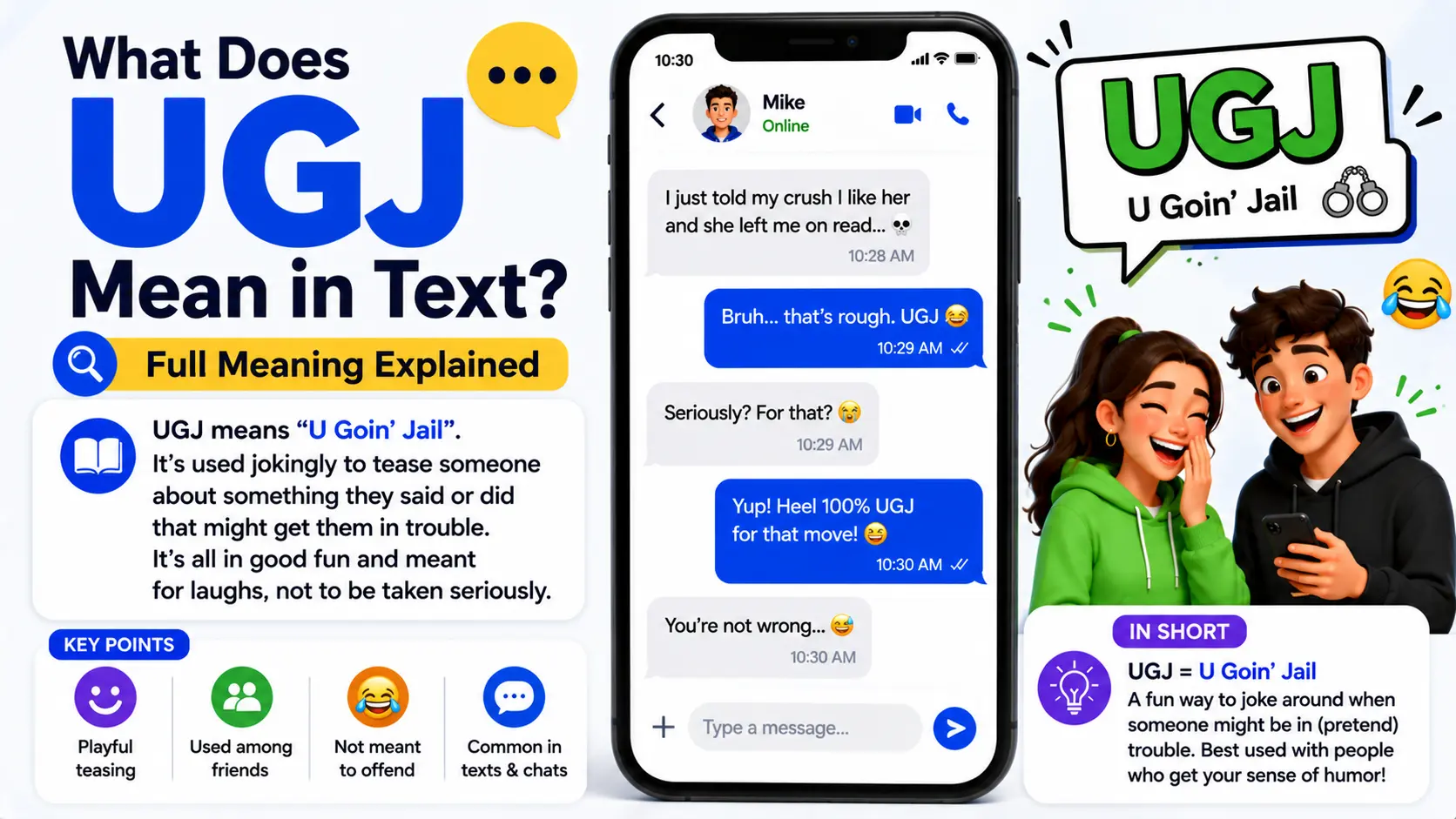
If you’ve recently seen “UGJ” in a text message, TikTok comment, Snapchat reply, or Instagram DM, you’re not alone in wondering what it means. Internet slang changes fast, and many abbreviations appear out of nowhere before spreading across social media.
The term “UGJ” often confuses people because it does not have one universally accepted meaning. In most texting and online situations, UGJ is commonly used as shorthand for “U Go Girl” or “You Go, Girl!” It’s usually a supportive, encouraging expression used to cheer someone on.
At the same time, some people use UGJ differently depending on the platform, friend group, or gaming community. That’s why so many users search for its meaning after seeing it online.
In this guide, you’ll learn:
- What UGJ means in text
- Where it came from
- How people actually use it
- Emotional and cultural context
- When you should or should not use it
- Common misunderstandings
- Real conversation examples
By the end, you’ll know exactly how to understand and respond to UGJ naturally.
UGJ – Quick Meaning
UGJ usually means:
- “U Go Girl”
- A supportive or celebratory phrase
- Used to encourage someone
- Common in texting and social media comments
People use it when someone shares:
- Good news
- Confidence
- Success
- A bold opinion
- A glow-up or achievement
Quick Examples
“You finally quit that toxic job? UGJ 🔥”
“Started my business today.”
“UGJ!! Proud of you.”
“She posted her graduation pics and everyone commented UGJ.”
The tone is usually positive, playful, and uplifting.
Origin & Background
UGJ likely evolved from the phrase “You Go Girl!”, which became extremely popular in pop culture during the 1990s and early 2000s.
The original phrase was often used:
- In movies and TV shows
- Among close friends
- In supportive female friendships
- During celebrations or moments of empowerment
As texting became shorter and faster, people began compressing common phrases into abbreviations. “You Go Girl” eventually became:
- YGG
- UGG
- UGJ in some online circles
Internet culture helped spread these shortened forms through:
- Snapchat
- TikTok comments
- Twitter/X replies
- Instagram captions
- Gaming chats
Interestingly, UGJ is not as standardized as terms like LOL or BRB. That’s why context matters heavily.
In some niche communities, people may attach different meanings to UGJ. However, the supportive interpretation remains the most recognizable in casual texting culture.
Real-Life Conversations
WhatsApp Conversation
Person A:
I finally passed my driving test today 😭
Person B:
UGJ!! I knew you could do it 🚗✨
Instagram DM
Person A:
I posted my first makeup tutorial and people actually liked it.
Person B:
UGJ girl 💖 keep posting!
TikTok Comments
Creator:
Started healing instead of chasing toxic people.
Commenter:
UGJ 👏 growth looks good on you
Text Message
Person A:
I told my boss I deserved better pay.
Person B:
UGJ. That takes confidence honestly.
Emotional & Psychological Meaning
At its core, UGJ is about encouragement.
People use it because modern digital communication often lacks emotional warmth. A short supportive phrase can instantly make someone feel seen, appreciated, or validated.
When someone says UGJ, they are usually expressing:
- Pride
- Excitement
- Emotional support
- Admiration
- Motivation
It also reflects how online friendships work today. Many people communicate through quick reactions instead of long conversations. A small phrase like UGJ can carry emotional energy without requiring a huge message.
There’s also a confidence element attached to it. Saying “You go girl” celebrates independence, courage, and personal growth.
Personal-Style Scenario
Imagine someone posting:
“I finally left a relationship that drained me emotionally.”
A simple “UGJ ❤️” in the comments can feel more meaningful than a long paragraph because it instantly communicates support and solidarity.
That emotional shorthand is one reason internet slang spreads so quickly.
Usage in Different Contexts
Social Media
On social platforms, UGJ is mostly used:
- Under selfies
- Achievement posts
- Glow-up videos
- Fitness transformations
- Graduation photos
It acts like a mini cheerleading phrase.
Example:
“Started my skincare journey.”
“UGJ ✨”
Friends & Relationships
Among friends, UGJ feels casual and affectionate.
People use it when:
- A friend becomes more confident
- Someone sets boundaries
- Someone succeeds academically or emotionally
It often strengthens emotional connection in conversations.
Work / Professional Settings
UGJ is generally not appropriate in professional communication.
Avoid using it in:
- Work emails
- Client chats
- Formal LinkedIn messages
- Academic writing
In professional settings, phrases like:
- “Great job”
- “Well done”
- “Congratulations”
sound more polished and respectful.
Casual vs Serious Tone
UGJ works best in casual environments.
It sounds:
- Fun
- Relaxed
- Emotionally expressive
However, in serious conversations involving grief, trauma, or conflict, it may feel too playful or insensitive.
Tone matters more than the abbreviation itself.
When NOT to Use It
Even supportive slang has limits.
Avoid UGJ in these situations:
Formal Situations
Do not use it:
- In job interviews
- Professional emails
- School essays
- Official communication
It can appear immature or unclear.
Sensitive Emotional Situations
If someone is discussing:
- Loss
- Mental health struggles
- Serious family issues
UGJ may sound dismissive or emotionally shallow.
Cross-Cultural Conversations
Not everyone understands internet slang equally.
Using UGJ with:
- Older relatives
- International coworkers
- Non-native English speakers
may create confusion.
Situations Needing Clarity
Sometimes abbreviations reduce emotional depth.
For example:
Instead of saying:
“UGJ”
A fuller response like:
“I’m genuinely proud of you”
may feel more meaningful.
Common Misunderstandings
One major issue with UGJ is that people interpret it differently.
People Think It’s a Typo
Some users assume:
- It was typed accidentally
- It’s random keyboard letters
- It’s a username abbreviation
Because UGJ is less common than LOL or OMG, confusion happens often.
Tone Confusion
Without emojis or context, UGJ can sound:
- Sarcastic
- Dismissive
- Passive-aggressive
Example:
“Oh… UGJ.”
The tone completely changes depending on punctuation and relationship dynamics.
Literal vs Figurative Meaning
Some people interpret “You Go Girl” literally as gender-specific encouragement.
But online, many users apply it more broadly:
- To friends regardless of gender
- As a meme-style supportive phrase
- Ironically in humorous conversations
Context always determines intent.
Comparison Table
| Expression | Meaning | Tone | Common Usage |
|---|---|---|---|
| UGJ | You Go Girl | Encouraging | Supportive reactions |
| SLAY | You’re doing amazing | Confident | Fashion, success, attitude |
| PERIOD | Agreement/emphasis | Bold | Strong opinions |
| W | Win/success | Casual | Gaming and achievements |
| Proud of you | Direct emotional support | Sincere | Personal moments |
| L | Failure/loss | Negative | Competitive slang |
| GG | Good game | Friendly | Gaming culture |
| Queen | Admiration | Playful/supportive | Social media compliments |
Key Insight
UGJ stands out because it combines encouragement with emotional warmth. Unlike harsher or meme-heavy slang, it usually carries genuine positivity.
Variations / Types
1. UGG
Another shortened version of “You Go Girl.”
2. YGG
A more direct abbreviation for “You Go Girl.”
3. Slay
Means someone is doing exceptionally well.
4. Ate
Used when someone performed impressively.
5. Queen
A compliment showing admiration or empowerment.
6. Pop Off
Encourages someone to express themselves boldly.
7. Big W
Means a major success or victory.
8. Proud of U
A more emotional and sincere supportive phrase.
9. Keep Shining
Encourages continued confidence and growth.
10. Go Off
Supports someone speaking honestly or confidently.
How to Respond When Someone Uses It
If someone sends you UGJ, your reply depends on the vibe of the conversation.
Casual Replies
- “Aww thank you 😭”
- “Haha appreciate it”
- “Trying my best honestly”
Funny Replies
- “Main character energy activated”
- “I’ve entered my success era”
- “Watch me become famous now”
Mature Replies
- “That genuinely means a lot.”
- “I’ve been working hard for this.”
- “Thank you for supporting me.”
Respectful Replies
- “I appreciate your encouragement.”
- “That’s really kind of you.”
- “Thanks for believing in me.”
Regional & Cultural Usage
Western Culture
In Western online culture, UGJ fits into empowerment language and supportive internet slang.
It’s especially common among:
- Gen Z users
- Lifestyle creators
- Friendship circles
- TikTok communities
Asian Culture
In many Asian online communities, supportive slang exists too, but UGJ itself may be less common.
People may understand the emotional tone through context rather than the abbreviation itself.
Middle Eastern Culture
In Middle Eastern digital spaces, English slang is widely mixed with local languages. Younger users may recognize UGJ from TikTok or Instagram trends.
However, older generations may not understand it immediately.
Global Internet Usage
Internet culture constantly blends slang across countries.
Even when users don’t fully know the literal meaning, they often recognize UGJ as:
- Positive
- Supportive
- Friendly
That emotional tone travels faster than the exact definition.
Generational Differences
Gen Z
- Uses abbreviations naturally
- Understands internet slang quickly
- Often uses UGJ casually or ironically
Millennials
- More likely to type the full phrase
- May recognize the meaning but use it less often
Older generations may find it confusing or unnecessary.
Is It Safe for Kids?
Yes, UGJ is generally safe for kids.
It is usually:
- Positive
- Encouraging
- Non-explicit
Still, parents should understand the broader online context where slang evolves quickly. Even harmless abbreviations can appear in conversations with sarcasm or peer pressure depending on tone.
Context matters more than the letters themselves.
FAQs
What does UGJ stand for in text?
UGJ usually stands for “U Go Girl” or “You Go Girl,” which is a supportive and encouraging phrase.
Is UGJ a compliment?
Yes. In most cases, it’s meant positively to celebrate confidence, success, or personal growth.
Is UGJ used on TikTok?
Yes. You’ll often see UGJ in TikTok comments, Instagram replies, and Snapchat conversations.
Can boys use UGJ?
Yes. Although the original phrase references “girl,” internet slang is flexible, and many people use it casually regardless of gender.
Is UGJ rude?
Not usually. However, tone and context can make it sound sarcastic if used mockingly.
Why do people shorten phrases like this?
People shorten phrases for speed, style, humor, and internet culture convenience.
Is UGJ popular worldwide?
It is recognized in many online communities, though usage varies by age group, country, and platform.
Conclusion
UGJ may look confusing at first, but in most online conversations, it carries a simple and uplifting meaning: encouragement.
Whether someone just achieved a goal, posted a confidence boost, or shared a personal victory, UGJ acts like a quick digital cheer. It reflects how modern communication has become faster while still trying to preserve emotional connection.
The most important thing to remember is context. Like many internet abbreviations, UGJ changes slightly depending on tone, platform, and relationship dynamics.
Once you understand the emotional intent behind it, recognizing and using UGJ becomes much easier and more natural.
So the next time you see someone winning at life online, you’ll know exactly what to say.
UGJ. 🌟