
If you’ve ever received a message that simply says “whyd,” you probably paused for a second. It looks incomplete, almost like a typo. But it’s not.
“Whyd” is one of those modern texting shortcuts that reflects how fast and informal digital communication has become. People use it in casual chats, social media comments, and quick replies where typing speed matters more than perfect grammar.
Many people search for “whyd mean in text” because the meaning isn’t instantly obvious. Is it a question? Is it sarcastic? Is it emotional? The truth is, it can be all of those depending on context.
This guide breaks it down in a natural, real-world way so you can understand it and use it confidently.
Whyd Mean in Text – Quick Meaning
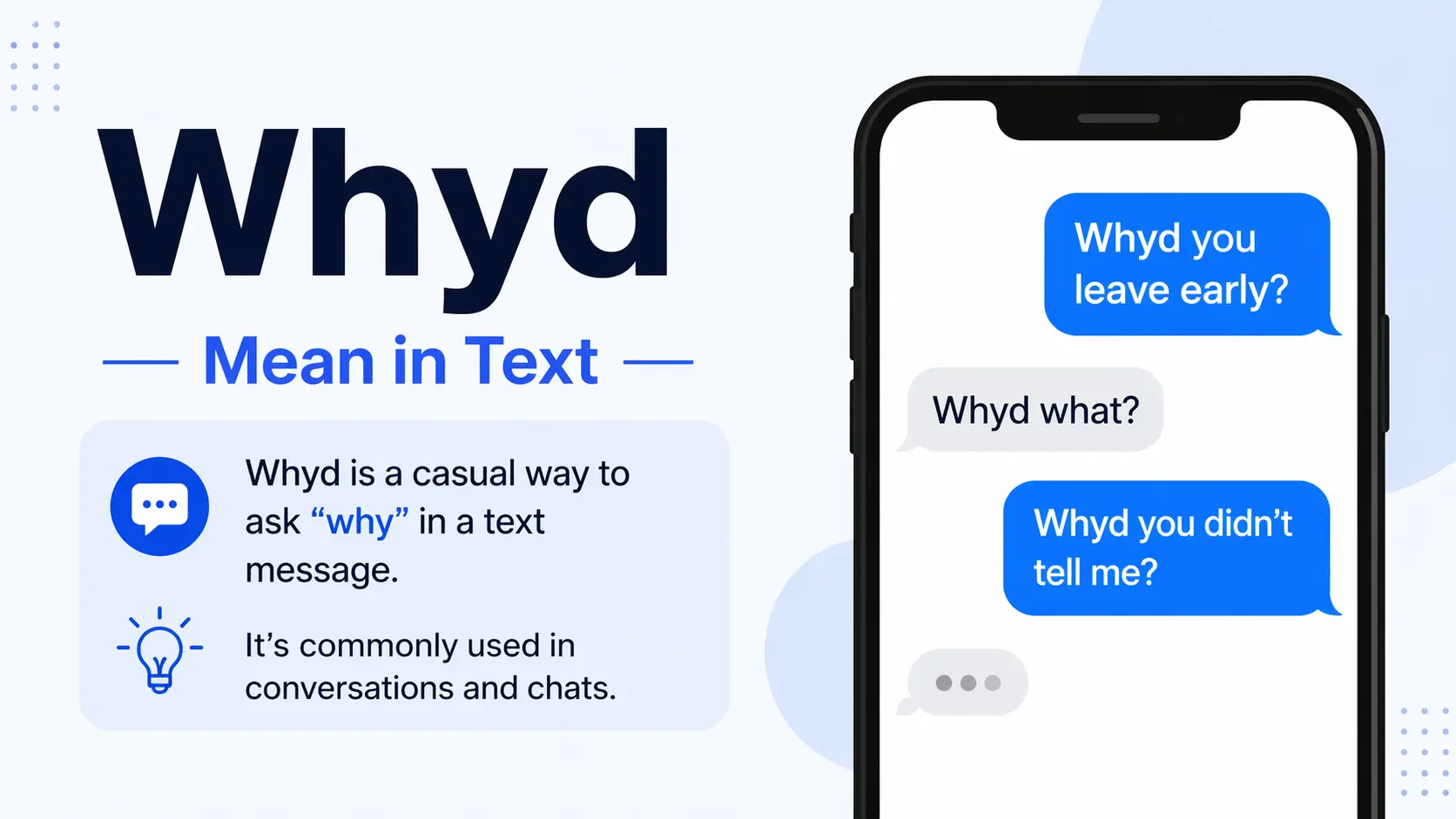
“Whyd” is a shortened version of:
👉 “Why did”
It is commonly used in casual texting to ask about something that already happened.
Simple Breakdown:
- “why” + “did” → whyd
- Used in informal conversations
- Often appears in quick messages or reactions
Examples:
- “whyd you leave early?”
- “whyd you say that?”
- “whyd he block me?”
Even though it looks unusual, once you see it a few times, it becomes easy to recognize.
Origin & Background
“Whyd” comes from the natural evolution of texting language. As smartphones and messaging apps became popular, people started shortening phrases to type faster.
This trend grew alongside platforms like:
- SMS texting
- Instagram DMs
- TikTok comments
Short forms like “idk” (I don’t know) and “wyd” (what are you doing) became mainstream. “Whyd” followed the same pattern but stayed slightly less common.
Its rise is connected to:
- Fast typing culture
- Informal communication habits
- Younger generations experimenting with language
Over time, “whyd” became a quick way to ask “why did you…” without typing the full sentence.
Real-Life Conversations
Here’s how “whyd” naturally appears in everyday chats.
WhatsApp Chat
Person A: I saw you left the group
Person B: yeah
Person A: whyd tho?
Instagram DMs
Person A: You deleted your post 😭
Person B: yeah it felt weird
Person A: whyd it was so good
TikTok Comments
User 1: This video was perfect
User 2: whyd you remove the ending 😩
Text Message
Person A: I called you yesterday
Person B: sorry I was busy
Person A: whyd you didn’t text back
These examples show that “whyd” often carries curiosity, confusion, or even emotion.
Emotional & Psychological Meaning
“Whyd” is not just about asking a question. It often carries emotional weight.
Depending on the tone, it can express:
- Curiosity → “whyd you do that?”
- Confusion → “whyd this happen?”
- Disappointment → “whyd you ignore me?”
- Concern → “whyd you leave suddenly?”
People use it because it feels quick and less formal. It allows them to react instantly without overthinking the wording.
A Real-Life Scenario
Imagine you post something meaningful and then delete it. A friend messages:
“whyd you delete it?”
They are not just asking for a reason. They are showing they noticed and care. That small word carries attention and emotion.
Usage in Different Contexts
Social Media
“Whyd” appears frequently in comments and DMs where people react quickly.
Example:
- “whyd you change the caption?”
Friends & Relationships
Among friends, it feels casual and natural.
Example:
- “whyd you not come yesterday?”
In relationships, it can carry more emotional tone depending on context.
Work / Professional Settings
This is where you should avoid it.
Instead of:
- “whyd you send this late?”
Use:
- “Why did you send this late?”
Professional communication requires clarity and respect.
Casual vs Serious Tone
- Casual → friendly, quick, relaxed
- Serious → may sound blunt or slightly confrontational
Tone depends heavily on context and relationship.
When NOT to Use It
There are situations where “whyd” can feel inappropriate.
Avoid it in:
- Job emails or formal communication
- Academic writing
- Professional messages
- Serious conversations requiring clarity
Why?
It may come across as:
- Lazy
- Rude
- Emotionally unclear
In sensitive situations, full sentences are always better.
Common Misunderstandings
Many people get confused about “whyd.”
1. Thinking it’s a typo
It looks like a mistake, but it’s intentional slang.
2. Tone confusion
“whyd” can sound neutral or slightly aggressive depending on context.
Example:
- “whyd you do that?” → curious or confrontational
3. Grammar issues
People often mix it incorrectly:
❌ “whyd you didn’t come”
✔ “whyd you not come” (still informal)
✔ “why didn’t you come” (correct)
Comparison Table
| Expression | Meaning | Tone | Usage |
|---|---|---|---|
| whyd | why did | casual | texting, DMs |
| why did | full form | neutral | everywhere |
| wyd | what are you doing | casual | chatting |
| idk | I don’t know | casual | texting |
| because | giving reason | neutral | all contexts |
Key Insight
“Whyd” is part of a larger trend where speed replaces structure. It works best in informal spaces but loses clarity in serious communication.
Variations / Types
Here are common variations you might see:
- whyd u → why did you
- whyd you → same meaning, slightly clearer
- whyd they. → asking about others
- whyd tho → adds emotion or emphasis
- whyd this happen → asking about events
- whyd you do that → common reaction phrase
- whyd I do that → self-reflection
- whyd they leave → group context
- whyd it matter → questioning importance
- whyd you even say that → emotional tone
Each variation depends on context and emotion.
How to Respond When Someone Uses It
Casual Replies
- “just felt like it”
- “no reason honestly”
- “I had to”
Funny Replies
- “plot twist 😄”
- “main character energy”
- “because chaos”
Mature Replies
- “I wasn’t comfortable with it”
- “it didn’t feel right to me”
- “I needed a break”
Respectful Replies
- “I’ll explain when you’re free”
- “there’s a reason, I’ll share later”
- “it’s a bit personal”
Your response depends on how serious the question is.
Regional & Cultural Usage
Western Culture
“Whyd” is more common among younger users. It fits into fast, informal texting habits.
Asian Culture
Less commonly used in formal English communication. People prefer clearer grammar, especially in professional settings.
Middle Eastern Culture
Used occasionally in casual chats but not widely accepted in formal communication.
Global Internet Usage
Seen across platforms, especially where English slang dominates.
Generational Differences
- Gen Z: uses it naturally and frequently
- Millennials: understand it but may not use it often
Younger users are more comfortable bending language rules.
Is It Safe for Kids?
Yes, “whyd” is safe. It is not offensive or inappropriate.
However, kids should learn:
- When to use slang
- When to use proper grammar
Balance is important for communication skills.
FAQs
1. What does “whyd” stand for?
It stands for “why did.”
2. Is “whyd” correct English?
No, it is informal slang, not grammatically standard.
3. Can I use “whyd” in school or work?
It’s better to avoid it in formal settings.
4. Is “whyd” rude?
Not necessarily. Tone depends on context.
5. Why do people use “whyd”?
To save time and keep conversations casual.
6. Is it the same as “why did”?
Yes, but less formal and less clear.
7. How do I reply to “whyd”?
Respond based on tone. You can be casual, honest, or detailed.
Conclusion
“Whyd” is a small word with a simple meaning, but it reflects a much bigger shift in how we communicate today.
It shows how language adapts to speed, convenience, and emotion. In casual conversations, it feels natural and expressive. In formal situations, it falls short.
Understanding when and how to use it gives you an advantage. You can switch between relaxed and professional communication without confusion.
At the end of the day, “whyd” is not just about grammar. It is about connection, curiosity, and the way we interact in a fast-moving digital world.