
In the fast-paced world of texting and social media, acronyms fly across screens every second. One you may have stumbled upon recently is SYK. If you are scratching your head wondering what someone meant when they sent “SYK,” you are not alone. People search this term constantly because it can be confusing, especially when context is minimal. Understanding SYK not only saves miscommunication but also helps you stay fluent in modern digital conversation.
Whether you are chatting with friends on WhatsApp, reading Instagram DMs, or scrolling TikTok comments, knowing what SYK stands for makes your online interactions smoother. This guide breaks it down in plain English, with real-life examples, emotional insight, and practical usage tips.
SYK – Quick Meaning
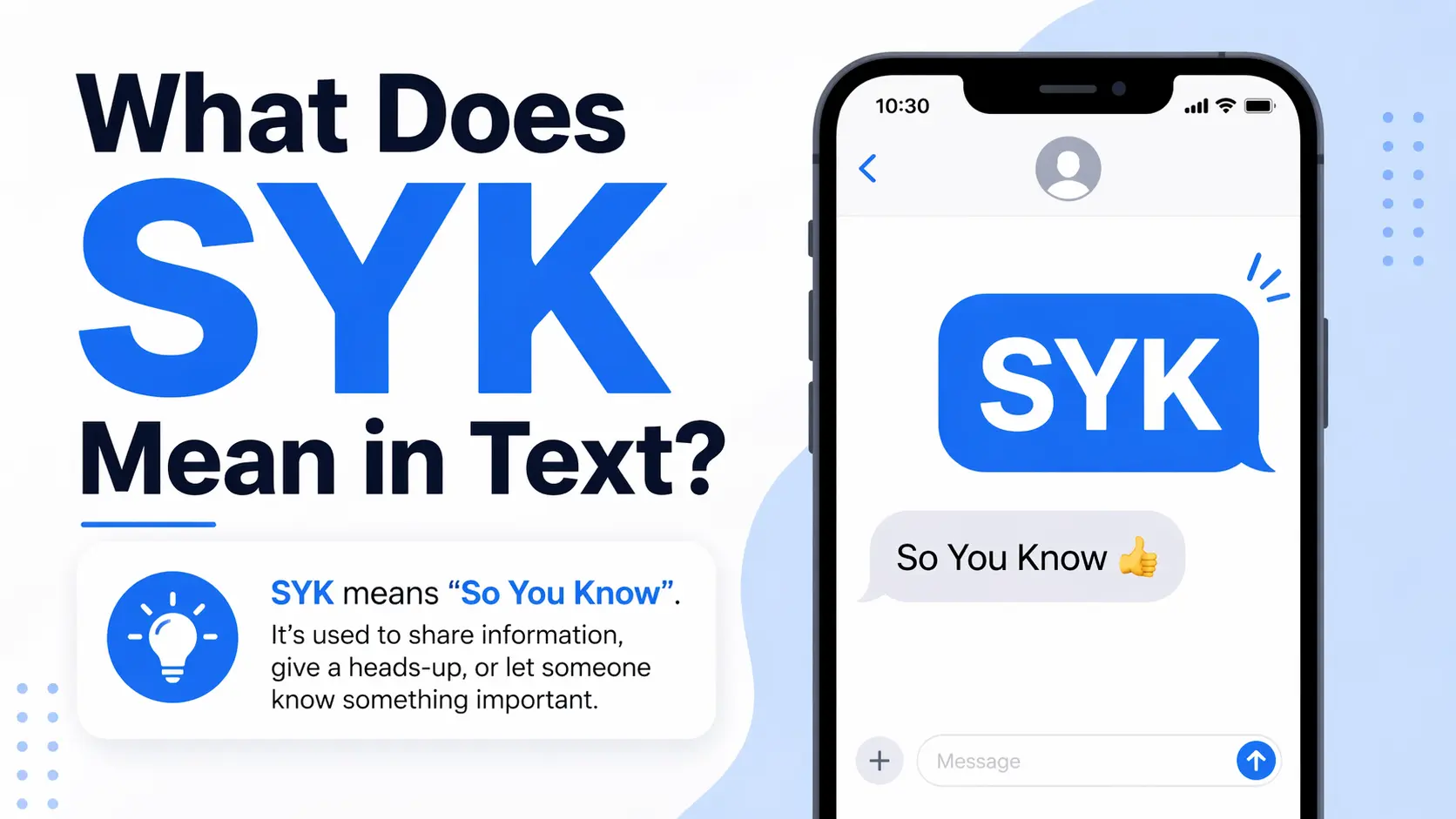
At its core, SYK is an abbreviation, and the most widely accepted meaning is:
SYK = See You Know or So You Know
- Often used to clarify or give a heads-up
- Can carry a casual, informative, or slightly sarcastic tone depending on context
- Common in texting, DMs, and social media replies
Examples in conversation:
- “SYK, the meeting starts at 3 PM today.”
- “I’m not ignoring you, SYK, just busy.”
- “SYK, I’ll be out of town this weekend.”
This short abbreviation saves time but also adds a casual, conversational layer to your text.
Origin & Background
SYK emerged with the rise of internet shorthand. Early 2000s texting and instant messaging platforms like AOL Instant Messenger and SMS laid the groundwork for abbreviations like LOL, BRB, and OMG. As platforms evolved—think Instagram, TikTok, and WhatsApp—users began compressing phrases even further.
- Cultural influence: It mirrors spoken English shortcuts. People naturally shorten “So you know” to “SYK” for efficiency.
- Social media impact: It became popular in comment threads where space is limited and speed is key.
- Evolution: While it started as a practical tool, it now also conveys tone and attitude subtly, often hinting at casualness or mild warning.
Real-Life Conversations
Here are realistic examples to see SYK in action:
WhatsApp
Person A: “Are we still meeting tomorrow?”
Person B: “SYK, I can only come after 5 PM.”
Instagram DM
Person A: “Did you tell her about the surprise?”
Person B: “Not yet, SYK, I’m planning to call tonight.”
TikTok Comments
User1: “I can’t believe this happened 😳”
User2: “SYK, it’s been trending all week 😂”
Text Message
Person A: “I heard rumors about the event?”
Person B: “SYK, it’s true. Just keep it low-key.”
These examples show how SYK keeps communication quick, clear, and expressive.
Emotional & Psychological Meaning
Using SYK is more than shorthand—it carries emotional nuance.
- Clarity: It signals information you should notice
- Casual authority: It subtly asserts you have knowledge
- Relatability: People feel connected when someone shares info efficiently
Scenario: Imagine texting a friend about a party. “SYK, it starts at 8.” That small message communicates awareness, social engagement, and thoughtfulness all at once. Modern digital communication thrives on these micro-emotional signals, and SYK is a perfect example.
Usage in Different Contexts
- Social media: Perfect for comments or quick updates, e.g., “SYK, the trend is coming back.”
- Friends & relationships: Casual updates or teasing, e.g., “SYK, your crush asked about you 😏”
- Work / professional: Use sparingly, usually internal team chats, e.g., “SYK, the deadline moved to Friday.”
- Casual vs serious tone: Casual in friend groups, more neutral in professional contexts.
When NOT to Use It
- Formal emails: Avoid in client emails or reports
- Misunderstanding risk: Not everyone knows slang; it can confuse older colleagues or less tech-savvy contacts
- Cultural sensitivity: Some regions interpret abrupt abbreviations as rude
Common Misunderstandings
People often misinterpret SYK as:
- A typo for “sick”
- “See You” or “You Know” incorrectly
- Sarcasm when none is intended
Tone matters. Without context, the same SYK message could feel friendly, abrupt, or sarcastic.
Comparison Table
| Expression | Meaning | Tone | When to Use |
|---|---|---|---|
| SYK | So You Know | Casual/informative | Quick updates |
| FYI | For Your Information | Neutral/formal | Professional info |
| TMI | Too Much Information | Informal | Over-sharing jokes |
| LMK | Let Me Know | Casual/request | Asking response |
| BTW | By The Way | Casual | Adding info |
Key Insight: SYK sits comfortably between formal and informal shorthand, making it versatile but dependent on context.
Variations / Types
- SYK – So You Know; general heads-up
- SYK, FYI – Combined for clarity
- SYK 😉 – Adds playful tone
- SYK… – Indicates suspense or emphasis
- SYK rn – “Right now,” urgent notice
- SYK tbh – “To be honest,” casual honesty
- SYK ASAP – Urgent heads-up
- SYK fam – Friendly, peer-group tone
- SYK bruh – Informal, humorous
- SYK lol – Light-hearted info
How to Respond When Someone Uses It
- Casual: “Got it, thanks!”
- Funny: “SYK you’re the best 😂”
- Mature: “Appreciate the update”
- Respectful: “Thanks for letting me know, noted.”
Regional & Cultural Usage
- Western culture: Casual, often humorous or sarcastic
- Asian culture: Increasingly used among younger tech-savvy groups
- Middle Eastern culture: Growing in social media circles
- Global internet: Common in fast-paced online communities
- Generational differences: Gen Z uses it more freely; Millennials may interpret it literally or sparingly
Is It Safe for Kids?
Generally, yes. SYK is non-explicit, neutral language. Parents or educators should ensure children understand context to avoid misinterpretation.
FAQs
Q1: Is SYK the same as FYI?
A1: Not exactly. FYI is more formal; SYK is casual and often friendly.
Q2: Can SYK be sarcastic?
A2: Yes, tone depends on punctuation and context.
Q3: Is SYK only used online?
A3: Mostly, but it can appear in text messages or casual spoken chats.
Q4: Do adults use SYK?
A4: Yes, especially in tech-savvy or casual professional contexts.
Q5: Can SYK be misunderstood?
A5: Yes, especially by those unfamiliar with internet slang.
Q6: How do I know when to use SYK?
A6: Use it for casual updates, quick alerts, or friendly reminders.
Q7: Is there an opposite meaning?
A7: No direct opposite, but ignoring someone’s info could be considered contrary in tone.
Conclusion
SYK is more than just an acronym—it is a bridge between efficiency and emotional nuance in modern communication. Understanding it helps you connect better, stay current in digital conversations, and communicate clearly without overexplaining. The next time you see SYK pop up in a text, DM, or comment, you can confidently interpret it and respond with the tone intended. Keep practicing, and this little abbreviation will become second nature in your digital language toolkit.