
If you have ever seen someone reply with “TBD” in a chat and felt slightly confused, you are not alone. It is one of those short internet expressions that looks simple but often creates uncertainty.
So, what is TBD mean in text?
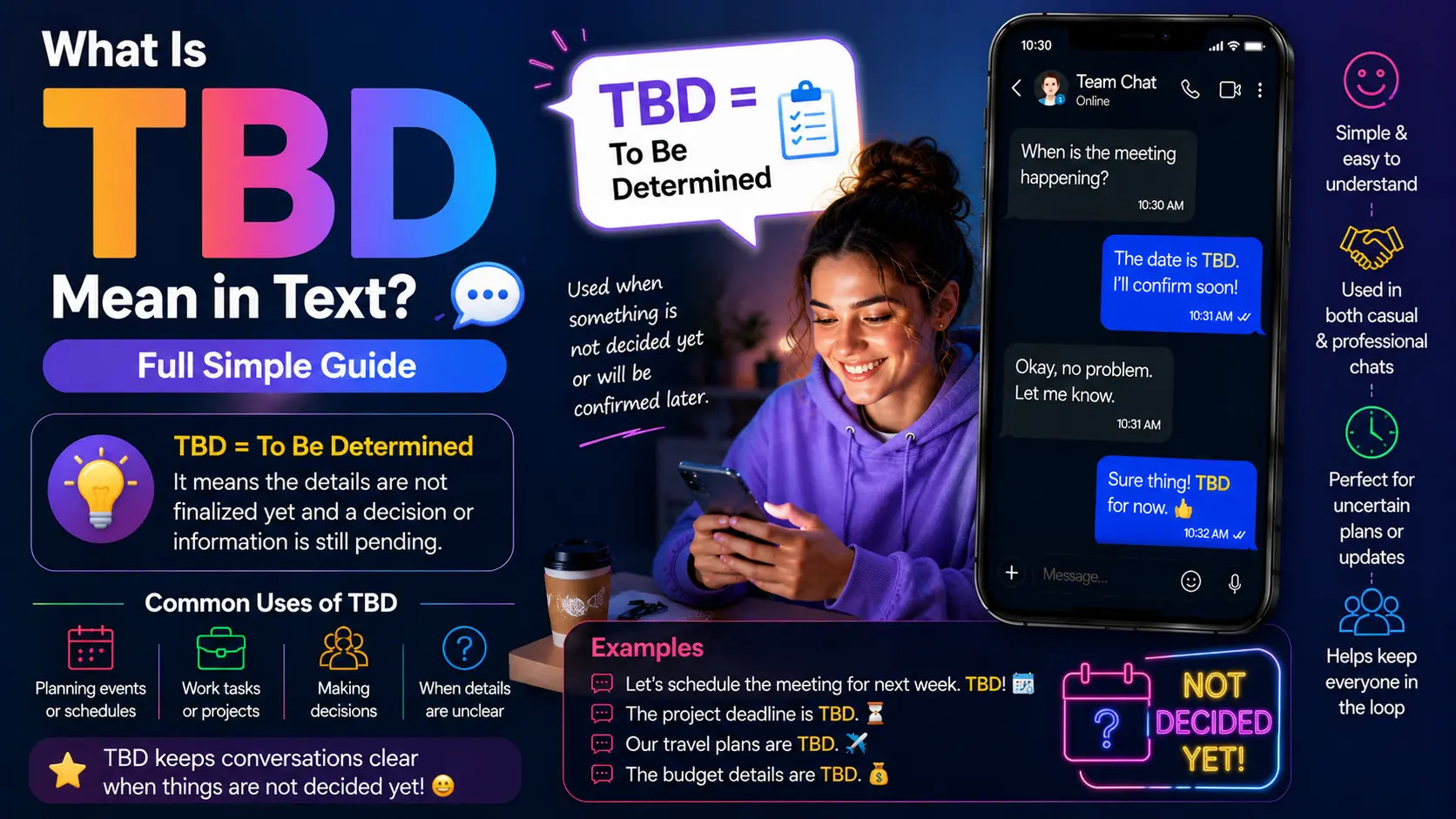
In most cases, TBD stands for “To Be Determined” or “To Be Decided.” People use it when something is not finalized yet, whether it is a plan, time, location, or detail that is still pending confirmation.
You will often see it in casual messages, work chats, group plans, or even social media updates. The confusion usually happens because the tone is not always obvious. Sometimes it feels professional, other times it feels casual or even a bit vague.
This article breaks it down in a clear, human way so you can understand not only the meaning, but also how, when, and why people use it in real conversations.
3️⃣ TBD – Quick Meaning
TBD means:
- To Be Determined
- To Be Decided
- Not finalized yet
- Still pending confirmation
It is used when information is missing or waiting for approval.
Simple examples:
- “Meeting time: TBD”
- “Location is TBD”
- “Guest list: TBD”
In short chat usage:
- “We are going out on Saturday, time TBD”
- “Trip plan is TBD for now”
It basically signals: “We will update you later when we know more.”
4️⃣ Origin & Background
TBD did not start as internet slang. It comes from formal English used in business, project management, and scheduling.
Before texting culture, TBD was commonly used in:
- Corporate reports
- Event planning documents
- Academic schedules
- Meeting agendas
As digital communication grew, especially through messaging apps and social media, people started using it in casual conversations because it was short, efficient, and universally understood.
Its popularity increased further with:
- Group chats on WhatsApp
- Work communication on Slack and email
- Event planning on Facebook and Instagram
- Meme culture using short abbreviations
Over time, TBD shifted from a strictly formal term to a flexible internet expression used by almost everyone.
5️⃣ Real-Life Conversations (MANDATORY)
WhatsApp Group Chat
Ayesha: Are we meeting at 5 or 6?
Ali: Time is TBD, waiting for everyone to confirm
Sara: Okay, just update us later 👍
Instagram DM
Friend 1: Are you coming to the beach trip?
Friend 2: Yes, but my transport is TBD 😭
Friend 1: Just tell us when you know!
TikTok Comment Thread
User A: When is part 2 coming out?
Creator: Release date is TBD for now
User B: We are waiting patiently 😩
Text Message
Brother: When is your exam result?
Sister: Date is TBD, university hasn’t announced it yet
Brother: That’s stressful 😅
These examples show how naturally TBD blends into everyday conversations when something is still undecided.
6️⃣ Emotional & Psychological Meaning
TBD is more than just a technical abbreviation. It carries a specific emotional tone depending on context.
Most of the time, it expresses:
- Uncertainty
- Flexibility
- Waiting
- Lack of final control
People use it because it reduces pressure. Instead of giving a wrong answer, they leave it open.
In modern communication, TBD reflects how people deal with incomplete information without overexplaining.
Short real-life scenario:
Imagine you are planning a birthday party. Your friend asks for timing, but the venue is not confirmed yet. Instead of stressing or guessing, you simply say “TBD.” It keeps things honest and avoids confusion.
Psychologically, it also shows:
- A preference for clarity over guessing
- A tendency to delay commitment until details are confirmed
- A modern habit of keeping conversations efficient
7️⃣ Usage in Different Contexts
Social Media
Used in captions or updates:
- “Event date: TBD”
- “New video drop: TBD”
Friends & Relationships
Used casually:
- “Our hangout plan is TBD”
- “Dinner location is TBD 😂”
Work / Professional Settings
Very common:
- “Project deadline: TBD”
- “Client meeting time: TBD”
Casual vs Serious Tone
- Casual: relaxed, flexible, sometimes humorous
- Serious: indicates pending decisions or missing information
The tone depends heavily on context and punctuation.
8️⃣ When NOT to Use It
Even though TBD is widely used, it is not always appropriate.
Avoid it when:
- Someone needs urgent and exact information
- You are giving final instructions
- Emotional or sensitive situations require clarity
- Formal legal or official communication demands precision
Example of poor usage:
- “Your surgery time is TBD” (too vague and stressful)
- “Your salary is TBD” (unprofessional in sensitive HR communication)
In such cases, clarity matters more than abbreviation.
9️⃣ Common Misunderstandings
Many people misinterpret TBD in different ways.
Common mistakes:
- Thinking it means “To Be Done”
- Assuming it means “Today Before Deadline”
- Confusing it with uncertainty about cancellation
- Believing it always means delay
Tone confusion:
Some people read TBD as:
- Lazy communication
- Indifference
- Avoiding responsibility
But in reality, it usually just means information is not finalized yet.
Literal vs intended meaning:
- Literal: something is unknown
- Intended: something will be confirmed later
🔟 Comparison Table
| Expression | Meaning | Tone | Usage |
|---|---|---|---|
| TBD | To be determined | Neutral | Pending info |
| TBA | To be announced | Formal | Official updates |
| Pending | Waiting approval | Formal | Work/legal use |
| Later | Informal delay | Casual | Everyday chat |
| Confirmed | Finalized | Positive | Fixed plans |
Key Insight:
TBD is the most neutral and flexible expression among all these terms. It neither confirms nor denies, it simply pauses the decision until more information is available.
1️⃣1️⃣ Variations / Types (8–10)
- TBD (To Be Determined)
Meaning: Not decided yet - TBD (To Be Decided)
Meaning: Choice is pending - TBA (To Be Announced)
Meaning: Official update coming later - TBC (To Be Confirmed)
Meaning: Needs final approval - TBR (To Be Resolved)
Meaning: Issue still open - TBD Date
Meaning: Date not fixed - TBD Time
Meaning: Time not set - TBD Location
Meaning: Place not finalized - TBD Plan
Meaning: Full plan still flexible - TBD Details
Meaning: Information not available yet
1️⃣2️⃣ How to Respond When Someone Uses It
Casual replies:
- “Alright, just let me know 👍”
- “Cool, waiting for update”
- “No worries, take your time”
Funny replies:
- “TBD = Too Busy Dreaming? 😄”
- “Classic TBD moment 😂”
- “Let me guess… still TBD?”
Mature replies:
- “Understood, update me when finalized”
- “Sure, I will wait for confirmation”
- “That works, thanks for informing”
Respectful replies:
- “Okay, I appreciate the update”
- “No problem, I will stay available”
1️⃣3️⃣ Regional & Cultural Usage
Western culture
Common in professional and casual communication. Widely accepted and understood.
Asian culture
Used mostly in work environments and academic contexts. Less common in emotional conversations.
Middle Eastern culture
Common in business and planning, but often replaced with clearer phrases in formal communication.
Global internet usage
Highly universal due to social media and global work tools.
Generational differences
- Gen Z: Uses it casually in chats and memes
- Millennials: Uses it more in structured communication and planning
1️⃣4️⃣ Is It Safe for Kids?
Yes, TBD is completely safe for kids and teenagers.
It does not contain offensive, harmful, or inappropriate meaning. It is simply a neutral abbreviation used to indicate something is not yet decided.
However, younger users should still learn its proper use so they understand when clarity is needed instead of vague replies.
1️⃣5️⃣ FAQs
1. What does TBD mean in simple words?
It means something is not decided or confirmed yet.
2. Is TBD formal or informal?
It can be both, depending on context.
3. Is TBD the same as TBA?
Not exactly. TBD is “not decided,” while TBA is “will be announced later.”
4. Can I use TBD in WhatsApp chats?
Yes, it is very commonly used in messaging apps.
5. Does TBD mean canceled?
No, it does not mean canceled. It only means pending.
6. Is TBD rude?
No, but it can feel unclear if overused.
7. What is the full form of TBD?
To Be Determined or To Be Decided.
1️⃣6️⃣ Conclusion
TBD is one of the simplest yet most widely used expressions in modern communication. It helps people handle uncertainty without overexplaining or making assumptions.
Whether you see it in a work schedule, a group chat, or a social media update, the meaning stays consistent: something is still waiting to be finalized.
Understanding TBD gives you better clarity in both formal and casual conversations, helping you respond more naturally and confidently in everyday digital communication.