
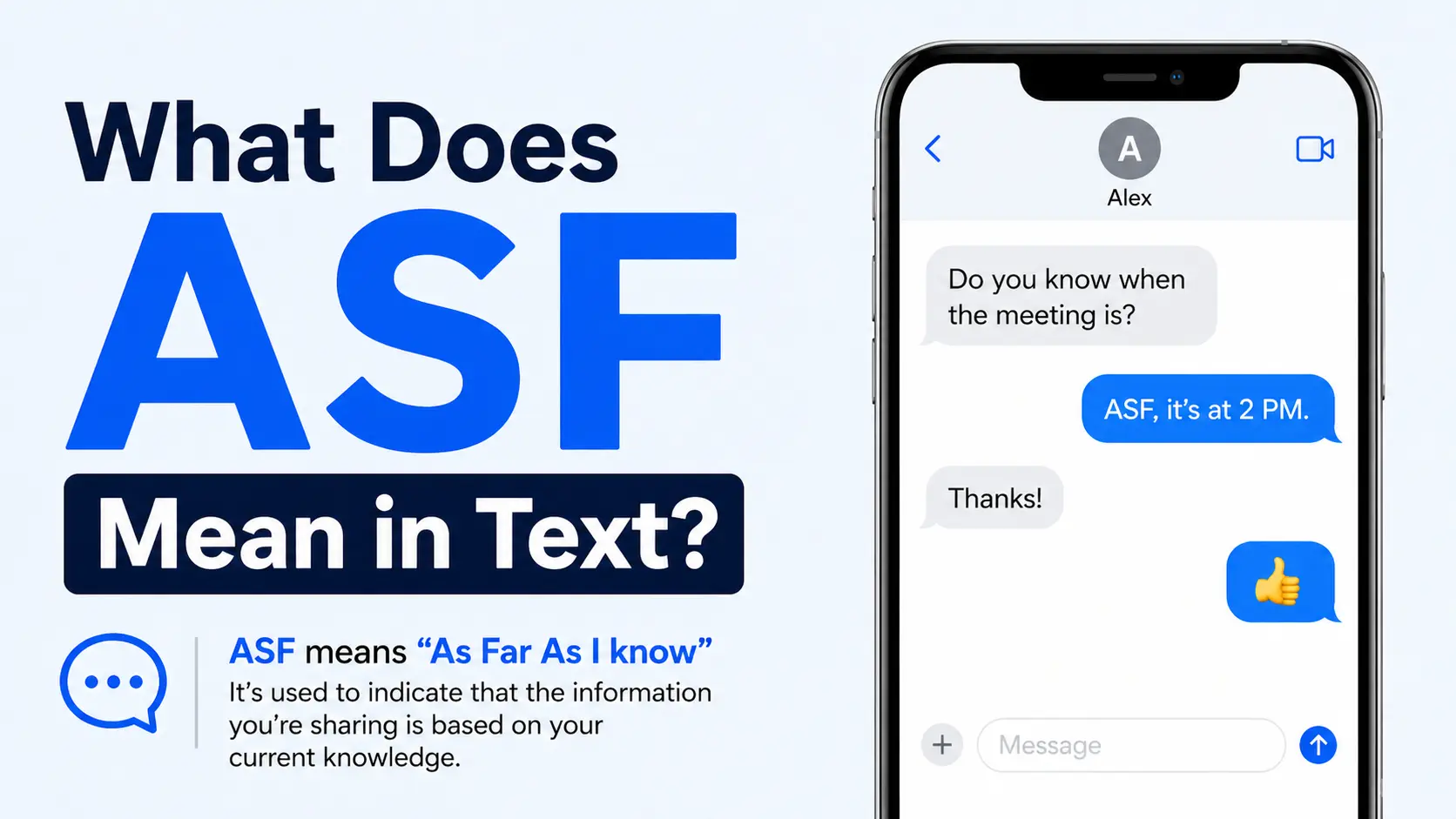
If you spend time on social media or messaging apps, you have probably seen someone type “ASF” at the end of a sentence.
Maybe a friend texted, “I’m tired ASF today,” or you saw a comment on TikTok saying, “That video was funny ASF.”
At first glance, it can feel confusing. Is it an abbreviation? A typo? A hidden code?
The truth is much simpler.
ASF is a popular internet slang expression used to intensify emotions or opinions. People add it to sentences to emphasize how strongly they feel about something.
The reason so many people search for “what asf mean in text” is because slang spreads fast online. New expressions appear every year, especially through platforms like TikTok, Instagram, and Snapchat. If you are not part of that digital culture, the meaning can feel unclear.
This guide explains exactly what ASF means, where it came from, how people use it in real conversations, and when you should or should not use it.
By the end, you will understand the tone, the cultural context, and the psychology behind this widely used slang.
ASF – Quick Meaning
ASF stands for:
“As F*”**
It is used to intensify a statement, meaning very, extremely, or really.
Instead of writing a long explanation, people simply add ASF to show strong emotion.
Simple definition
- ASF = extremely / very / intensely
- Used mainly in informal texting and social media
- Often expresses humor, excitement, frustration, or exaggeration
Example sentences
“I’m hungry ASF right now.”
“That movie was scary ASF.”
“This weather is hot ASF today.”
In each example, ASF strengthens the emotion the speaker is expressing.
Origin and Background
The slang ASF comes from a longer expression that has been used in spoken language for decades: “as f*.”**
People historically used it in casual conversation to emphasize something strongly.
Examples include:
- “Cold as f”
- “Funny as ”
- “Hard as f”
When texting became popular in the early 2000s, people began shortening phrases to type faster. Abbreviations like LOL, BRB, and OMG became part of everyday communication.
Eventually, users started typing ASF instead of the full phrase.
Social media influence
The popularity of ASF exploded with platforms such as:
- TikTok
- Snapchat
Short comments, quick reactions, and meme culture made slang like ASF perfect for online communication.
Evolution of meaning
Originally, the phrase carried a strong or even aggressive tone. Over time, internet culture softened it.
Today, many people use ASF playfully rather than seriously.
For example:
“That cat is cute ASF.”
The meaning is simply “very cute.”
Real-Life Conversations
Here are realistic examples showing how ASF appears in everyday digital conversations.
WhatsApp conversation
Person A:
I barely slept last night.
Person B:
Same. I’m tired ASF today.
Instagram DM
Person A:
Did you see that sunset photo I posted?
Person B:
Yes! It looks beautiful ASF.
TikTok comments
Person A:
This dance challenge is harder than it looks.
Person B:
For real. My legs were sore ASF after trying it.
Text message
Person A:
The exam results just came out.
Person B:
I’m nervous ASF. I don’t even want to check.
These conversations show that ASF appears naturally in casual communication, especially when people want to emphasize their feelings.
Emotional and Psychological Meaning
Slang often reveals something deeper about how people communicate emotionally.
When someone uses ASF, they are usually trying to intensify their emotional expression quickly.
Instead of writing:
“I am extremely excited about this concert.”
Someone simply writes:
“I’m excited ASF.”
The emotion feels more direct and spontaneous.
Why people use ASF
- It adds emphasis quickly
- It feels natural in fast conversations
- It creates a casual tone
- It matches internet culture
A real-life scenario
Imagine a group of friends planning a trip.
One person texts:
“Guys, the hotel has a rooftop pool. I’m excited ASF.”
That message instantly communicates enthusiasm and energy. The slang makes the message feel authentic rather than formal.
Modern digital communication often prioritizes speed, emotion, and personality. Expressions like ASF fit perfectly into that style.
Usage in Different Contexts
Although ASF is common online, the context matters a lot.
Social media
On platforms like TikTok or Instagram, ASF appears frequently.
Examples:
“That outfit is stylish ASF.”
“This song is catchy ASF.”
In social media comments, the slang often adds humor or enthusiasm.
Friends and relationships
Among close friends, ASF feels natural.
Examples:
“I miss you ASF.”
“That party was fun ASF.”
The tone is relaxed and expressive.
Work or professional settings
Using ASF in professional communication is usually not appropriate.
Example to avoid:
“This report is confusing ASF.”
Work environments generally prefer clear and respectful language.
Casual vs serious tone
ASF works best in casual conversations.
It can sound immature or unprofessional in serious discussions.
For example:
Casual
“That burger was good ASF.”
Serious context
“This medical situation is serious ASF.”
The second example feels inappropriate because the topic is sensitive.
When NOT to Use It
Even though ASF is common online, there are situations where it should be avoided.
Professional communication
Emails, work chats, or formal presentations should avoid slang.
Talking to elders
Some people may find the expression disrespectful or crude.
Academic writing
School assignments and reports require formal language.
Sensitive situations
Avoid using slang when discussing serious topics such as illness, grief, or conflict.
Using ASF in those moments can sound insensitive.
Common Misunderstandings
Because internet slang spreads quickly, people sometimes misunderstand ASF.
Misunderstanding 1: Thinking it is a random abbreviation
Some assume ASF stands for a technical phrase. In reality, it is simply an intensifier.
Misunderstanding 2: Believing it is always offensive
While the original phrase contains strong language, many people now use ASF casually.
However, context still matters.
Misunderstanding 3: Tone confusion
Text messages lack facial expressions and voice tone. Sometimes a sentence like:
“You’re annoying ASF”
could sound playful or insulting depending on the relationship.
Comparison Table
| Expression | Meaning | Tone |
|---|---|---|
| ASF | Extremely / very | Casual slang |
| Very | Strong emphasis | Neutral |
| Super | Friendly emphasis | Informal |
| Extremely | Strong emphasis | Formal |
| A lot | Large amount | Neutral |
| Not at all | Opposite meaning | Neutral |
Key Insight
The biggest difference is tone. Words like very or extremely fit formal communication, while ASF adds personality and emotion in casual conversations.
Variations and Types
Internet slang often creates variations. Here are common ones related to ASF.
1. Funny ASF
Means extremely funny.
2. Tired ASF
Expresses deep exhaustion.
3. Cute ASF
Used to describe something adorable.
4. Hungry ASF
Shows intense hunger.
5. Bored ASF
Expresses extreme boredom.
6. Cold ASF
Means extremely cold weather.
7. Busy ASF
Indicates a packed schedule.
8. Happy ASF
Shows strong happiness.
9. Mad ASF
Expresses strong anger or frustration.
10. Late ASF
Means very late or behind schedule.
These variations follow the same pattern. The slang simply amplifies the adjective before it.
How to Respond When Someone Uses It
Responses depend on the tone of the conversation.
Casual replies
“Same here.”
“I feel that.”
“Honestly, me too.”
Funny replies
“Sounds like you need coffee ASAP.”
“Life is stressful ASF sometimes.”
Mature replies
“I get what you mean.”
“That makes sense.”
Respectful replies
“Hope things get better.”
“Let me know if you need help.”
Responding appropriately helps keep the conversation comfortable and natural.
Regional and Cultural Usage
Slang like ASF travels quickly across cultures, but its interpretation can vary.
Western culture
In North America and Europe, ASF is widely understood among young people. It appears frequently in memes and online comments.
Asian culture
In many Asian countries, English internet slang spreads through gaming, social media, and pop culture. Younger users often understand it, while older generations may not.
Middle Eastern culture
Some users understand the slang but may avoid it because of the implied strong language behind the abbreviation.
Global internet culture
Online communities blend language styles. People from different countries adopt slang even if English is not their first language.
Generational differences
Gen Z uses expressions like ASF frequently in digital communication.
Millennials understand it but may use it less often.
Older generations often prefer traditional words such as very or extremely.
Is It Safe for Kids?
Parents sometimes worry about slang because of hidden meanings.
While ASF is widely used online, it is connected to a phrase containing strong language. For that reason, it may not be ideal for younger children to use regularly.
Teenagers often encounter it on social media, but understanding the context helps them communicate responsibly.
Teaching kids about digital language awareness is usually more helpful than simply banning slang.
FAQs
What does ASF mean in texting?
ASF means “as f*”** and is used to emphasize something strongly, similar to saying very or extremely.
Is ASF rude?
It can be considered mildly vulgar because it comes from a strong phrase, but many people use it casually among friends.
Is ASF used only by Gen Z?
Gen Z uses it most frequently, but many millennials also understand and use it in informal messages.
Can ASF be used in professional messages?
No. It is best avoided in professional or formal communication.
What does “funny ASF” mean?
It means extremely funny or very funny.
Why do people use ASF instead of “very”?
Slang feels more expressive and emotional, especially in fast online conversations.
Is ASF the same as “AF”?
Yes. Both expressions come from the same phrase and serve the same purpose of intensifying a statement.
Conclusion
Language on the internet changes quickly, and expressions like ASF show how modern communication adapts to speed and emotion.
At its core, ASF simply means “extremely” or “very.” People use it to intensify feelings, whether they are talking about being tired, excited, hungry, or amused.
The key is understanding context.
Among friends and social media communities, it feels natural and expressive. In professional or formal situations, it is better to stick with standard language.
Once you understand the tone behind the slang, reading messages that include ASF becomes much easier. Instead of confusion, you recognize it as a small but powerful way people add personality to their digital conversations.
Language continues to evolve with culture, and knowing expressions like this helps you stay confident and comfortable in modern communication.