
If you have ever seen someone type “TMP” in a chat and paused for a moment, you are not alone. Many people search for what is TMP mean in text because the abbreviation can feel confusing at first glance.
In modern messaging, short forms and slang change how we communicate. One small acronym can carry different meanings depending on the situation, tone, or even the platform. TMP is one of those terms that looks simple but still causes confusion for many users.
Most of the time, TMP is connected to the idea of something being “temporary” or “temp.” However, its meaning can shift slightly depending on context. That is why understanding how, when, and why people use it is important.
This guide breaks down everything in a natural, real-life way so you can confidently understand TMP whenever you see it in texts, social media posts, or online chats.
3️⃣ TMP – Quick Meaning
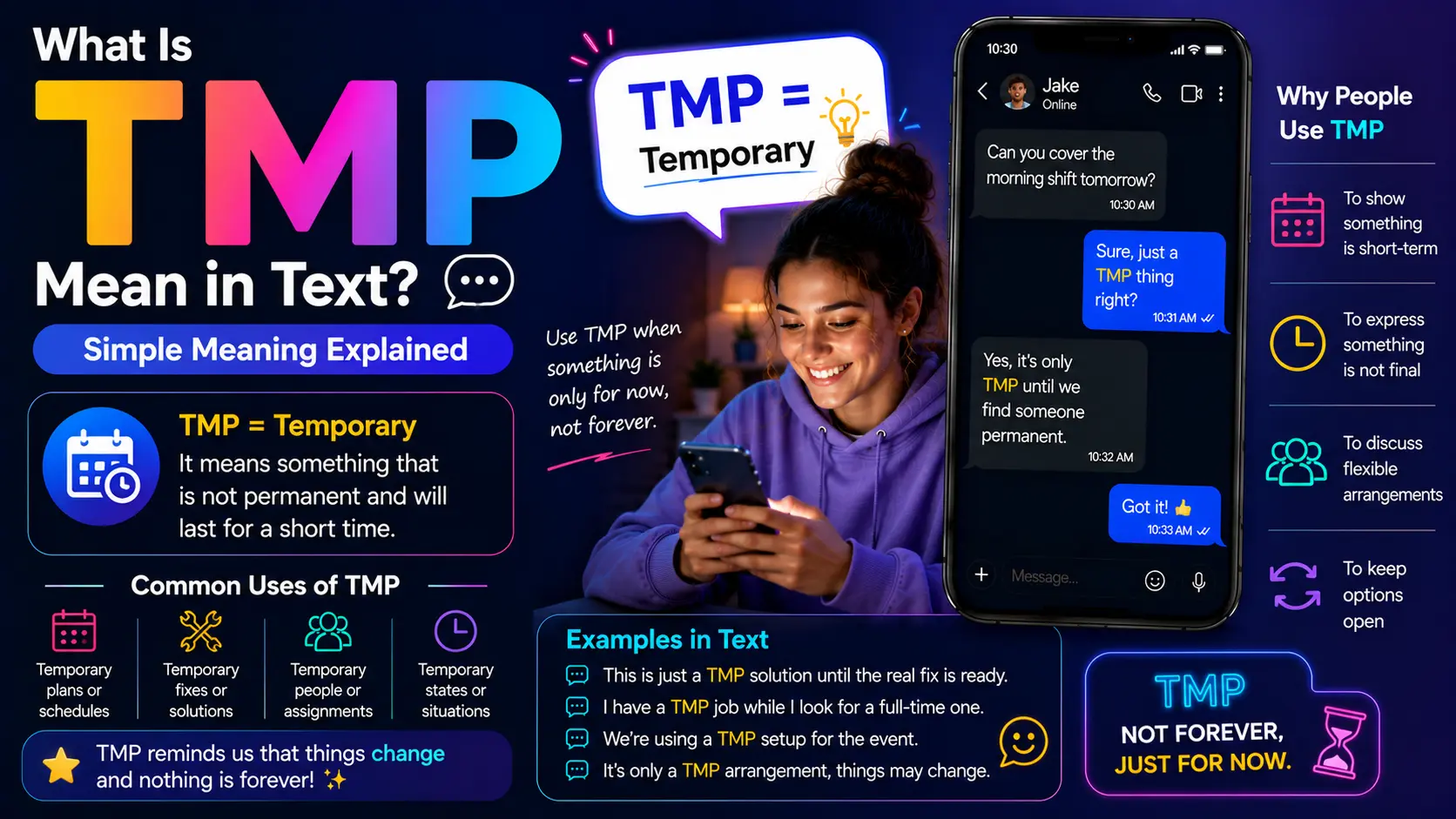
In texting and online conversations, TMP most commonly means:
- TMP = Temporary
- TMP = Temp (short form of temporary)
- TMP = Something not permanent or fixed
It is used when someone wants to describe a situation, file, account, idea, or condition that is not final.
Simple examples:
- “This is just TMP, don’t worry.”
- “I made a TMP account for testing.”
- “It’s TMP until we finalize everything.”
In most casual conversations, TMP works as a quick way to say something is “for now only.”
4️⃣ Origin & Background
The abbreviation TMP did not start as a social media trend. It originally comes from computing and digital systems.
In early computer systems, “temp” or “tmp” was used to label temporary files. For example:
- tmp folder
- tmp data
- tmp storage
These files were created for short-term use and deleted later. Over time, this technical term slowly entered everyday digital language.
As messaging apps like WhatsApp, Instagram, Snapchat, and Discord became popular, users started borrowing tech-based shortcuts. Instead of typing “temporary,” people shortened it to “TMP” or “temp.”
Cultural influence
The rise of internet slang culture pushed people toward faster communication. Teenagers and young adults especially preferred shorter forms like:
- LOL
- BRB
- IDK
- TMP
TMP became more common in group chats, gaming communities, and online collaborations where things change quickly.
How meaning evolved
Originally technical, TMP now has a more casual tone. It is no longer limited to computers. Today, it is used in everyday conversations to describe anything temporary in life, plans, or digital activity.
5️⃣ Real-Life Conversations (MANDATORY)
WhatsApp Conversation 1
Person A: “Is this group permanent?”
Person B: “No, it’s TMP for the event only.”
Instagram DM Conversation 2
Person A: “Why did you delete your profile?”
Person B: “It was just a TMP account for testing content ideas.”
TikTok Comment Thread 3
Person A: “Is this your real editing style?”
Person B: “Nope, just TMP edits. I’m still experimenting.”
Text Message 4
Person A: “Should I save your number?”
Person B: “Not yet, it’s TMP until I get a new SIM.”
These conversations show how naturally TMP appears in casual digital communication. It usually signals flexibility, testing, or something not final.
6️⃣ Emotional & Psychological Meaning
TMP is not just a shortcut. It also reflects how people think and communicate in a fast-moving digital world.
At an emotional level, TMP often expresses:
- Uncertainty
- Flexibility
- Experimentation
- Non-permanence
People use it when they do not want to fully commit to something yet. It gives them room to adjust later without pressure.
Why people use it
In modern communication, people often avoid final decisions. Saying something is “TMP” reduces pressure and expectations. It creates emotional safety in conversations.
What it reveals about communication today
TMP reflects a broader shift in how humans interact online. Instead of fixed statements, people prefer adaptable language. Everything can be changed, updated, or replaced.
Personal-style scenario
Imagine someone starting a small online business. They create a TMP logo, TMP branding, and TMP website layout. Nothing is final yet. They are exploring ideas without stress. TMP gives them creative freedom without commitment pressure.
7️⃣ Usage in Different Contexts
Social media
TMP is often used when content is not final or is being tested:
- TMP captions
- TMP edits
- TMP profile setups
Friends & relationships
In casual conversations, it can describe temporary plans:
- TMP meetup plans
- TMP decisions
- TMP arrangements
Work / professional settings
In workplaces, TMP is slightly more formal but still used:
- TMP files
- TMP drafts
- TMP project setups
Casual vs serious tone
- Casual: “It’s TMP lol, don’t worry.”
- Semi-formal: “This is a TMP version for review.”
- Serious: “We are using a TMP structure until approval.”
The meaning stays the same, but tone changes depending on situation.
8️⃣ When NOT to Use It
Even though TMP is useful, it is not suitable everywhere.
Avoid using it in:
- Legal documents
- Official contracts
- Academic essays
- Formal business communication with clients
- Sensitive or serious announcements
Cultural sensitivity
Some people may not understand TMP, especially in non-digital or older audiences. It can cause confusion if used in the wrong environment.
Risk of misunderstanding
If someone does not know the slang, they might think TMP is a code, error, or unrelated abbreviation.
9️⃣ Common Misunderstandings
Many people misinterpret TMP because it is not as widely standardized as other slang terms.
Common mistakes:
- Thinking it is a brand or company name
- Confusing it with “TMI” (Too Much Information)
- Assuming it means something permanent
- Believing it has only one fixed meaning
Tone confusion
Depending on context, TMP can sound:
- Neutral (most common)
- Casual
- Technical
- Sometimes unclear if used alone
Literal vs figurative meaning
Literally, TMP means temporary. But figuratively, it can represent flexibility, experimentation, or something unfinished.
🔟 Comparison Table
| Term | Meaning | Usage | Tone |
|---|---|---|---|
| TMP | Temporary | Something not final | Neutral |
| Temp | Short for temporary | Casual use | Informal |
| Draft | Unfinished version | Writing, design | Neutral/Formal |
| Prototype | Early model | Product development | Technical |
| Final | Completed version | Official use | Confident |
Key Insight
TMP is best understood as a flexible label. It signals that something is in progress, not finished, and may change later.
1️⃣1️⃣ Variations / Types (Minimum 8–10)
1. TMP file
Temporary computer file used for short-term storage.
2. TMP account
A test or secondary account not meant for long-term use.
3. TMP draft
An unfinished version of content or document.
4. TMP plan
A temporary arrangement before final decision.
5. TMP setup
Experimental setup used for testing.
6. TMP version
A non-final version of an app, design, or project.
7. TMP chat
A temporary conversation group or thread.
8. TMP profile
A short-term social media identity.
9. TMP edit
Experimental content editing style.
10. TMP idea
A rough idea still under development.
1️⃣2️⃣ How to Respond When Someone Uses It
Casual replies
- “Got it, just TMP for now.”
- “Okay, makes sense.”
- “Cool, temporary setup.”
Funny replies
- “Everything in life is TMP until we panic 😂”
- “So basically beta version of life?”
- “TMP gang activated 😄”
Mature replies
- “Understood, we can finalize later.”
- “That works as a temporary solution.”
- “Let’s treat it as a draft for now.”
Respectful replies
- “Thanks for clarifying, I understand it’s temporary.”
- “Okay, I’ll wait for the final version.”
- “No problem, I’ll adjust accordingly.”
1️⃣3️⃣ Regional & Cultural Usage
Western culture
Widely used in tech, gaming, and startup environments. Often understood as “temporary.”
Asian culture
Common in student groups, online communities, and mobile messaging apps, especially in casual use.
Middle Eastern culture
Less common in formal communication but appears in digital chats among youth.
Global internet usage
Mostly consistent meaning: temporary or test-related context.
Gen Z vs Millennials
- Gen Z: Uses TMP casually in chats and memes
- Millennials: More likely to use “temp” or full “temporary”
1️⃣4️⃣ Is It Safe for Kids?
Yes, TMP is generally safe for kids because it is harmless slang meaning “temporary.” However, children may not always understand when or how to use it properly in formal writing or school settings.
1️⃣5️⃣ FAQs
1. What does TMP mean in texting?
It usually means temporary or something not final.
2. Is TMP the same as temp?
Yes, TMP is a shortened form of temp or temporary.
3. Is TMP slang or technical?
It started as technical but is now widely used as slang.
4. Can TMP have different meanings?
Yes, but most commonly it means temporary.
5. Is TMP formal?
No, it is mostly used in casual communication.
6. Where is TMP commonly used?
In chats, social media, gaming, and digital conversations.
7. Can I use TMP in professional emails?
Only in informal internal communication, not formal emails.
1️⃣6️⃣ Conclusion
TMP may look like a small abbreviation, but it carries an important idea in modern communication. It reflects flexibility, experimentation, and the idea that not everything is permanent.
Once you understand its meaning, you will start noticing it everywhere in chats, online posts, and even work discussions. It is a simple but powerful reminder that many things in digital life are just temporary steps toward something final.
Using TMP correctly helps you communicate more naturally in online spaces while staying clear and relatable.