
If you’ve recently seen “AHI” in a text message, social media comment, or online chat, you may have wondered what it means. Unlike popular abbreviations such as LOL or BRB, AHI is less common and can have multiple meanings depending on the context.
People often search for “what does AHI mean in text” because they encounter it in conversations where the intended meaning is not immediately obvious. AHI can be used as a casual expression, a cultural term, or even an abbreviation with specific meanings in certain communities.
Understanding the context is the key to interpreting it correctly. In this guide, you’ll learn what AHI means, where it comes from, how people use it in real conversations, and when you should or should not use it.
AHI Meaning in Text – Quick Meaning
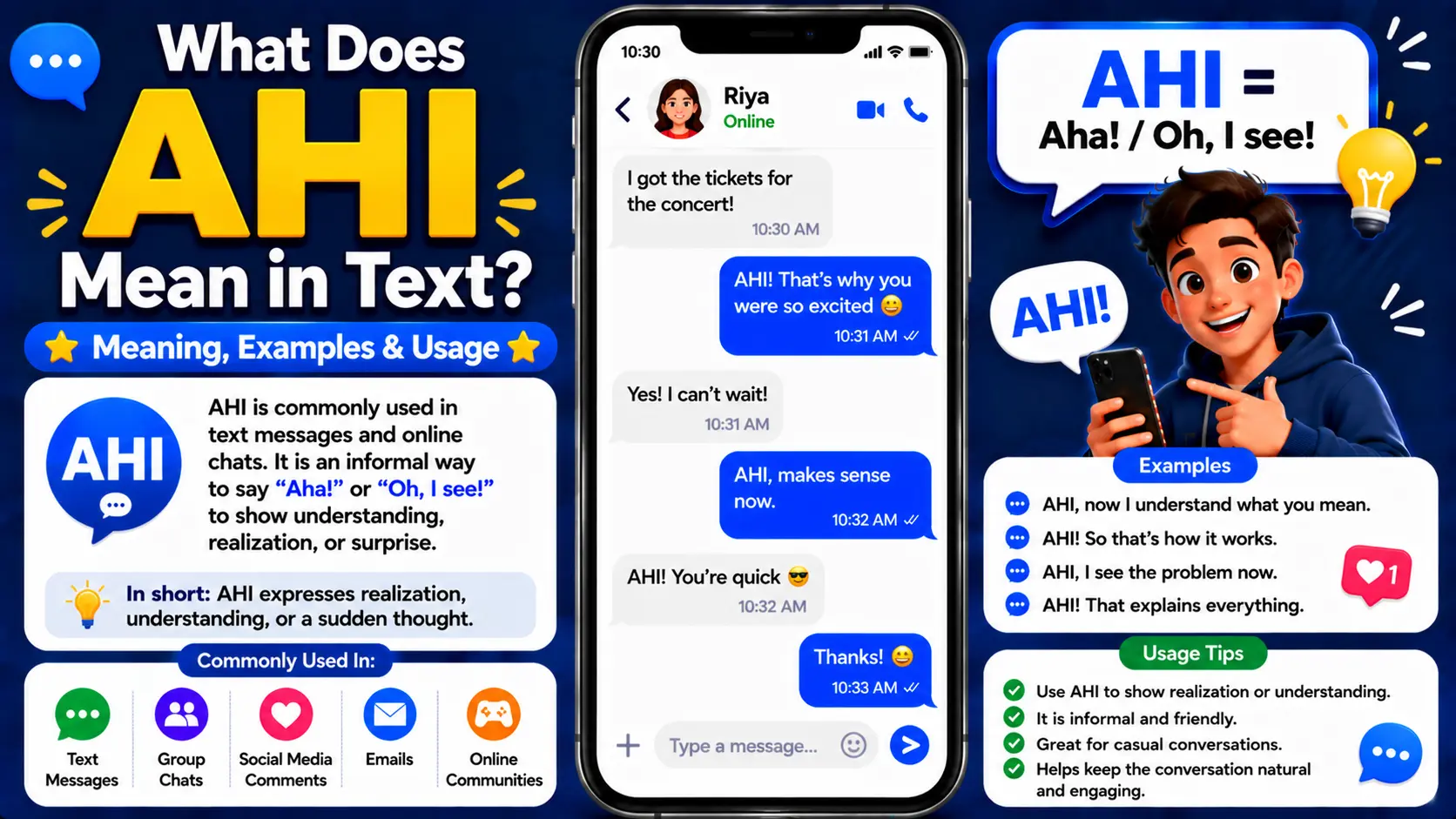
In texting and online communication, AHI is most commonly used as an informal expression similar to:
- “Oh, I see”
- “Aha!”
- “Got it”
- A reaction showing understanding, realization, or acknowledgment
Depending on the conversation, it can express:
- Recognition
- Surprise
- Understanding
- Agreement
- A moment of realization
Quick Examples
“AHI, now I understand what you meant.”
“AHI! That’s why everyone was talking about it.”
“AHI, thanks for explaining.”
The exact meaning depends heavily on the relationship between the people communicating and the overall tone of the conversation.
Origin & Background
The meaning of AHI varies across languages and cultures. In some cases, it comes from natural speech patterns where people express realization or understanding through sounds like “aha” or “ah.”
As digital communication evolved, many users began shortening expressions to type faster. This led to variations such as:
- AHA
- AH
- AHI
In some cultures, particularly in parts of Asia, the Middle East, and Latin communities, similar expressions have existed in spoken language for generations. Social media accelerated their spread across international audiences.
Platforms like:
- TikTok
- Snapchat
- Discord
helped expose users to expressions from different languages and online communities. As a result, AHI can sometimes carry slightly different meanings depending on who is using it.
Today, it is generally recognized as a reaction indicating understanding, realization, or acknowledgment.
Real-Life Conversations
WhatsApp Conversation
Person A: Did you check the email I sent yesterday?
Person B: I couldn’t find it.
Person A: Check your spam folder.
Person B: AHI! There it is. Thanks.
Instagram DM
Person A: That photo was actually taken last year.
Person B: Really? I thought it was recent.
Person A: Nope, it’s from summer 2024.
Person B: AHI, that makes sense now.
TikTok Comments
Person A: The joke is based on a movie reference.
Person B: Which movie?
Person A: The Matrix.
Person B: AHI! Now I get it 😂
Text Message
Person A: The meeting starts at 2 PM, not 3 PM.
Person B: Wait, seriously?
Person A: Yep, they changed it this morning.
Person B: AHI, thanks for telling me.
Emotional & Psychological Meaning
Modern texting is about more than sharing information. People use short expressions to communicate emotions efficiently.
When someone types AHI, they often signal:
- Understanding
- Recognition
- Relief
- Agreement
- Mental clarity
Psychologically, these small responses help conversations flow naturally. They reassure the other person that their message has been understood.
A Real-Life Scenario
Imagine a friend explaining why they seemed distant all week. After hearing the explanation, you finally understand the situation.
Instead of writing a long paragraph, you might simply reply:
“AHI, I understand now.”
That small response communicates empathy, comprehension, and acknowledgment all at once.
Usage in Different Contexts
Social Media
On platforms like TikTok, Instagram, and X, AHI often appears in comment sections when someone finally understands a joke, trend, or reference.
Example:
“AHI, that’s what everyone was talking about!”
Friends and Relationships
Friends frequently use AHI during casual conversations.
Example:
“AHI, so that’s why you canceled.”
The tone feels relaxed and conversational.
Work and Professional Settings
AHI is generally uncommon in professional communication.
Instead of using AHI, professionals usually prefer:
- I understand.
- Noted.
- Thank you for clarifying.
- That makes sense.
Casual vs Serious Tone
In casual chats, AHI feels friendly and natural.
In serious discussions involving work, education, or formal matters, it may appear too informal and potentially confusing.
When NOT to Use It
Although AHI can be useful, there are situations where it may create confusion.
Formal Business Communication
Avoid using AHI in:
- Job applications
- Client emails
- Official reports
- Academic communication
Cross-Cultural Conversations
Not everyone recognizes the term. Some people may misunderstand it or assume it has a different meaning.
Sensitive Discussions
During emotional or serious conversations, a simple “AHI” may seem dismissive.
Instead, consider more thoughtful responses such as:
- I understand what you’re saying.
- Thank you for explaining.
- That helps me see the situation better.
Common Misunderstandings
Many people misunderstand AHI because it lacks a universally accepted definition.
Mistake #1: Thinking It’s Always an Acronym
Some users assume every online abbreviation stands for specific words.
In many cases, AHI functions more as a reaction than a formal acronym.
Mistake #2: Confusing It With AHA
AHI and AHA can have similar meanings, but usage varies among individuals and communities.
Mistake #3: Assuming Everyone Knows It
Since AHI is not as popular as LOL or OMG, some people may not understand it immediately.
Mistake #4: Misreading the Tone
A simple AHI might sound:
- Friendly
- Neutral
- Surprised
The interpretation depends entirely on context.
Comparison Table
| Expression | Meaning | Tone | Usage |
|---|---|---|---|
| AHI | I understand / realization | Casual | Texting & social media |
| AHA | Sudden realization | Excited | Conversations |
| OH | Mild reaction | Neutral | Everyday communication |
| I See | Understanding | Professional | Formal and casual |
| Got It | Acknowledgment | Direct | Work and personal chats |
| Huh? | Confusion | Questioning | Informal conversations |
| No Idea | Lack of understanding | Opposite meaning | Casual communication |
Key Insight
AHI sits somewhere between “AHA” and “Got it.” It is usually less dramatic than AHA and more conversational than a direct acknowledgment like “Understood.”
Variations and Types
Here are some common variations related to AHI-style expressions:
1. AH
A brief acknowledgment or realization.
2. AHA
A stronger moment of discovery or understanding.
3. AHH
Shows realization with added emotion.
4. OHH
Indicates understanding after confusion.
5. OHHH
Emphasizes a bigger realization.
6. GOT IT
Direct acknowledgment of information.
7. I SEE
A clearer and more professional version.
8. NOW I GET IT
Expresses complete understanding.
9. MAKES SENSE
Shows agreement and comprehension.
10. UNDERSTOOD
A formal acknowledgment.
How to Respond When Someone Uses It
Casual Replies
- Exactly!
- Yep 😊
- That’s right.
- You got it.
- Glad it makes sense.
Funny Replies
- Finally! 😂
- Welcome to the club.
- Better late than never.
- The mystery is solved.
- Sherlock strikes again.
Mature Replies
- I’m glad that helped.
- Thanks for understanding.
- Happy to clarify.
- That’s what I meant.
- Appreciate your understanding.
Respectful Replies
- Thank you for listening.
- I’m glad we cleared that up.
- I appreciate your perspective.
- Thanks for taking the time to understand.
- That means a lot.
Regional and Cultural Usage
Western Culture
In Western online communities, AHI is usually interpreted as a reaction expressing realization or acknowledgment.
Asian Culture
Many Asian languages use similar sounds and expressions that communicate understanding or recognition, making AHI feel familiar in certain contexts.
Middle Eastern Culture
Some users may encounter AHI through multilingual communication where expressions from different languages mix with English texting habits.
Global Internet Usage
The internet blends languages and slang constantly. As a result, AHI may carry slightly different meanings across communities while still conveying understanding.
Gen Z vs Millennials
Gen Z
- More likely to experiment with niche slang.
- Uses expressions creatively.
- Adapts meanings quickly.
Millennials
- Tend to prefer established abbreviations.
- May interpret AHI as a variation of AHA.
- Often rely more on context.
Is It Safe for Kids?
Yes, in most cases AHI is harmless.
When used as an expression of understanding or realization, it does not contain offensive language or inappropriate content.
However, parents should remember that online slang evolves rapidly. The safest approach is always to examine the surrounding conversation rather than focusing on a single term.
Frequently Asked Questions
What does AHI mean in text messages?
AHI generally expresses understanding, realization, or acknowledgment in a conversation.
Is AHI the same as AHA?
They are similar, but AHA often expresses a stronger moment of discovery, while AHI can feel more conversational.
Is AHI an official acronym?
Not always. Many users treat it as a reaction rather than a strict abbreviation.
Can I use AHI in professional emails?
It’s better to use “I understand,” “Noted,” or “Thank you for clarifying” in professional communication.
Why do people use AHI online?
It saves time and quickly communicates understanding or recognition.
Is AHI popular on social media?
It appears in some online communities, though it is less common than major internet abbreviations like LOL or OMG.
Can AHI have different meanings?
Yes. Context, culture, and community can influence its meaning.
Conclusion
If you’ve been wondering what does AHI mean in text, the simplest answer is that it usually expresses understanding, realization, or acknowledgment. It functions much like saying “Aha,” “I see,” or “Got it” during a conversation.
Its meaning is shaped by context, tone, and culture. In casual chats, social media comments, and messaging apps, AHI helps people react quickly while still conveying emotion and comprehension.
As with most internet expressions, the smartest approach is to read the surrounding conversation before assuming a specific meaning. Once you understand the context, interpreting AHI becomes much easier.
The next time someone sends you “AHI,” you’ll be able to recognize it confidently and respond naturally.