

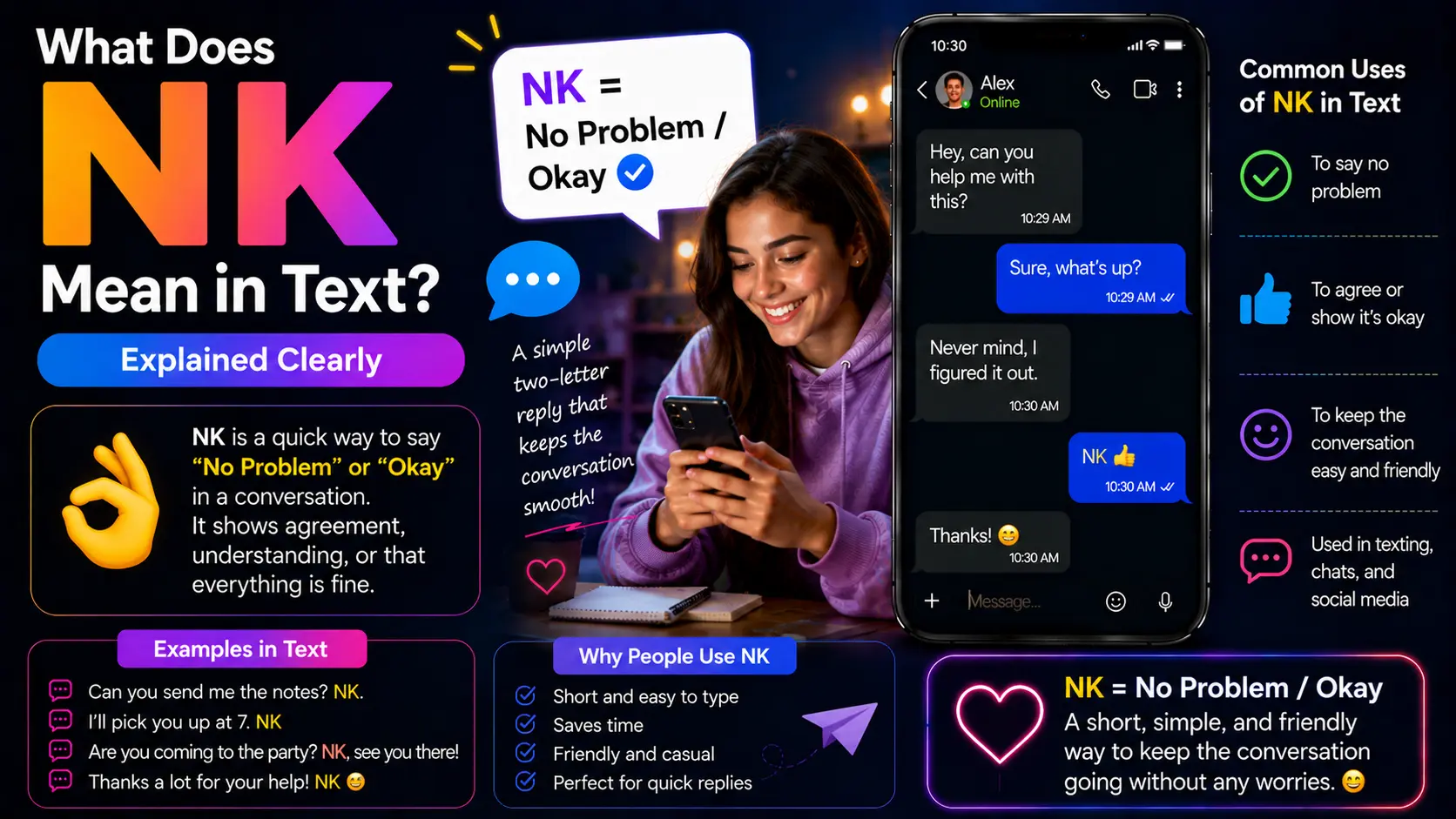
If you’ve seen someone type “NK” in a chat and felt confused, you are not alone. Modern texting language moves fast, and short abbreviations often carry multiple meanings depending on context, platform, and even the relationship between people.
The term “NK” is one of those flexible expressions that can feel simple on the surface but confusing in real conversations. Some people use it casually in friendship chats, others in dating apps, and sometimes it appears in professional or informational messages.
So what does NK actually mean in text?
The answer is not just one definition. It depends on tone, intention, and where it is used. In this guide, you will learn every possible meaning of NK, how people use it in real life, and how to respond naturally without misunderstanding the message.
NK – Quick Meaning
In most texting contexts, NK commonly stands for:
- Not Kidding
- No Kids
- No Known (rare or technical use)
- Nickname (short form in informal chats)
Most common meaning:
“NK = Not Kidding”
Examples:
- “That movie was ridiculous NK.”
- “I’m moving abroad next month NK.”
- “She said she quit her job NK.”
In these cases, NK is used to emphasize honesty or seriousness.
Origin & Background
Text slang like NK comes from the evolution of digital communication. As texting, WhatsApp, Instagram, and Snapchat became popular, people began shortening phrases to type faster and sound more casual.
NK likely gained popularity from two major digital habits:
- Speed typing culture
People wanted to reduce “not kidding” into something quicker. - Social media shorthand
Platforms like TikTok and Twitter encouraged short expressions that fit into limited space and fast conversations.
Over time, NK spread across different communities, especially among younger users who prefer short, punchy expressions instead of full sentences.
Interestingly, NK also developed secondary meanings in niche groups. For example, in dating profiles, “no kids” became a common interpretation. This shows how slang adapts based on context rather than having a fixed definition.
Real-Life Conversations (MANDATORY)
WhatsApp Chat Example
Ali:
Bro, I just got a job offer in Dubai NK
Sara:
Wait really? That’s huge! Congratulations!
Ali:
Yeah everything happened so fast NK
Instagram DM Example
User1:
Your trip photos look edited lol
User2:
Nope, it was exactly like that NK 😭
TikTok Comment Section
Commenter:
This can’t be real
Creator:
It happened NK, I was there
Text Message Example
Friend 1:
Did you actually meet the singer?
Friend 2:
Yes I did NK, still can’t believe it
These examples show how NK is used to emphasize truth, surprise, or emotional intensity in everyday digital conversations.
Emotional & Psychological Meaning
NK is more than just shorthand. It reflects how people try to build trust and emotional intensity in fast communication.
When someone uses NK, they are usually trying to say:
- “Believe me, I am serious”
- “This is not a joke”
- “I want you to trust what I’m saying”
Psychological angle
In modern communication, messages can easily feel flat or unclear. People often add small expressions like NK to make their message feel more personal and believable.
For example, instead of writing:
“I got promoted.”
Someone might write:
“I got promoted NK.”
The second version feels more emotional and convincing.
Personal-style scenario
Imagine a friend telling you they saw a celebrity at a café. If they just say it normally, you might doubt it. But if they say “I saw him there NK,” the added NK creates emotional weight and makes the story feel more real.
Usage in Different Contexts
1. Social Media
On platforms like Instagram, TikTok, and Twitter, NK is used for:
- Emphasizing truth
- Reacting to surprising content
- Commenting casually
Example:
“This edit is ridiculous NK 🔥”
2. Friends & Relationships
In personal chats, NK is used to:
- Strengthen trust
- Add emotion to stories
- Express excitement or disbelief
Example:
“I actually passed the exam NK 😭”
3. Work / Professional Settings
NK is generally NOT used in formal communication. However, in casual workplace chats (like Slack or WhatsApp groups), it may appear informally among colleagues.
Example:
“I finished the report NK, sending now.”
Still, it is better to avoid it in professional emails.
4. Casual vs Serious Tone
- Casual tone: Very common
- Serious tone: Rare but used for emphasis
- Professional tone: Not recommended
NK works best in relaxed conversations where tone is informal.
When NOT to Use It
Even though NK is common, there are situations where it should be avoided:
- Formal emails or business communication
- Academic writing or professional reports
- Conversations with elders who may not understand slang
- Sensitive topics where clarity is important
Cultural sensitivity note
Some people may misunderstand NK, especially if they interpret it as “no kids” or another meaning. So using it in unclear contexts can create confusion.
Common Misunderstandings
Many people misread NK because it has multiple interpretations.
1. Thinking it always means “No Kids”
This is common in dating apps, but not the only meaning.
2. Confusing tone
Some assume NK is sarcastic or dismissive, when it is usually meant for emphasis.
3. Overlooking context
NK changes meaning depending on conversation type.
Example confusion:
- “I moved to Canada NK”
Could mean “not kidding” or be misunderstood as something else if context is missing.
Comparison Table
| Expression | Meaning | Tone | Usage |
|---|---|---|---|
| NK | Not Kidding | Emphatic | Casual chats |
| LOL | Laughing Out Loud | Humorous | Social media |
| FR | For Real | Serious emphasis | Friends, texting |
| NGL | Not Gonna Lie | Honest expression | Casual + emotional |
| IDC | I Don’t Care | Neutral/negative | Informal |
| TBH | To Be Honest | Sincere tone | General use |
| IDK | I Don’t Know | Neutral | Everyday texting |
| BRB | Be Right Back | Informational | Active chats |
Opposite meaning example:
- NK (Not Kidding) vs JK (Just Kidding)
Key Insight
NK is mainly used to strengthen truthfulness, while similar slang like JK is used to soften statements or indicate humor.
Variations / Types of NK (10 Examples)
- NK = Not Kidding
Used to emphasize truth. - NK = No Kids
Common in dating profiles. - NK = Nickname
Informal shorthand in chats. - NK = Not Known
Rare, informational use. - NK = No Knowledge
Used in technical discussions. - NK = New Kid
Slang in school environments. - NK = No Karma
Used in online gaming contexts. - NK = Next Known
Rare scheduling reference. - NK = No Comment (informal twist)
Used sarcastically sometimes. - NK = Not Keeping
Very rare, conversational shorthand.
How to Respond When Someone Uses It
Casual replies:
- “Wait really?”
- “No way!”
- “That’s obsessed!”
Funny replies:
- “NK or JK? I can’t tell 😂”
- “Proof or it didn’t happen 😭”
Mature replies:
- “Got it, thanks for sharing.”
- “I understand now.”
Respectful replies:
- “Thanks for clarifying that.”
- “I appreciate you telling me.”
Regional & Cultural Usage
Western culture
Most commonly interpreted as “Not Kidding” or “No Kids” depending on context.
Asian culture
Used mainly in social media chats, especially among younger users familiar with English slang.
Middle Eastern culture
Less common in formal settings, but widely understood among English-speaking youth.
Global internet usage
NK is a niche slang term, not universally standardized, so interpretation varies widely.
Generational differences
- Gen Z: Uses NK casually in chats and captions
- Millennials: Less frequent usage, prefers full phrases
- Older generations: Often unfamiliar with the term
Is It Safe for Kids?
Yes, NK is generally safe because it is not offensive or harmful. However, kids may get confused due to multiple meanings. It is important to explain context so they understand when it means “not kidding” versus “no kids.”
FAQs
1. What does NK mean in texting?
NK usually means “Not Kidding,” used to emphasize truth.
2. Does NK always mean the same thing?
No, it can also mean “No Kids” or “Nickname” depending on context.
3. Is NK formal or informal?
It is informal and used mainly in casual chats.
4. Can NK be used in professional messages?
It is not recommended in formal communication.
5. Is NK slang or abbreviation?
It is a texting abbreviation used in digital slang.
6. Why do people use NK instead of full words?
To save time and add emotional emphasis in quick conversations.
7. Is NK commonly used worldwide?
It is common in online youth culture but not universally standardized.
Conclusion
NK may look like a small and simple abbreviation, but it carries different meanings depending on how and where it is used. In most cases, it stands for “Not Kidding,” helping people emphasize truth in casual conversations. In other situations, it can mean “No Kids” or even “Nickname,” showing how flexible internet language can be.
Understanding NK is less about memorizing definitions and more about reading context. Once you get used to digital slang, these expressions become easier to interpret naturally in conversations.
So next time you see NK in a chat, don’t overthink it. Just look at the tone, the situation, and the person using it. That is the real key to understanding modern texting language.