
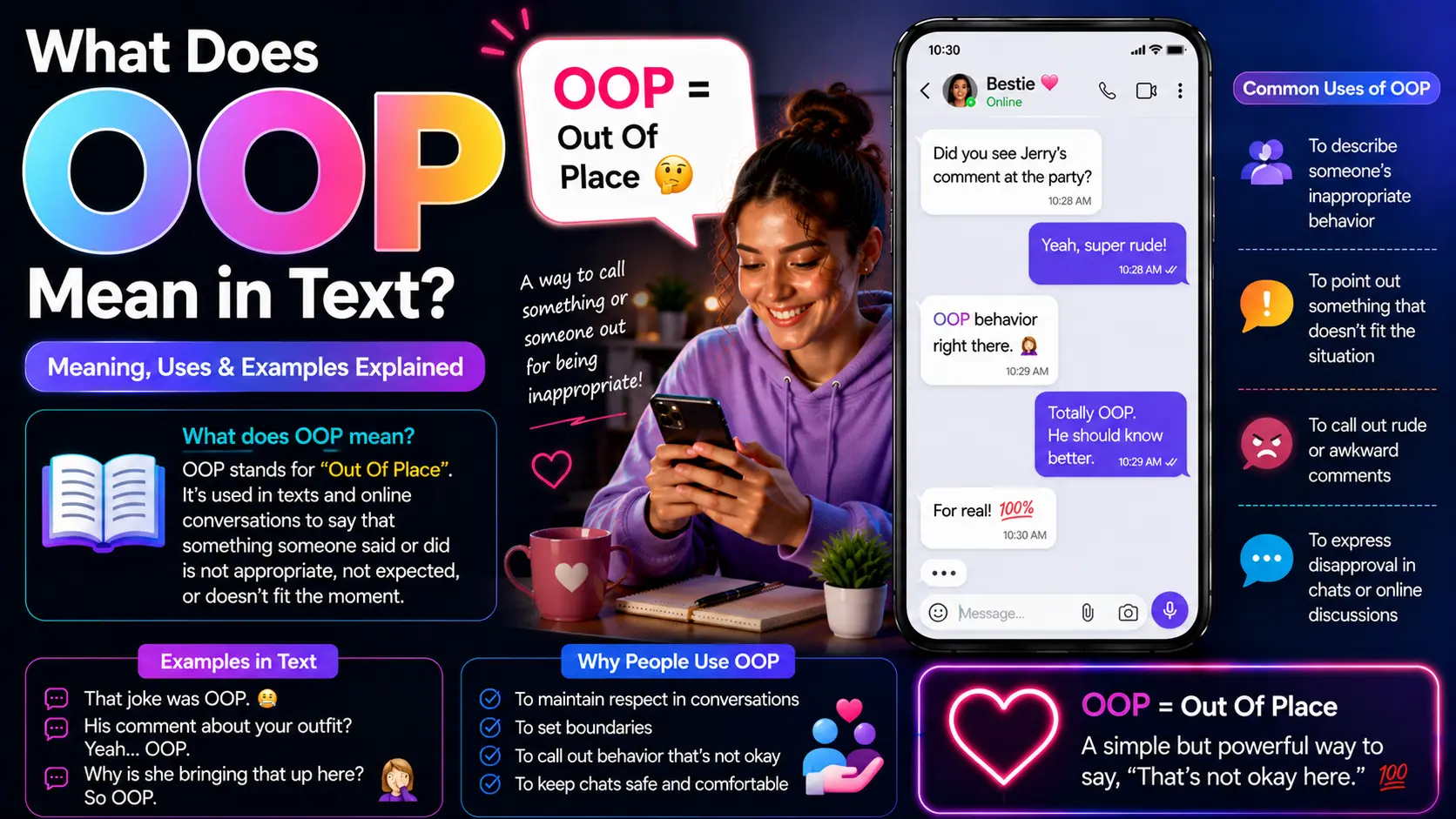
If you have seen someone type “oop” in a chat, comment section, or social media conversation, you might wonder what it actually means. Unlike many internet abbreviations that have one fixed definition, oop meaning in text depends heavily on the situation, tone, and the person using it.
Most commonly, “oop” is a casual expression used when someone reacts to a mistake, surprise, awkward moment, or unexpected situation. It is similar to saying “oops,” but with a more playful internet style.
People search for this phrase because online conversations move quickly, and slang changes with culture. A simple three-letter word can carry humor, embarrassment, surprise, or even playful teasing.
Understanding what oop means in text helps you read digital conversations more naturally and avoid misunderstandings.
What OOP Mean in Text: Quick Meaning
In texting and online communication, oop usually means a reaction to something unexpected.
Common meanings include:
- A playful version of “oops”
- A reaction to a mistake
- A response to awkward or surprising information
- A way to show amusement or mild embarrassment
Examples:
“Oop, I accidentally sent that to the wrong person.”
“Oop, you really said that in public?”
“Oop, that got serious fast.”
The meaning is usually not serious. It often adds personality and emotion to a message.
Origin and Background of OOP
The expression “oop” developed from the word “oops,” which people have used for decades to acknowledge small mistakes or accidents.
The internet changed how people use language. On platforms like social media, short reactions became a major part of communication. Users began shortening words, exaggerating sounds, and creating playful spellings.
The rise of platforms such as TikTok, Instagram, and Twitter helped “oop” become more recognizable among younger internet users.
A famous influence came from online phrases like:
“And I oop…”
This expression became popular as a reaction to sudden surprises, awkward moments, or unexpected events.
Over time, “oop” moved beyond mistakes and became a general reaction word. Today, someone may use it even when nothing went wrong, simply to show surprise or humor.
Real-Life Conversations Using OOP
WhatsApp Conversation
Person A:
I just realized I replied to my boss instead of my friend.
Person B:
Oop 😭 what did you send?
Person A:
A message complaining about Monday.
Person B:
Oop, that is painful.
Instagram DM Conversation
Person A:
I posted a picture and forgot my ex could see it.
Person B:
Oop 👀
Person A:
Exactly my reaction.
TikTok Comments
Person A:
Creator: “I tried making a cake for the first time.”
Person B:
Oop, that looks interesting 😂
Person C:
The kitchen survived though, so that’s a win.
Text Message Conversation
Person A:
I accidentally liked their old photo from 2018.
Person B:
Oop. Time to disappear.
Person A:
I am deleting my account now.
Emotional and Psychological Meaning of OOP
Language in texting is not only about information. It is also about emotion.
When someone writes “oop,” they are often trying to soften a reaction. Instead of directly saying:
“You made a mistake.”
They say:
“Oop 😂”
which feels friendlier and less judgmental.
The word creates a lighter emotional atmosphere. It can show:
- Humor
- Surprise
- Playfulness
- Awkwardness
- Friendly teasing
A personal example is when someone sends a message to the wrong person. A simple “oop” from a friend can turn an embarrassing moment into something funny instead of uncomfortable.
Modern communication often uses small expressions like this to build connection.
Usage of OOP in Different Contexts
OOP on Social Media
On platforms like Instagram, TikTok, and online communities, “oop” is commonly used as a reaction.
Example:
Someone reveals unexpected news.
Comment:
“Oop, we were not ready for this.”
It adds personality and makes comments feel conversational.
OOP Between Friends and Relationships
Friends often use “oop” during playful conversations.
Example:
“Oop, someone is jealous.”
It can create a teasing but friendly mood.
OOP in Work or Professional Settings
“Oop” is usually too casual for formal workplace communication.
A coworker chat might allow:
“Oop, I attached the wrong file.”
But an official email should use:
“Sorry, I attached the incorrect file. Please find the updated version.”
Casual vs Serious Tone
Casual:
“Oop, my bad 😂”
Serious:
“I apologize for the mistake.”
The same situation can require different wording depending on the relationship.
When Not to Use OOP
Although “oop” is harmless in many situations, it is not suitable everywhere.
Avoid using it:
- In formal business communication
- During serious discussions
- When apologizing for major mistakes
- In situations requiring professionalism
For example, saying:
“Oop, sorry about the delay”
to a customer may sound too relaxed.
A better choice:
“I apologize for the delay and appreciate your patience.”
Cultural understanding also matters. Some people may find internet slang confusing or immature.
Common Misunderstandings About OOP
Many people misunderstand “oop” because it has no single emotional meaning.
Some common mistakes:
Thinking It Always Means a Mistake
Not always.
Someone might say:
“Oop, that outfit looks amazing.”
Here it expresses surprise or excitement.
Thinking It Is Rude
Usually, it is not rude. The tone depends on context.
“Oop 😂” from a friend is different from “oop” in a serious argument.
Confusing Literal and Figurative Meaning
The word does not always describe an actual accident.
It can simply show a reaction.
OOP Comparison Table
| Expression | Meaning | Tone |
|---|---|---|
| Oop | Small surprise, mistake, reaction | Playful |
| Oops | Traditional apology or mistake reaction | Neutral |
| My bad | Accepting responsibility | Casual |
| LOL | Showing amusement | Funny |
| Uh-oh | Something may be wrong | Concerned |
| Nice one | Positive reaction | Encouraging |
| Oh wow | Surprise | Emotional |
Key Insight:
“Oop” is less about the actual mistake and more about the feeling behind the reaction. It adds emotion and personality to digital conversations.
Variations and Types of OOP
1. Oop
Basic reaction to surprise or mistakes.
Example:
“Oop, I forgot.”
2. Oop Sorry
A softer apology.
Example:
“Oop sorry, I misunderstood.”
3. Oop Moment
A funny or awkward situation.
Example:
“That was an oop moment.”
4. And I Oop
A dramatic reaction to unexpected information.
Example:
“And I oop, she actually said it.”
5. Big Oop
Used for a bigger mistake.
Example:
“That was a big oop.”
6. Oop Energy
Describes someone’s playful or chaotic behavior.
Example:
“She has pure oop energy.”
7. Oop There It Is
A humorous reaction when something appears or happens.
8. Oop My Mistake
A casual way to admit an error.
9. Oop Anyway
Used to move past an awkward moment.
10. Oop Sorry About That
Friendly acknowledgment of a small problem.
How to Respond When Someone Uses OOP
Casual Replies
“Haha happens 😂”
“No worries.”
“Classic mistake.”
Funny Replies
“The damage is done 😂”
“Too late, we saw it.”
“Oop accepted.”
Mature Replies
“No problem, thanks for letting me know.”
“It happens. Don’t worry.”
Respectful Replies
“That’s okay, I understand.”
“Thanks for explaining.”
Regional and Cultural Usage of OOP
Western Culture
In many Western online communities, “oop” is strongly connected with humor, memes, and casual reactions.
It often appears in friendly conversations.
Asian Culture
Many Asian internet users adopt English slang through social media. “Oop” may be understood mainly by younger users who spend time online.
Older generations may not recognize it.
Middle Eastern Culture
Among younger internet users, English slang expressions are often mixed with local languages. “Oop” may appear in online chats as a trendy reaction.
Global Internet Usage
Internet culture spreads quickly. A phrase created in one online community can become worldwide slang within months.
Gen Z vs Millennials
Gen Z often uses “oop” as a humorous reaction.
Millennials may understand it but may use it less frequently.
The difference is not meaning, but style and frequency.
Is OOP Safe for Kids?
Yes, “oop” is generally harmless.
It is a casual expression similar to “oops” and usually does not contain inappropriate meaning.
However, parents and teachers should still consider context because internet slang can change over time.
Teaching children how tone works online is more useful than simply banning words.
FAQs About OOP Meaning in Text
What does oop mean in texting?
Oop usually means a playful reaction to a mistake, surprise, or awkward moment.
Is oop the same as oops?
They are similar. “Oop” is a more internet-style and casual version.
Is oop rude?
No. It is usually friendly, funny, or playful depending on the situation.
Why do people say “and I oop”?
It became popular online as a dramatic reaction to unexpected situations.
Can I use oop at work?
You can use it in casual workplace chats, but avoid it in formal communication.
Does oop have a hidden meaning?
Usually no. Its meaning depends on context and tone.
Who uses oop the most?
Younger internet users commonly use it, especially on social media platforms.
Conclusion
Understanding what oop means in text helps you understand modern online conversations better.
This small expression carries more emotion than its three letters suggest. It can show surprise, humor, embarrassment, or a playful reaction.
Like many internet expressions, “oop” is shaped by culture, relationships, and the situation where it appears.
When used with the right audience, it adds warmth and personality to communication. The key is knowing when casual language fits and when a clearer, more professional response is better.