
If you’ve ever received a message that just says “ope” or seen it slip into a comment online, you probably paused for a second. It’s one of those tiny words that feels familiar but also confusing at the same time.
People search “what’s ope mean in text” because it doesn’t behave like typical slang. It’s not an acronym, it’s not exactly a reaction emoji, and it doesn’t carry a fixed definition. Instead, it captures a moment. A feeling. A tiny human slip.
In today’s fast, informal digital conversations, words like “ope” are becoming more common because they mirror how we actually speak and react in real life. Understanding it helps you read tone better and connect more naturally with others.
Let’s break it down in a way that actually makes sense in real conversations.
What’s “Ope” Mean in Text – Quick Meaning
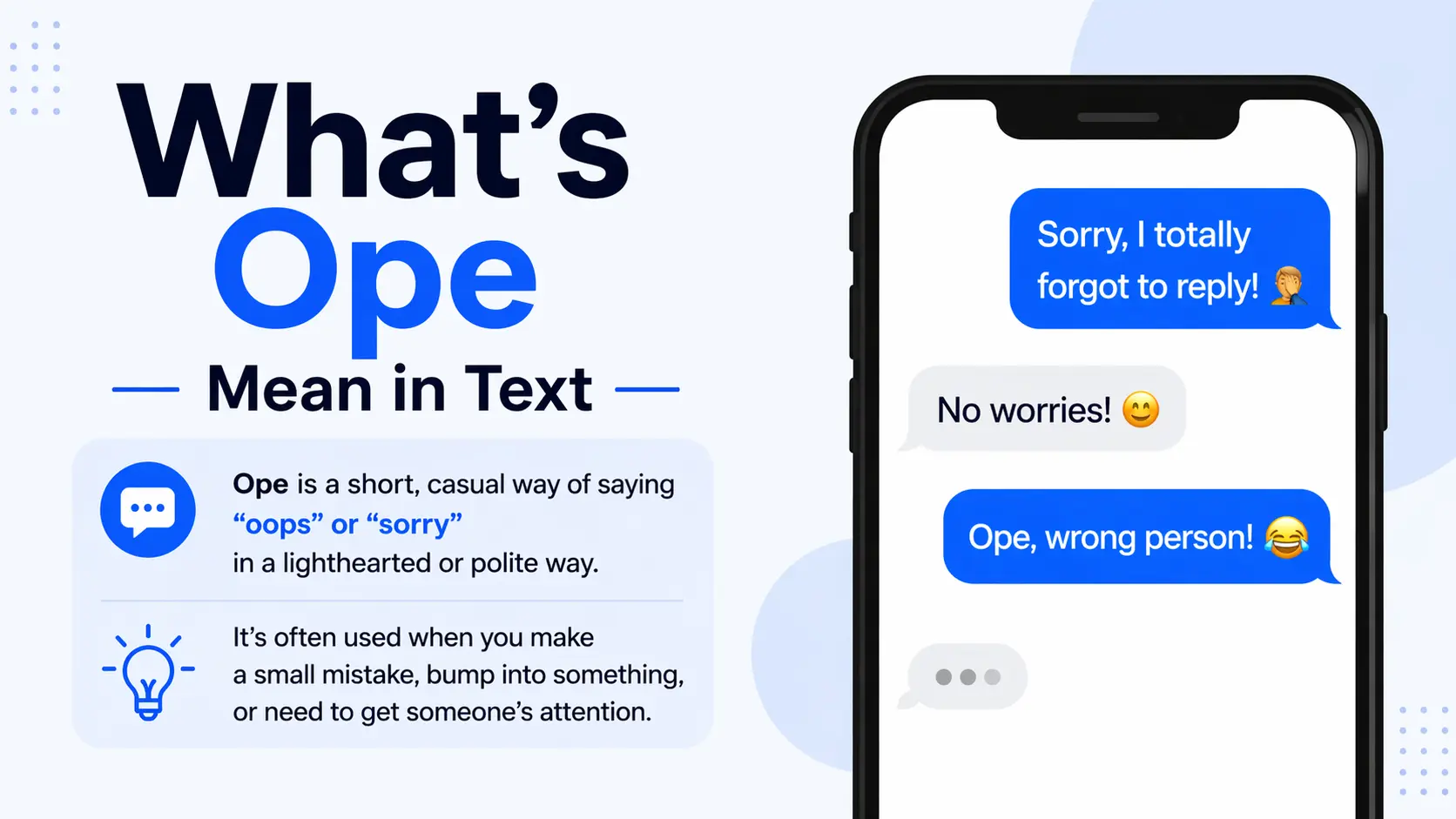
“Ope” is a short, spontaneous expression used when something small, unexpected, or slightly awkward happens.
It usually conveys:
- Mild surprise
- A quick reaction to a mistake
- A polite interruption
- A soft, human “oops” moment
Simple examples:
- “Ope, didn’t see your message earlier!”
- “Ope sorry, sent that to the wrong chat 😅”
- “Ope, my bad!”
It’s not dramatic. It’s subtle and almost instinctive.
Origin & Background
“Ope” didn’t start as internet slang. It actually comes from real-life speech, especially in parts of the United States, particularly the Midwest.
People there have been saying “ope” for years in everyday situations:
- Bumping into someone slightly
- Dropping something
- Interrupting politely
Over time, social media platforms like TikTok and Instagram picked it up. Videos joking about Midwestern habits made “ope” go viral, turning it into a recognizable digital expression.
Now, it has moved beyond geography. Even people who’ve never heard it in real life are using it in texts because it feels natural, quick, and relatable.
Real-Life Conversations
Here’s how “ope” actually shows up in everyday digital chats.
WhatsApp Chat
Person A: I thought the meeting was tomorrow
Person B: Ope, it’s today at 4 😅
Instagram DMs
Person A: Wait, did I like your old post from 2021?
Person B: Ope yes you did 😂
TikTok Comments
User 1: I accidentally sent this to my boss
User 2: Ope… that’s rough 😭
Text Messages
Person A: I just realized I forgot your birthday
Person B: Ope wow… thanks 😐
These examples show how “ope” softens the moment. It makes awkwardness feel lighter.
Emotional & Psychological Meaning
At its core, “ope” reflects something deeply human. It’s a micro-reaction. The kind you don’t plan.
Emotionally, it often carries:
- Slight embarrassment
- Gentle acknowledgment of a mistake
- Friendly awareness
- Soft surprise
People use it because it feels less heavy than saying “sorry” or “oops.” It reduces tension.
There’s also a psychological layer. In modern communication, especially texting, people want to sound natural and non-confrontational. “Ope” helps with that. It keeps things casual and emotionally safe.
Real-life scenario:
You accidentally double-text someone you like. Instead of over-explaining, you send:
“Ope didn’t mean to send twice lol”
That one word removes pressure. It shows awareness without making it awkward.
Usage in Different Contexts
Social Media
“Ope” thrives on platforms like TikTok, Instagram, and Twitter. It’s often used in captions, comments, or reactions to relatable content.
Example:
“Ope, this is literally me every morning”
Friends & Relationships
With friends, it adds humor and softness.
Example:
“Ope, I ate your snacks 😬”
In relationships, it can lighten small mistakes.
Work / Professional Settings
This is where you need to be careful.
“Ope” is usually too casual for formal communication. It might work in relaxed team chats, but not in emails or professional messages.
Better to avoid it in serious work contexts.
Casual vs Serious Tone
- Casual: Perfect fit
- Playful: Works great
- Serious situations: Not appropriate
It’s a low-stakes word. It doesn’t carry emotional weight for serious conversations.
When NOT to Use It
There are moments where “ope” can feel out of place or even insensitive.
Avoid using it:
- During serious apologies
- In professional emails
- In emotionally intense conversations
- When someone is upset or hurt
Example of misuse:
“Ope sorry for what happened”
This can feel dismissive instead of sincere.
Common Misunderstandings
Many people misunderstand “ope” because it’s subtle.
1. Thinking it’s an acronym
It’s not. It doesn’t stand for anything.
2. Assuming it’s always funny
Sometimes it’s just neutral, not humorous.
3. Confusing tone
Depending on context, it can feel:
- Playful
- Awkward
- Slightly sarcastic
4. Taking it too seriously
It’s meant to be light. Overanalyzing it can lead to confusion.
Comparison Table
| Expression | Meaning | Tone | Usage |
|---|---|---|---|
| Ope | Small surprise or mistake | Light, soft | Casual chats |
| Oops | Mistake acknowledgment | Neutral | Common everywhere |
| Uh-oh | Something went wrong | Slight concern | Playful or serious |
| My bad | Admitting fault | Casual apology | Friendly tone |
| Sorry | Formal apology | Serious | All contexts |
Key Insight:
“Ope” stands out because it feels spontaneous and human. It’s less about the mistake and more about the moment.
Variations / Types
Here are some common variations you might see:
- Ope sorry
Quick, soft apology. - Ope my bad
Casual admission of a mistake. - Ope lol
Awkward moment turned humorous. - Ope wait
Realizing something suddenly. - Ope didn’t mean to
Gentle clarification. - Ope there it is
Pointing out something obvious. - Ope hi
Awkward or shy greeting. - Ope nope
Playful correction or disagreement. - Ope okay
Accepting something lightly. - Ope I forgot
Acknowledging forgetfulness casually.
How to Respond When Someone Uses It
Casual Replies
- “Haha it’s fine”
- “No worries”
- “All good!”
Funny Replies
- “Ope detected 😂”
- “Classic ope moment”
- “You just ope’d that”
Mature Replies
- “No problem, thanks for letting me know”
- “It happens, don’t worry”
Respectful Replies
- “That’s okay, I understand”
- “Appreciate you saying that”
Your response should match the tone of the conversation.
Regional & Cultural Usage
Western Culture
“Ope” is most recognized in American culture, especially the Midwest. It’s part of everyday speech there.
Asian Culture
Less commonly used. People may understand it online but rarely use it naturally in conversation.
Middle Eastern Culture
It’s not widely used in spoken language, but younger users may adopt it through social media.
Global Internet Usage
Thanks to TikTok, “ope” has become globally recognizable. Still, it remains informal and niche.
Generational Differences
- Gen Z: Uses it more comfortably and frequently
- Millennials: Understand it but may use it less
It’s part of a broader trend toward expressive, human-like texting.
Is It Safe for Kids?
Yes, “ope” is completely safe.
It’s a harmless expression with no offensive meaning. It’s actually a positive example of soft, polite communication.
Parents don’t need to worry about it.
FAQs
1. Does “ope” mean sorry?
Not exactly. It can include a sense of apology, but it’s softer and less formal.
2. Is “ope” rude?
No. It’s generally polite and friendly.
3. Can I use “ope” in formal writing?
No, it’s best kept for casual conversations.
4. Why do people say “ope”?
It reflects natural, spontaneous reactions in speech.
5. Is “ope” the same as “oops”?
They’re similar, but “ope” feels more subtle and conversational.
6. Is it okay to use “ope” in texts?
Yes, especially with friends or in relaxed chats.
Conclusion
“Ope” might look like a tiny, insignificant word, but it carries a lot of human nuance. It’s quick, soft, and emotionally intelligent in a way that formal language often isn’t.
It helps people acknowledge small mistakes without making things awkward. It adds warmth to digital conversations that can sometimes feel cold or distant.
Once you understand it, you start noticing it everywhere. And more importantly, you start feeling how it changes the tone of a message.
Use it when the moment is light. Keep it natural. And don’t overthink it.
Sometimes, one small word is enough to make communication feel real again.