
If you’ve ever received a message that simply says “hu,” you’re not alone in feeling confused. It’s short, vague, and can mean different things depending on who sent it and how.
People search for “hu mean in text” because it looks incomplete. It feels like a typo or a secret code. But in reality, it’s a casual texting shortcut that carries more tone than meaning.
This article clears that confusion. You’ll learn what “hu” really means, where it comes from, how people use it in real conversations, and how to respond without overthinking.
“HU” – Quick Meaning
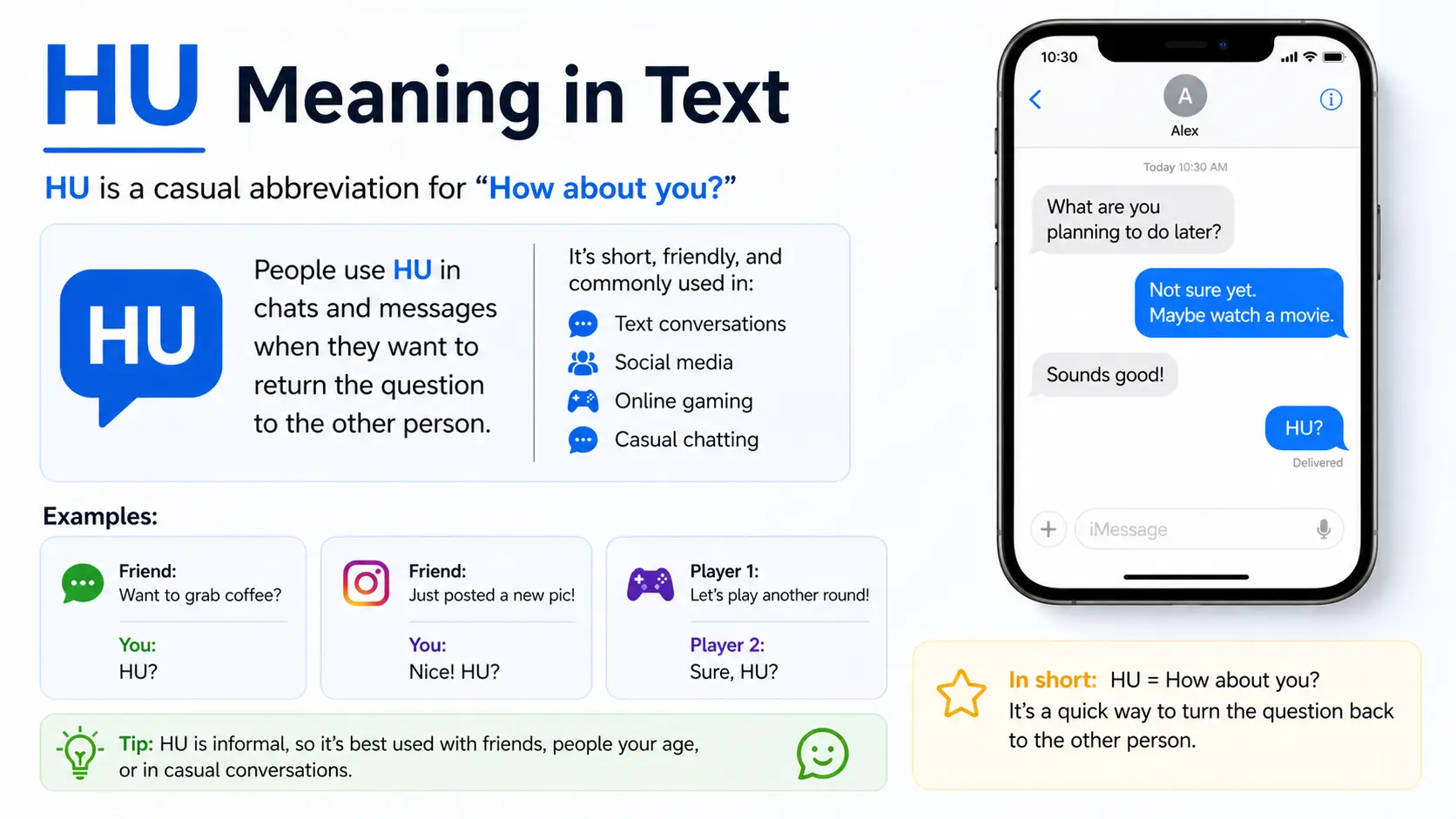
In most texting situations, “hu” is a casual or shortened form of “who” or sometimes “huh.” It depends entirely on context and tone.
Common meanings:
- “Who?” → Asking for identity
- “Huh?” → Expressing confusion
- Typing shortcut → Quick, lazy texting style
Examples:
- “hu is this?”
- “hu told you that?”
- “hu?? what are you saying 😭”
It’s not formal English. It’s fast, informal, and often used when someone doesn’t feel like typing the full word.
Origin & Background
“HU” didn’t come from a dictionary. It grew out of texting culture and social media habits.
In early mobile messaging, people typed quickly to save time and effort. Words like “you” became “u,” and “who” naturally turned into “hu.”
Over time, platforms like WhatsApp, Instagram, and TikTok normalized this shorthand. People began using “hu” not just for speed, but also for tone. It can feel playful, careless, or even slightly dismissive depending on context.
Its meaning evolved from simple abbreviation to something more emotional. Today, it’s less about grammar and more about vibe.
Real-Life Conversations
Here’s how “hu” actually appears in everyday chats.
1. WhatsApp Chat
Person A: I saw you talking to someone yesterday
Person B: hu?
Person A: The guy near the cafe
Person B: ohhh him 😅 just a friend
2. Instagram DM
Person A: Guess who texted me last night
Person B: hu 👀
Person A: My ex…
Person B: no way 😭
3. TikTok Comments
User 1: This reminds me of someone
User 2: hu tho??
User 1: I’m not saying 😭
4. Text Message
Person A: Someone asked about you today
Person B: hu asked?
Person A: Your old teacher
These examples show how “hu” is rarely about grammar. It’s about quick reactions and natural flow.
Emotional & Psychological Meaning
“HU” may look simple, but it often carries subtle emotional signals.
What it can express:
- Curiosity → “hu?” shows interest
- Confusion → trying to understand quickly
- Casual attitude → relaxed, effortless texting
- Mild disbelief → like “wait, what?”
People use it because it feels natural. It mirrors how we speak in real life. We don’t always say full sentences when reacting.
Real-life scenario
You’re chatting late at night. A friend suddenly says, “someone likes you.”
You reply with “hu?” instead of “who is it?”
That small choice makes your response feel more immediate, curious, and real. It shows emotion without overexplaining.
Usage in Different Contexts
Social Media
On platforms like Instagram or TikTok, “hu” is common in comments and DMs. It keeps conversations fast and informal.
Friends & Relationships
Among friends, it feels natural and relaxed. It can even add personality to your messages.
Work / Professional Settings
Avoid using “hu” in professional communication. It may seem careless or unclear. Always use full words like “who.”
Casual vs Serious Tone
- Casual: “hu is coming tonight?”
- Serious: “Who is responsible for this?”
Tone matters. “HU” belongs in relaxed conversations, not formal ones.
When NOT to Use It
There are situations where “hu” can create confusion or seem inappropriate.
- Professional emails or messages
- Talking to someone you don’t know well
- Serious discussions where clarity matters
- Cross-cultural conversations where slang may confuse
Using it in the wrong setting can make you appear uninterested or careless.
Common Misunderstandings
Many people misinterpret “hu” because it lacks clarity.
Common issues:
- Thinking it’s a typo instead of intentional
- Confusing it with “huh” only
- Misreading tone as rude or dismissive
- Assuming the sender is not paying attention
The truth is, “hu” is flexible. Its meaning depends on context, not spelling.
Comparison Table
| Expression | Meaning | Tone | Usage |
|---|---|---|---|
| hu | who / huh | Casual | Texting, social media |
| who | asking identity | Neutral | All contexts |
| huh | confusion | Informal | Spoken + text |
| wut | what | Playful | Internet slang |
| idk | I don’t know | Casual | Texting |
| why | asking reason | Neutral | All contexts |
Key Insight
“HU” is not just a word shortcut. It reflects how modern communication values speed, emotion, and tone over perfect grammar.
Variations / Types
Here are common variations you might see:
- hu?
Simple curiosity. Asking “who?” - hu is this
Direct question about identity. - hu told you
Questioning source of information. - hu??
Stronger confusion or surprise. - hu tho
Casual, slightly playful tone. - hu even cares
Dismissive or sarcastic use. - hu tf
Strong emotion, often frustration. - hu dis
Very informal version of “who is this?” - hu said that
Challenging or questioning. - hu lol
Light, humorous curiosity.
How to Respond When Someone Uses It
Your response depends on tone and relationship.
Casual Replies
- “It’s just me 😄”
- “My friend from school”
Funny Replies
- “Your biggest fan 😎”
- “A mystery you’ll never solve 👀”
Mature Replies
- “It’s Ahmed, we met last week”
- “Someone from the office”
Respectful Replies
- “This is Sarah, I hope you’re doing well”
- “I believe we spoke earlier today”
Match your tone with theirs. Keep it natural.
Regional & Cultural Usage
Western Culture
Common in texting culture. Seen as normal and informal.
Asian Culture
Used among younger users, especially in digital spaces. Older generations may find it confusing.
Middle Eastern Culture
Appears in casual chats, but formal communication still prefers full words.
Global Internet Usage
“HU” is part of a broader trend of shortening words. It’s widely understood among active internet users.
Generational Differences
- Gen Z: Uses it freely and naturally
- Millennials: Understand it but may not use it as often
Is It Safe for Kids?
Yes, “hu” is safe. It has no harmful or inappropriate meaning.
However, children should learn when to use proper language, especially in school or formal situations. Context awareness is important.
FAQs
1. Does “hu” always mean “who”?
Not always. It can also mean “huh,” depending on context.
2. Is “hu” rude?
No, but it can seem careless if used in serious conversations.
3. Why do people use “hu” instead of “who”?
Mostly for speed and casual tone.
4. Can I use “hu” in emails?
No. It’s too informal for professional communication.
5. Is “hu” a typo?
Sometimes, but often it’s intentional slang.
6. What’s the difference between “hu” and “huh”?
“Hu” can mean both, while “huh” clearly expresses confusion.
7. Should I reply formally to “hu”?
Only if the situation requires it. Otherwise, keep it casual.
Conclusion
“HU” may look like a tiny, unfinished word, but it carries the essence of modern texting. It’s quick, expressive, and shaped by how people naturally communicate today.
Understanding it isn’t just about decoding slang. It’s about recognizing tone, context, and emotion in digital conversations.
Once you get the feel of it, you won’t overthink it again. You’ll simply read it, respond naturally, and keep the conversation flowing.