
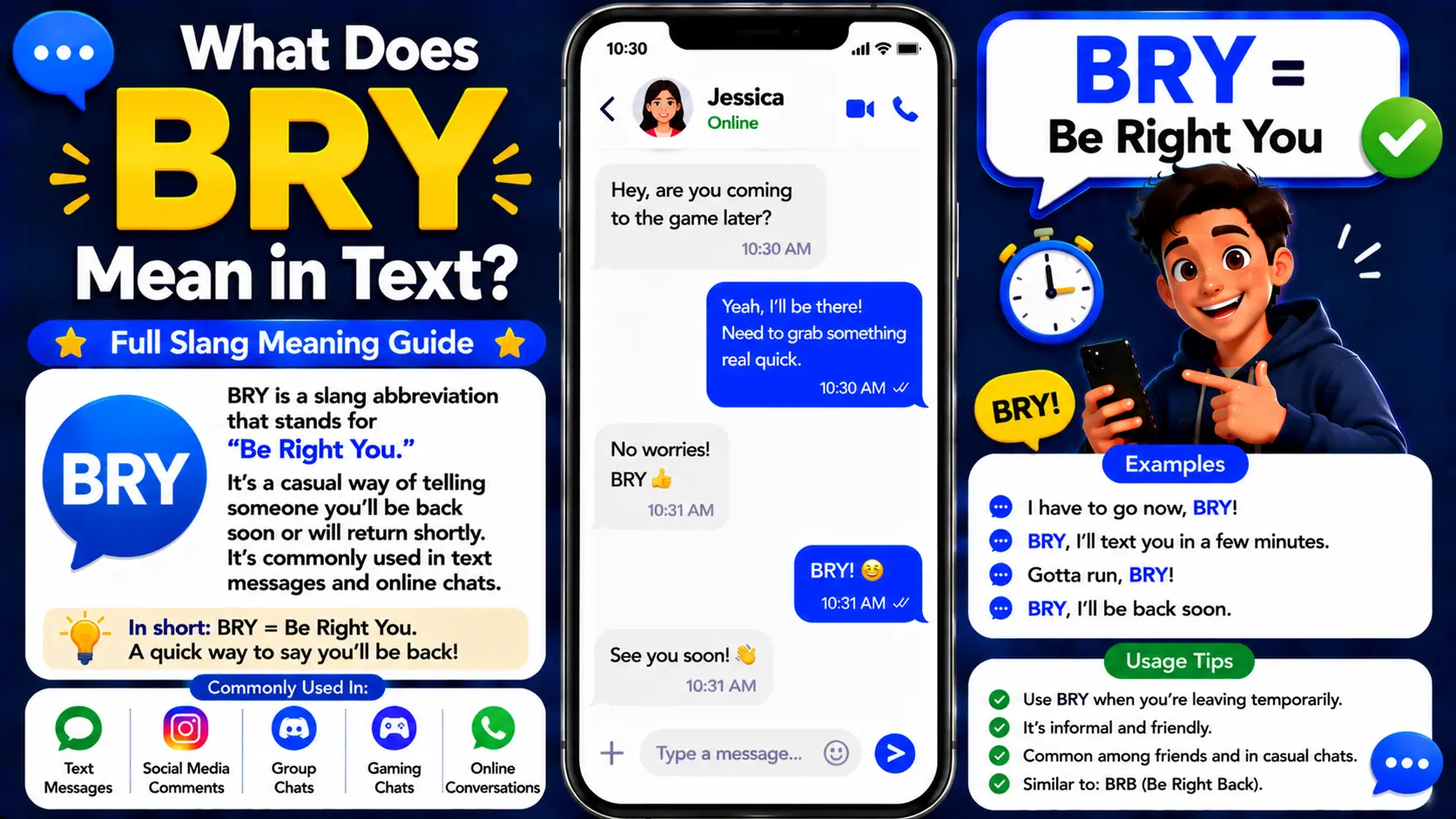
If you’ve recently seen “BRY” in a text message, TikTok comment, Snapchat streak, or Instagram DM, you’re not alone in wondering what it means. Internet slang changes fast, and many abbreviations carry different emotional tones depending on who’s using them and where they appear.
In most online conversations, BRY is commonly used as a casual nickname, shorthand expression, or stylized slang term. Sometimes it refers to someone named “Bryan,” “Bryce,” or “Bry.” In other cases, people use it as a friendly or playful way to address someone online.
The confusion happens because BRY does not have one universal dictionary definition. Its meaning depends heavily on context, tone, relationship, and platform culture.
This guide breaks down exactly what BRY means in text, where it came from, how people use it emotionally, and when you should avoid using it.
BRY Meaning in Text – Quick Definition
The slang term BRY usually means:
- A shortened nickname for someone
- A casual online greeting
- A playful way to address a friend
- Sometimes an affectionate or teasing label
People often use it in fast-paced texting where shorter words feel more natural.
Common Examples
“Yo bry, where you at?”
“Miss you bry 😂”
“Bry really disappeared after one game loss.”
In many conversations, BRY feels relaxed, friendly, and informal.
Origin & Background of BRY
The word BRY mostly evolved from internet nickname culture.
Originally, people shortened names online to save time while texting. Names like:
- Bryan
- Bryant
- Bryce
- Brianna
- Bryson
naturally became “Bry.”
Over time, social media transformed it from a simple nickname into a conversational slang term. Platforms like TikTok, Snapchat, Discord, and Instagram helped normalize short identity-based expressions.
Younger users especially enjoy shortening words because it creates a feeling of closeness and familiarity.
A person calling you “bry” can feel more personal than using your full name.
Social Media Influence
TikTok and gaming communities pushed this style further. Quick comments, inside jokes, and meme culture made short nicknames feel cooler and more emotionally expressive.
Instead of saying:
“Hey Bryan.”
People now casually type:
“bryyyy 😭”
That stretched spelling adds emotion, humor, or affection.
The internet often rewards speed, personality, and emotional shorthand. BRY fits perfectly into that communication style.
Real-Life Conversations Using BRY
WhatsApp Chat
Person A: bry are we still meeting tonight?
Person B: yeah give me 20 mins 😂
Instagram DM
Person A: bry your story was actually funny today
Person B: finally someone appreciates my humor
TikTok Comments
Person A: bry thought nobody would notice 💀
Person B: caught in 4k honestly
Text Message
Person A: good luck on your exam bry
Person B: thank youu i’m stressed
These examples show how flexible the word feels. It can sound supportive, playful, sarcastic, or affectionate depending on the situation.
Emotional & Psychological Meaning of BRY
Modern texting is not just about information anymore. It’s about emotional efficiency.
Words like BRY help people create closeness quickly.
When someone uses a shortened nickname, it often signals:
- Comfort
- Familiarity
- Emotional warmth
- Group identity
- Casual trust
In digital communication, shorter names feel less formal and more emotionally connected.
Why People Use It
People use BRY because it feels:
- Faster
- Friendlier
- More modern
- More personal
It also reflects how younger generations value relaxed communication over formal structure.
A Realistic Scenario
Imagine someone posting a sad Instagram story late at night.
A close friend replies:
“u okay bry?”
That tiny word changes the emotional tone. It feels softer and more caring than using a full name.
Small language choices shape emotional connection online more than many people realize.
Usage in Different Contexts
Social Media
On TikTok, Snapchat, and Instagram, BRY is extremely casual.
People use it for:
- Reactions
- Teasing
- Friendly tagging
- Gaming conversations
- Meme culture
Example:
“bry really thought this was a good idea 😭”
Friends & Relationships
Among close friends, BRY often becomes a nickname with emotional meaning.
It can feel:
- Affectionate
- Funny
- Comfortable
- Protective
Some couples even use it playfully in private chats.
Work or Professional Settings
Using BRY professionally is usually not recommended unless:
- The person already goes by that nickname
- Workplace culture is extremely casual
Professional communication generally works better with full names.
Casual vs Serious Tone
BRY mostly belongs in casual communication.
In serious conversations, it may sound:
- Too playful
- Emotionally detached
- Immature
Context matters a lot.
When NOT to Use BRY
Even harmless slang can create misunderstandings.
Avoid using BRY in these situations:
Formal Emails
Do not write:
“Hey bry, attached the report.”
Unless the person specifically uses that nickname professionally.
Sensitive Conversations
During emotional conflict or serious discussions, slang nicknames may feel dismissive.
Example:
- Breakup conversations
- Workplace problems
- Apologies
- Family disputes
With Strangers
Some people dislike overly casual nicknames from people they barely know.
Using BRY too quickly can feel forced or awkward.
Cultural Misunderstandings
Not everyone understands internet slang equally. Older generations or non-native English speakers may become confused.
Common Misunderstandings About BRY
Mistaking It for an Acronym
Some people think BRY stands for a hidden phrase.
Usually, it does not.
Most of the time, it’s simply a nickname or shorthand expression.
Assuming It’s Romantic
Calling someone “bry” does not automatically mean flirting.
Friends use it constantly online.
Tone and context matter more than the word itself.
Thinking It’s Universal
Not every online community uses BRY the same way.
Gaming groups, TikTok users, and texting culture may interpret it differently.
Confusing Tone
A sentence like:
“ok bry 💀”
could mean:
- joking annoyance
- sarcasm
- affection
- playful teasing
Emoji choice changes everything.
Comparison Table
| Expression | Meaning | Tone | Usage Style |
|---|---|---|---|
| BRY | Casual nickname/slang | Friendly | Informal texting |
| Bro | Friend or buddy | Relaxed | Universal slang |
| Bruh | Disbelief or reaction | Humorous | Meme culture |
| Bestie | Close friend | Affectionate | Social media |
| Dude | Casual address | Neutral | Everyday speech |
| Sir/Ma’am | Respectful address | Formal | Professional |
| Buddy | Friendly term | Warm | Conversational |
| Fam | Close social circle | Trendy | Youth slang |
Key Insight
BRY works because it feels personal without sounding overly emotional. It sits somewhere between a nickname and casual slang, which makes it flexible in digital conversations.
Variations and Related Forms of BRY
1. Bryyy
Extra letters add emotion, excitement, or exaggeration.
2. Bry 😂
Adds humor or playful teasing.
3. Bry 😭
Usually expresses emotional drama or exaggerated sadness.
4. Hey Bry
A simple casual greeting.
5. Yo Bry
More energetic and friendly.
6. Bry Bro
Combines nickname culture with friendship slang.
7. Lil Bry
Used jokingly or affectionately for younger friends.
8. Bryy
A softer or more expressive spelling variation.
9. Bry Fr
Means “Bry for real,” emphasizing honesty.
10. Bry Stop
Used during playful teasing or mock frustration.
How to Respond When Someone Uses BRY
Casual Replies
- “what’s up”
- “yo 😂”
- “nothing much bry”
Funny Replies
- “don’t bry me unless you got snacks”
- “i only respond to royalty”
- “who summoned me”
Mature Replies
- “thanks for checking in”
- “appreciate it”
- “good to hear from you”
Respectful Replies
- “hope you’re doing well too”
- “thank you, bry”
- “that means a lot”
The best response depends on the emotional tone of the conversation.
Regional & Cultural Usage
Western Culture
In the US, Canada, and the UK, BRY feels very casual and youth-oriented.
It’s common in:
- gaming chats
- TikTok comments
- Snapchat streaks
- group conversations
Younger users treat shortened names as social bonding tools.
Asian Culture
In many Asian countries, English internet slang is heavily influenced by pop culture and K-pop fandom communication.
BRY may appear mostly among:
- bilingual users
- gaming communities
- younger social media audiences
Some users adopt it simply because it sounds trendy online.
Middle Eastern Culture
In Middle Eastern online spaces, slang mixing is very common.
English abbreviations often blend with Arabic texting styles. BRY may appear in multilingual chats where users combine English slang with local expressions.
Global Internet Usage
Internet culture has become deeply interconnected.
A slang term created in one country can spread globally within days through:
- memes
- TikTok trends
- influencers
- gaming streams
BRY survives because it’s short, adaptable, and emotionally flexible.
Gen Z vs Millennials
Gen Z
- Uses BRY more casually
- Adds emojis and exaggeration
- Often uses it ironically
Example:
“bryyyyy you failed again 😭”
Millennials
- May use it less frequently
- Prefer traditional nicknames
- Sometimes interpret it differently
The generational gap affects how internet slang is understood.
Is BRY Safe for Kids?
Generally, yes.
BRY itself is not considered offensive or dangerous slang.
However, parents should still pay attention to:
- overall conversation context
- online communities
- emotional tone
- who children are communicating with
The word is usually harmless and friendly.
Frequently Asked Questions
What does BRY mean in texting?
BRY usually means a shortened nickname or casual way of addressing someone online.
Is BRY slang?
Yes. It’s considered modern internet slang or nickname shorthand.
Is BRY rude?
Not usually. Most people use it playfully or casually.
Does BRY mean “bro”?
Sometimes it can feel similar emotionally, but BRY is typically more personalized.
Can BRY be romantic?
It can be, depending on the relationship and tone, but it is not automatically romantic.
Why do Gen Z users say BRY?
Gen Z communication often favors shorter, emotionally expressive words that feel informal and personal.
Should I use BRY at work?
Only if the person already uses it as their nickname and workplace culture is casual.
Conclusion
So, what does BRY mean in text?
In most cases, it’s a casual nickname or friendly slang expression used to create comfort, familiarity, and emotional closeness in digital conversations.
What makes BRY interesting is not just the word itself, but what it represents about modern communication. People today want texting to feel faster, warmer, and more personal. Small expressions like BRY help create that feeling instantly.
Whether you see it in TikTok comments, Snapchat messages, gaming chats, or Instagram DMs, the meaning usually depends on tone, relationship, and context.
Once you understand the emotional style behind it, BRY becomes much easier to recognize and use naturally.