
If you spend time on texting apps, TikTok, Snapchat, or Instagram, you’ve probably seen someone type “WDA” and wondered what it actually means. The tricky part is that WDA can mean different things depending on the conversation, the platform, and even the mood of the person using it.
That confusion is exactly why so many people search for the meaning of WDA in text messages.
Sometimes it sounds casual and playful. Other times it can feel dismissive, emotional, or even flirtatious. In modern texting culture, abbreviations carry more emotional weight than most people realize. A simple three-letter phrase can completely change the tone of a conversation.
This guide breaks down the real meaning of WDA, where it came from, how people use it online, and when you should avoid using it altogether.
WDA – Quick Meaning
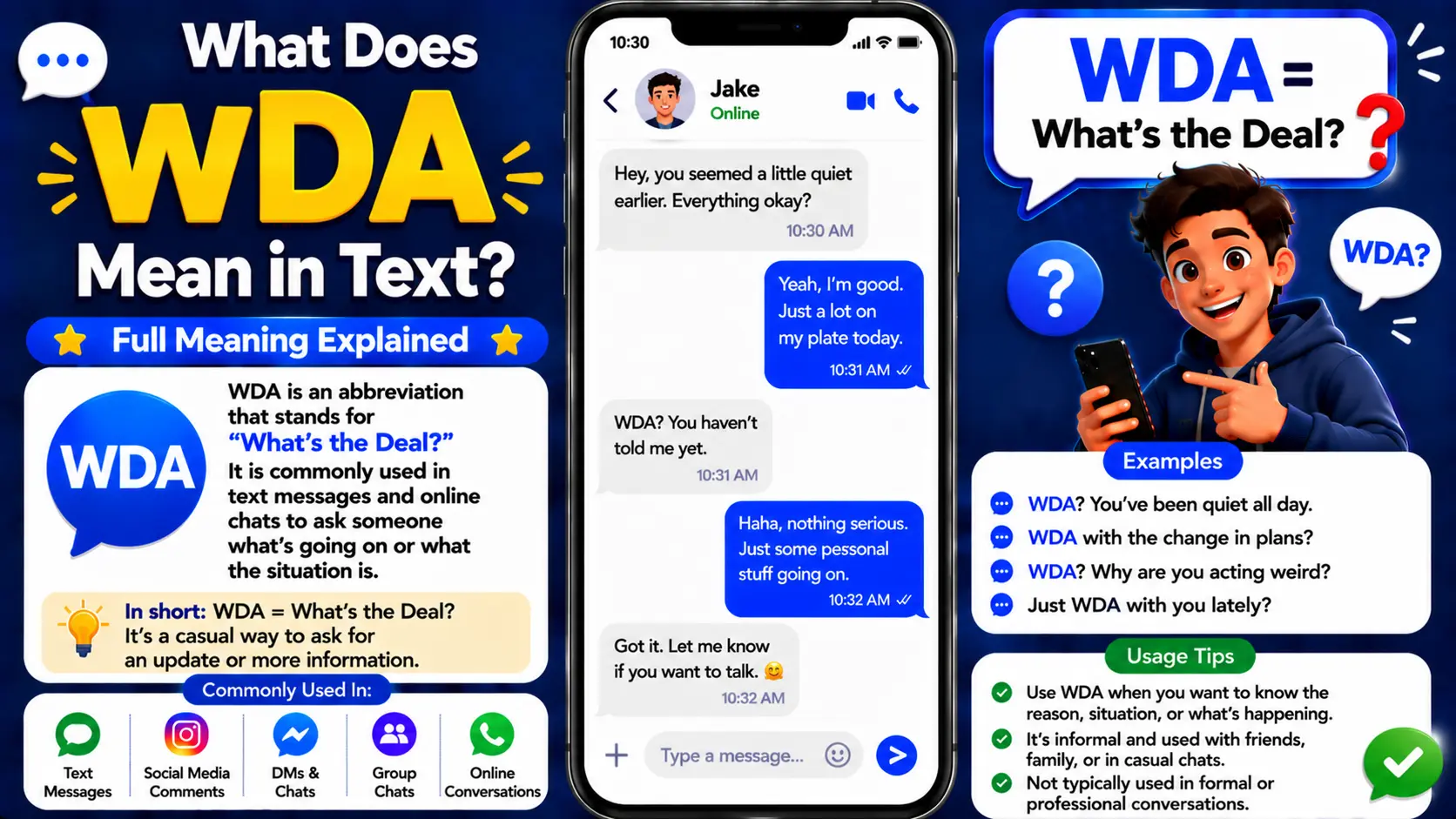
In texting, WDA most commonly means:
- “What Doing?”
- A casual slang version of “What are you doing?”
- Often used to start conversations quickly and casually
People usually send it when they want attention, conversation, or connection without sounding too formal.
Example Uses
“WDA tonight?”
“Heyyy WDA rn?”
“Bored at work. WDA?”
The tone is usually relaxed, friendly, or flirtatious.
In some cases, WDA can also mean other things depending on context, but in social texting culture, “What Doing?” is the most common interpretation.
Origin & Background of WDA
WDA grew out of fast-paced texting culture where people shortened phrases to type quicker. Similar abbreviations became popular during the rise of SMS messaging, Snapchat streaks, and online gaming chats.
Younger internet users especially began removing extra words from sentences:
- “What are you doing?” became “wyd”
- “Where you at?” became “wya”
- “What doing?” became “wda”
Unlike older abbreviations that sounded robotic, WDA feels conversational and spontaneous. It mimics how people casually talk in real life.
Social media also played a huge role in spreading it. TikTok comment sections, Instagram DMs, and Snapchat conversations normalized short emotional phrases that feel effortless and informal.
Over time, WDA became less about grammar and more about tone.
Someone typing “WDA?” usually wants one of these things:
- Attention
- Conversation
- Company
- Flirting
- Emotional connection
- Entertainment
That emotional layer is why slang like this spreads so quickly online.
Real-Life Conversations
Here’s how WDA actually appears in modern conversations.
WhatsApp Conversation
Person A:
Hey stranger 👀 WDA?
Person B:
Just watching Netflix. You?
Person A:
Trying not to die from boredom honestly.
Instagram DM
Person A:
WDA tonight?
Person B:
Probably staying home lol.
Person A:
Same. We officially have boring lives.
TikTok Comments
Person A:
WDA awake at 3am 😭
Person B:
Overthinking my entire existence.
Person A:
Realest comment here.
Text Message
Person A:
Yo WDA rn?
Person B:
At the gym.
Person A:
Respect. I’m in bed eating chips.
These examples show how casual and emotionally expressive the phrase can feel.
Emotional & Psychological Meaning
At first glance, WDA looks like a simple shortcut. But emotionally, it often means much more.
People rarely text “WDA?” just to collect information.
Usually, they are testing emotional availability.
They may be:
- Feeling lonely
- Looking for attention
- Trying to flirt
- Hoping to reconnect
- Avoiding awkward silence
- Wanting comfort without directly asking for it
Modern texting culture rewards low-pressure communication. Saying “WDA?” feels lighter and less vulnerable than saying:
- “I miss talking to you.”
- “Can we hang out?”
- “I feel lonely.”
That’s part of why abbreviations became emotionally powerful online.
I’ve seen conversations where a single “WDA?” reopened friendships after months of silence because it feels casual enough to send without embarrassment.
People often use slang to protect themselves emotionally while still reaching out for connection.
Usage in Different Contexts
Social Media
On Snapchat, TikTok, and Instagram, WDA is mostly casual and social.
People use it:
- To start conversations
- During late-night chats
- While flirting
- When bored
It feels relaxed and modern.
Friends & Relationships
Among friends, WDA is friendly and spontaneous.
In relationships, though, it can become more emotional or flirtatious.
Example:
“WDA later? Miss you.”
That small phrase suddenly carries emotional warmth.
Work / Professional Settings
WDA is generally inappropriate in professional communication.
Avoid using it in:
- Work emails
- Business chats
- Client conversations
- Academic writing
It can appear careless or immature.
Instead, use:
- “What are you working on?”
- “Are you available?”
- “What are you doing currently?”
Casual vs Serious Tone
WDA almost always sounds casual.
If someone uses it during a serious conversation, it may come across as emotionally detached or insensitive.
Example:
Bad timing:
“My grandfather is in the hospital.”
“Oh… WDA later?”
Tone awareness matters online more than people realize.
When NOT to Use It
There are situations where WDA can create confusion or even offend people.
Avoid It in Formal Situations
Using slang in professional settings may hurt credibility.
Avoid It During Emotional Conversations
If someone is discussing grief, stress, or conflict, casual slang can feel dismissive.
Avoid It With People Unfamiliar With Slang
Older generations or non-native English speakers may misunderstand it completely.
Avoid Overusing It
Repeatedly texting “WDA?” without meaningful conversation can feel lazy or emotionally shallow.
People appreciate effort, especially in close relationships.
Common Misunderstandings
One major problem with WDA is that people interpret tone differently.
Some Think It Means “Where Do You At?”
Because slang changes rapidly, users sometimes confuse WDA with:
- WYA (“Where You At?”)
- WYD (“What You Doing?”)
It Can Sound Dry
A single “WDA” without emojis or context may seem cold.
Compare:
“WDA”
vs.
“Heyyy WDA 😂”
The emotional tone completely changes.
Literal vs Figurative Meaning
Sometimes people ask “WDA?” simply to start talking, not because they genuinely care what you’re doing.
It acts more like:
- “I want your attention.”
- “Talk to me.”
- “I’m thinking about you.”
Understanding that emotional layer helps avoid confusion.
Comparison Table
| Expression | Meaning | Tone | Common Use |
|---|---|---|---|
| WDA | What Doing? | Casual | Starting chats |
| WYD | What You Doing? | Friendly | Everyday texting |
| WYA | Where You At? | Direct | Asking location |
| HMU | Hit Me Up | Social | Invitation to talk |
| IDC | I Don’t Care | Dismissive | Emotional distance |
| BRB | Be Right Back | Neutral | Temporary pause |
| TTYL | Talk To You Later | Warm | Ending conversations |
Key Insight
Most texting slang is not really about efficiency anymore. It’s about emotional tone. WDA feels lightweight, informal, and emotionally safe, which explains why younger users prefer it over fully written sentences.
Variations / Types of WDA
Here are common versions and related forms people use online.
1. WDA RN
Means “What doing right now?”
Used for immediate conversation.
2. WDA Later
Asking about future plans.
3. WDA Tonight
Usually social or flirtatious.
4. WDA Bro
Friendly version between friends.
5. WDA Babe
Romantic or affectionate tone.
6. WDA LOL
Makes the message playful.
7. WDA Fr
“Fr” means “for real.”
Adds seriousness or curiosity.
8. WDA Weekend
Asking about weekend plans.
9. WDA Text Me
Invitation to continue talking.
10. WDA Busy?
Checking emotional or conversational availability.
How to Respond When Someone Uses It
Your reply depends on your mood and relationship with the person.
Casual Replies
- “Nothing much honestly.”
- “Just chilling.”
- “Watching YouTube lol.”
- “Trying to survive this day.”
Funny Replies
- “Mentally buffering.”
- “Pretending to be productive.”
- “Avoiding responsibilities professionally.”
- “Training for the Olympics of overthinking.”
Mature Replies
- “Just finishing some work.”
- “Relaxing after a long day.”
- “Catching up with family.”
Respectful Replies
- “Hey, I’m a bit busy right now but I’ll text later.”
- “Doing okay. Hope you are too.”
Thoughtful responses usually keep conversations healthier and more engaging.
Regional & Cultural Usage
Western Culture
In the US, Canada, and the UK, WDA is mostly casual Gen Z slang.
It’s often used:
- Playfully
- Socially
- Flirtatiously
Asian Culture
In many Asian countries, English slang spreads heavily through TikTok and gaming culture.
However, some users may misunderstand abbreviations because literal English grammar is taught more formally in schools.
Middle Eastern Culture
In Middle Eastern online communities, slang usage varies depending on language mixing.
Young users often combine English abbreviations with Arabic texting styles, especially on Snapchat and Instagram.
Global Internet Usage
Globally, WDA is becoming part of internet-native communication.
Even users with different first languages adopt slang because it creates a sense of belonging online.
Generational Differences
Gen Z
- Uses abbreviations naturally
- Prefers fast emotional communication
- Understands slang instantly
Millennials
- More familiar with older texting slang
- Sometimes prefer complete sentences
- May interpret newer abbreviations differently
This generational gap explains many online misunderstandings.
Is It Safe for Kids?
Generally, yes.
WDA itself is harmless and usually just means “What Doing?” or “What are you doing?”
However, context always matters online.
Parents should understand that slang often changes meaning depending on platform, friend groups, and tone. Monitoring healthy digital communication is more important than focusing on a single abbreviation.
FAQs
What does WDA stand for in texting?
It usually means “What Doing?” which is slang for “What are you doing?”
Is WDA the same as WYD?
They are very similar. WYD means “What You Doing?” while WDA is a shorter casual variation.
Is WDA flirtatious?
Sometimes. The tone depends on context, emojis, timing, and relationship dynamics.
Can WDA be rude?
Not usually, but it can sound dry or dismissive if used during serious conversations.
Do adults use WDA?
Mostly younger users and Gen Z, though adults familiar with internet slang may use it casually.
Is WDA used on TikTok?
Yes. It commonly appears in comments, captions, and direct messages.
Should I use WDA at work?
No. Professional communication should remain clear and formal.
Conclusion
WDA may look like just another random internet abbreviation, but it reflects something bigger about modern communication.
People want connection that feels easy, fast, and emotionally low-pressure.
That’s why phrases like “WDA?” became popular. They allow people to check in, flirt, reconnect, or fight boredom without sounding too intense.
Understanding slang today is less about dictionary definitions and more about emotional context.
The next time someone texts you “WDA,” you’ll know they may not just be asking what you’re doing. They could be looking for attention, comfort, conversation, or simply a reason to feel connected.
And now, you can respond confidently without second-guessing the meaning.