
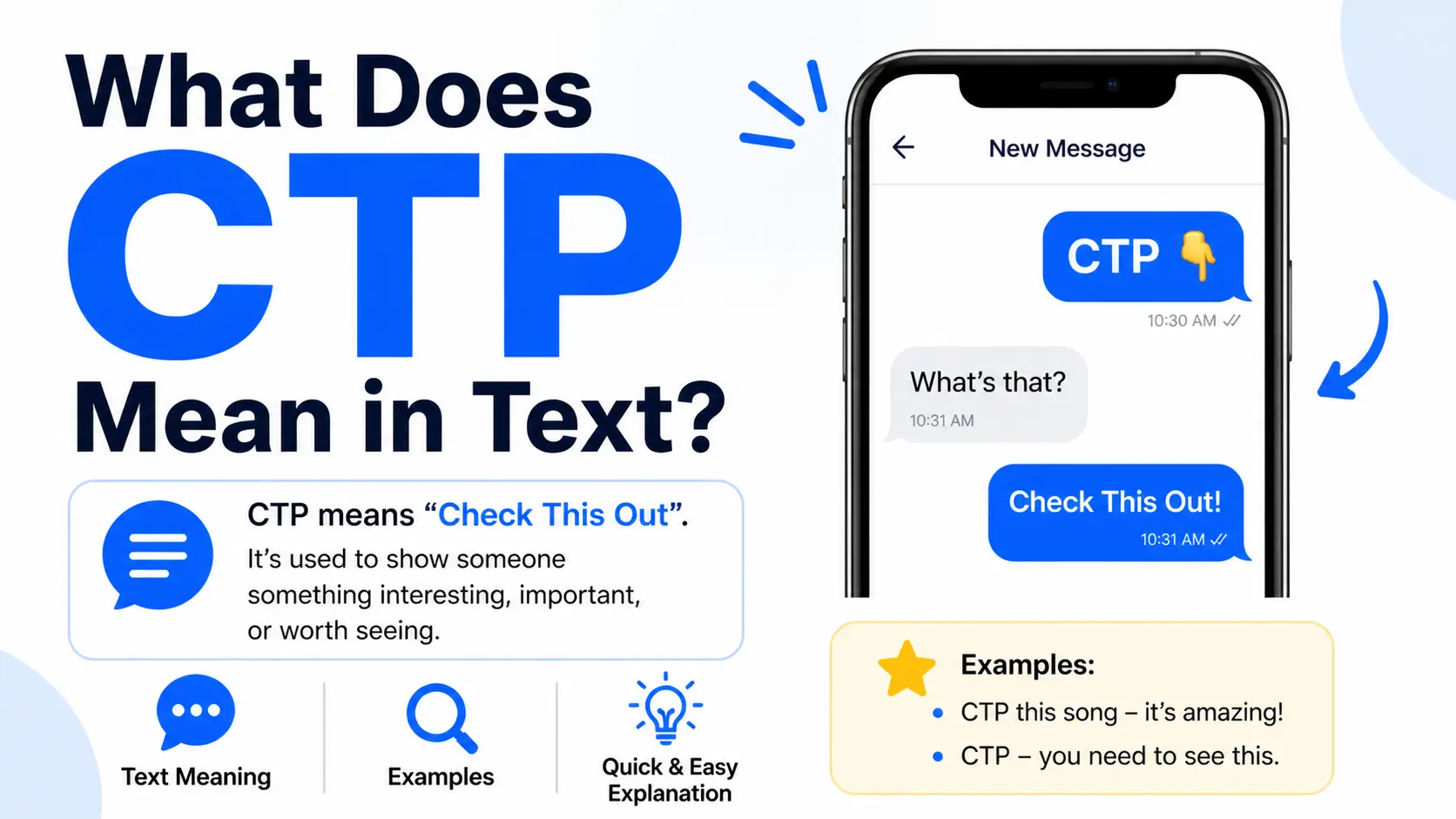
If you’ve ever received a message saying “CTP” and paused for a second, you’re not alone. It’s one of those short, cryptic text abbreviations that can feel confusing at first glance.
People search for “what does CTP mean in text” because it doesn’t have just one fixed meaning. Its interpretation often depends on the context, tone, and even the relationship between the people texting.
In today’s fast-paced digital conversations, acronyms like CTP are used to save time, express emotion quickly, or add a casual vibe. But without context, they can easily be misunderstood.
This guide breaks it all down in a clear, human way so you can not only understand CTP but also use it confidently in real conversations.
CTP – Quick Meaning
CTP most commonly stands for:
- “Chat To Please” – used casually to encourage someone to keep talking
- “Can’t Talk Properly” – used when someone is busy or distracted
- “Cut The Phone” – often used to end a call or conversation quickly
Example Messages
- “I’m in class rn, CTP later.”
- “Hey don’t go silent, CTP 😊”
- “Battery low, CTP now.”
The meaning depends entirely on how and where it’s used.
Origin & Background
CTP doesn’t come from one specific place like some viral slang terms. Instead, it evolved organically through texting culture.
As messaging apps like WhatsApp and Instagram grew, people started shortening phrases to type faster. Over time, combinations like “CTP” began appearing in chats, especially among younger users.
Its flexibility is part of its appeal. Unlike fixed slang terms, CTP adapts based on context. That’s why it feels confusing at first but becomes intuitive once you see it used in real situations.
Social media platforms like TikTok and Instagram also played a role. Short, fast communication styles encouraged abbreviations that could carry meaning without long explanations.
Real-Life Conversations
Here’s how CTP actually appears in everyday chats.
1. WhatsApp Conversation
Person A: Hey, are you free to talk?
Person B: Not really, busy with work. CTP later?
2. Instagram DM
Person A: Why did you disappear suddenly?
Person B: Sorry 😭 mom called me, CTP now
3. TikTok Comments
Person A: Bro explain this trend 😂
Person B: Too long, CTP and I’ll tell you
4. Text Message
Person A: Call me ASAP
Person B: In a meeting, can’t talk properly. CTP after 10
These examples show how flexible the meaning is. It shifts depending on tone and urgency.
Emotional & Psychological Meaning
CTP may look simple, but it carries subtle emotional signals.
When someone says “CTP later”, it shows:
- They still care about the conversation
- They want to continue but can’t right now
When used as “Chat To Please”, it can feel:
- Playful
- Slightly needy
- Engaging
It reflects how modern communication balances speed with emotional connection.
A Real-Life Scenario
Imagine texting a close friend late at night. The conversation is flowing, and suddenly they say:
“Hey, I’m sleepy… CTP tomorrow?”
That small phrase carries reassurance. It says, “I’m not ignoring you. I just need a break.”
That’s the emotional layer behind it.
Usage in Different Contexts
Social Media
On platforms like Instagram or TikTok:
- Used casually
- Often playful or informal
- Keeps conversations short and engaging
Example: “CTP in DMs if you want details”
Friends & Relationships
Among friends:
- Shows comfort and familiarity
- Used without overthinking tone
In relationships:
- Can feel caring if used right
- Can feel dismissive if used abruptly
Work / Professional Settings
This is where you need caution.
CTP is:
- Too informal for professional emails
- Acceptable only in very casual team chats
Better alternatives in work:
- “Let’s continue later”
- “I’ll follow up soon”
Casual vs Serious Tone
- Casual: “Busy rn, CTP later 😂”
- Serious: “Can’t talk properly right now. We’ll discuss later.”
Tone changes everything.
When NOT to Use It
CTP is not always appropriate.
Avoid using it:
- In formal communication
- With someone unfamiliar with slang
- During serious or emotional conversations
- When clarity is important
Example of misuse:
- Breaking serious news and ending with “CTP” can feel insensitive
Always match the tone to the situation.
Common Misunderstandings
Many people misread CTP because of its multiple meanings.
What People Get Wrong
- Assuming it has one fixed definition
- Misreading tone as rude or dismissive
- Taking it literally without context
Tone Confusion
“CTP now” could mean:
- Urgent ending
- Casual goodbye
- Technical issue
Without context, it’s easy to misinterpret.
Comparison Table
| Expression | Meaning | Tone | Usage |
|---|---|---|---|
| CTP | Chat / Can’t talk / Cut phone | Flexible | Casual texting |
| BRB | Be right back | Neutral | Temporary pause |
| TTYL | Talk to you later | Friendly | Ending conversation |
| GTG | Got to go | Direct | Quick exit |
| ASAP | As soon as possible | Urgent | Time-sensitive |
Key Insight
CTP stands out because it’s context-driven. Unlike fixed phrases, it adapts to emotion, urgency, and relationship dynamics.
Variations / Types
Here are common variations and related uses:
- CTP later – Continue conversation later
- CTP now – Ending conversation immediately
- CTP pls – Asking someone to keep chatting
- CTP bro – Casual tone among friends
- CTP asap – Urgent continuation or pause
- CTP after work – Delayed conversation
- CTP tomorrow – Scheduling future chat
- CTP in DM – Moving conversation privately
- CTP quick – Short conversation request
- CTP rn – Immediate but brief communication
Each variation slightly shifts the tone.
How to Respond When Someone Uses It
Casual Replies
- “Alright, talk later 👍”
- “Cool, I’ll wait”
Funny Replies
- “Don’t ghost me 😂”
- “I’ll remember this 😏”
Mature Replies
- “No worries, we’ll talk when you’re free”
- “Take your time”
Respectful Replies
- “Understood, speak soon”
- “Thanks for letting me know”
Your response should match your relationship with the person.
Regional & Cultural Usage
Western Culture
- Common in casual texting
- Widely understood among younger users
Asian Culture
- Less common
- Users may prefer clearer phrases
Middle Eastern Culture
- Used in informal chats
- Context matters more due to language differences
Global Internet Usage
- Increasingly popular
- Meaning varies widely
Generational Differences
- Gen Z: Uses it naturally and flexibly
- Millennials: May find it confusing or unclear
Is It Safe for Kids?
Yes, CTP is generally safe.
It doesn’t carry harmful or inappropriate meaning. However, context still matters.
Parents should be aware that:
- Kids use it casually
- Miscommunication can still happen
Encouraging clear communication is always better than relying too much on slang.
FAQs
1. What does CTP mean in texting?
It usually means “Chat To Please,” “Can’t Talk Properly,” or “Cut The Phone,” depending on context.
2. Is CTP rude?
Not inherently. It can feel rude if used abruptly or without explanation.
3. Can CTP have multiple meanings?
Yes, and that’s why context is essential.
4. Is CTP used worldwide?
It’s growing globally but is more common in informal online communication.
5. Should I use CTP in professional chats?
No, it’s better to use clear and formal language in work settings.
6. How do I know what CTP means in a message?
Look at the conversation tone, timing, and situation.
7. Is CTP similar to TTYL?
Yes, but CTP is more flexible and less defined.
Conclusion
CTP is one of those modern texting shortcuts that reflects how communication is evolving. It’s quick, adaptable, and packed with meaning depending on how it’s used.
At first, it might seem confusing. But once you understand its flexibility, it becomes a useful part of digital conversation.
The key is simple. Pay attention to context, tone, and relationship. When used thoughtfully, CTP can keep your communication smooth, natural, and human.
And that’s what texting is really about. Staying connected, even in just a few letters.