
In today’s fast-moving digital world, short text slang appears everywhere. One abbreviation that often leaves people confused is “OE.” You might see it in a text message, a TikTok comment, a Snapchat reply, or even inside gaming chats and Instagram DMs.
So, what does OE mean in text?
The answer depends on the conversation, the relationship between the people talking, and the platform where it appears. Sometimes it carries a casual tone. Other times, it can feel emotional, playful, or even dismissive.
People search this phrase because internet slang changes constantly. A term that means one thing in a gaming group might mean something completely different in a relationship chat. That confusion is exactly why understanding context matters.
This guide breaks down the meaning of OE in a simple, human way so you can understand when to use it, when to avoid it, and what people usually mean when they type it.
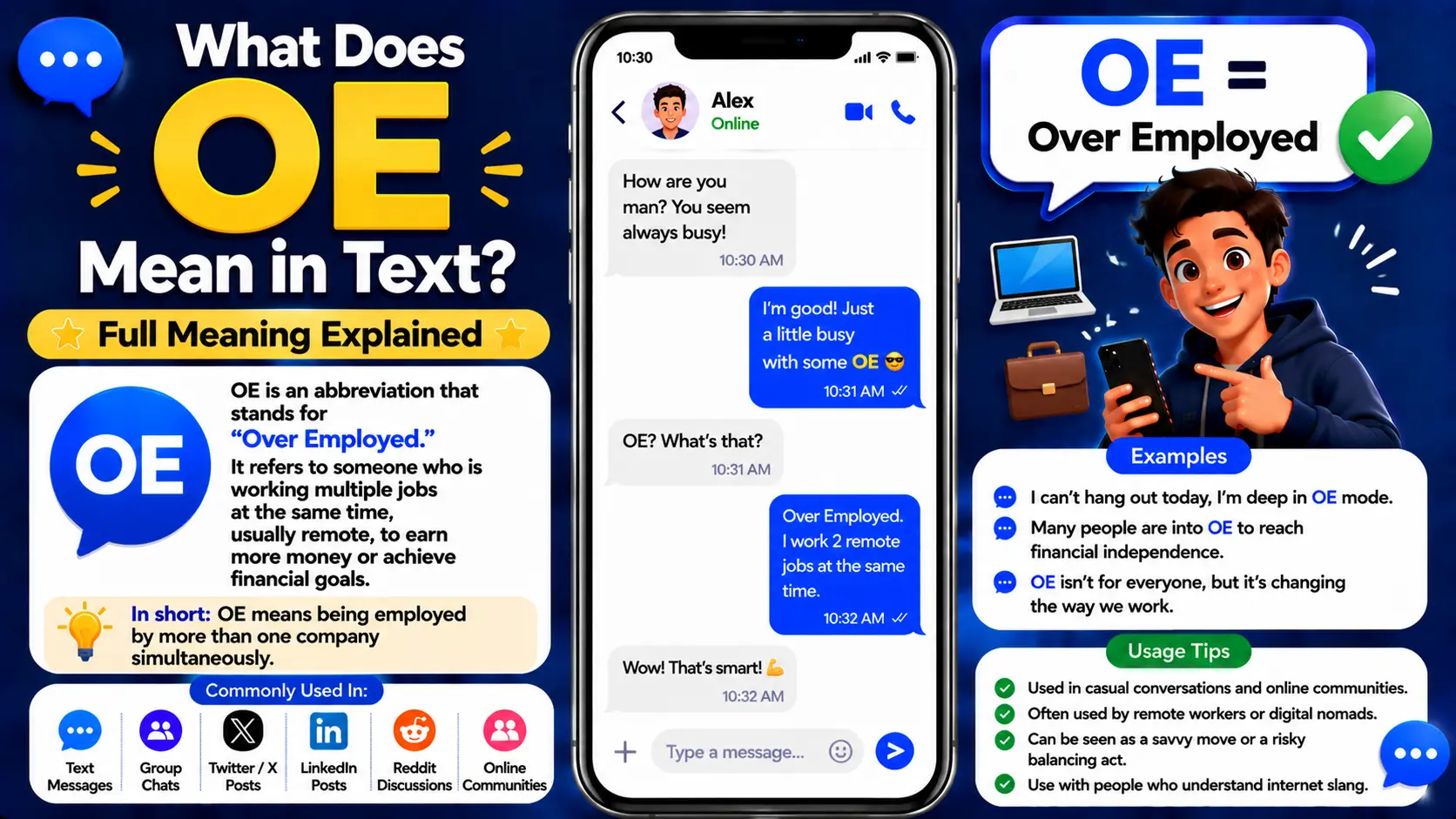
OE Meaning in Text – Quick Definition
“OE” most commonly means:
- “Over Everything”
- “Over Exaggerating”
- “Open Ended”
- Sometimes simply a typo or shortened expression in casual texting
In modern texting culture, the most popular interpretation is usually “Over Everything.”
It’s often used to show priority, loyalty, affection, or emotional importance.
Quick Examples
“My family OE always ❤️”
“Best friends OE fr.”
“You know music OE stress.”
In some situations, people also use it sarcastically:
“Bro acting dramatic OE 😂”
The exact meaning depends heavily on tone and context.
Origin & Background of OE
Like many internet abbreviations, OE did not explode from one single source. Instead, it evolved gradually through online culture.
Early uses appeared in gaming communities and informal texting spaces where people shortened phrases to type faster. Over time, social media platforms helped spread it further.
TikTok and Instagram especially accelerated slang culture. Short captions, fast comments, and emotional reactions encouraged users to compress longer phrases into tiny abbreviations.
“Over Everything” became popular because it expresses emotional priority in a compact way. Younger users liked it because it sounded intense, loyal, and expressive without needing a full sentence.
For example:
- “Money OE drama.”
- “Peace OE negativity.”
- “My girl OE everybody.”
The phrase fits perfectly into modern internet communication where emotions are often delivered quickly but dramatically.
Another reason OE spread is because online users enjoy creating “inside language.” Slang builds group identity. When people understand the abbreviation, they feel socially connected.
That is why slang terms like OE often grow fastest among Gen Z users and online communities.
Real-Life Conversations Using OE
WhatsApp Conversation
Person A:
You still going out tonight?
Person B:
Nah honestly sleep OE partying rn 😭
Instagram DM
Person A:
You disappeared all day lol
Person B:
Family OE socials sometimes ❤️
TikTok Comments
Commenter 1:
This song got me emotional.
Commenter 2:
Real music OE fake vibes.
Text Message
Person A:
Why you defending him so hard?
Person B:
Cause loyalty OE gossip.
Emotional & Psychological Meaning of OE
One interesting thing about internet slang is that it often reveals emotional priorities.
When someone uses “OE,” they are usually emphasizing what matters most to them.
It can express:
- Loyalty
- Passion
- Emotional attachment
- Frustration
- Priorities
- Personal identity
Modern communication is heavily emotion-driven. People want to express feelings quickly while still sounding authentic and relatable. “OE” works because it compresses a strong emotional message into just two letters.
For example, saying:
“Peace OE drama”
instantly communicates emotional maturity, personal boundaries, and values.
A lot of people also use OE to create emotional intensity without sounding overly serious. That balance is part of why slang spreads so quickly online.
A Realistic Scenario
Imagine someone posting:
“Mental health OE everything this year.”
That short sentence says far more than it appears to. It signals burnout, healing, self-protection, and emotional growth all at once.
That is the power of modern internet shorthand.
Usage in Different Contexts
Social Media
On TikTok, Instagram, Snapchat, and X, OE is mostly emotional or expressive.
Examples:
- “Friends OE fake love.”
- “Peace OE attention.”
- “Real life OE internet drama.”
It helps create short, impactful captions.
Friends & Relationships
Among friends or couples, OE often shows loyalty or emotional closeness.
Examples:
- “My bestie OE everybody.”
- “You OE all this nonsense.”
It can sound affectionate or protective depending on tone.
Work or Professional Settings
Using OE in professional communication is usually not recommended.
A manager or coworker may not understand the abbreviation, and it can appear too casual.
Instead of:
“Work-life balance OE stress.”
A professional setting would sound better with full wording.
Casual vs Serious Tone
OE can feel playful or deeply emotional depending on context.
Casual:
“Food OE homework 😂”
Serious:
“Health OE money.”
Tone matters more than the abbreviation itself.
When NOT to Use OE
Even common slang has situations where it may feel inappropriate.
Professional Emails
Avoid using OE in:
- Work presentations
- Client emails
- Academic writing
- Formal applications
Not everyone understands internet slang.
Sensitive Conversations
If someone is grieving, upset, or emotionally vulnerable, shorthand slang may sound dismissive.
For example:
“Drama OE feelings.”
could accidentally sound insensitive.
Cross-Generational Communication
Older audiences may misunderstand OE entirely or assume it is a typo.
That confusion can weaken your message.
Common Misunderstandings About OE
One major issue with internet slang is that people assume there is only one meaning.
That is not true.
Some People Think It Means:
- “Okay”
- “Open”
- “Online Energy”
- “Over Emotional”
Because context changes meaning, misunderstandings happen frequently.
Tone Confusion
A sentence like:
“You OE everybody.”
could sound:
- Romantic
- Possessive
- Loyal
- Aggressive
depending on the relationship and tone.
Literal vs Figurative Meaning
Most OE usage is emotional or figurative.
When someone says:
“Peace OE drama”
they are expressing values, not making a literal comparison.
Understanding emotional intent is essential.
Comparison Table
| Expression | Meaning | Tone | Common Usage |
|---|---|---|---|
| OE | Over Everything | Emotional | Loyalty, priorities |
| FR | For Real | Honest | Agreement |
| IDC | I Don’t Care | Dismissive | Casual texting |
| GOAT | Greatest of All Time | Admiring | Sports, culture |
| IMO | In My Opinion | Neutral | Discussions |
| Lowkey | Secretly/Subtly | Casual | Social media |
| Highkey | Openly/Strongly | Intense | Emotional emphasis |
Key Insight
Most modern slang works as emotional shorthand. OE stands out because it often reflects what a person values most in that moment.
Variations & Types of OE Usage
1. Family OE
Family comes before everything else.
2. Loyalty OE
Values loyalty above drama or popularity.
3. Peace OE
Choosing emotional calm over conflict.
4. Money OE
Prioritizing financial goals.
5. Health OE
Putting physical or mental wellness first.
6. Love OE
Expressing strong romantic attachment.
7. Friends OE
Showing loyalty to close friendships.
8. Realness OE
Preferring authenticity over appearances.
9. Sleep OE
Usually used humorously when tired.
10. Music OE
Expressing emotional connection to music.
How to Respond When Someone Uses OE
Casual Replies
- “Facts honestly.”
- “Can’t argue with that.”
- “You’re so real for that.”
Funny Replies
- “Pizza OE responsibilities 😂”
- “Sleep OE literally everything.”
Mature Replies
- “I respect your priorities.”
- “That actually makes sense.”
Respectful Replies
- “I understand where you’re coming from.”
- “Everyone values different things.”
Regional & Cultural Usage
Western Culture
In Western online culture, OE often emphasizes individuality and personal priorities.
Examples include:
- Self-care
- Mental health
- Personal freedom
- Loyalty
Asian Culture
Asian internet users may use OE more selectively because communication styles can be more indirect or context-sensitive.
It often appears in fandoms, gaming communities, and youth culture.
Middle Eastern Culture
In Middle Eastern communication, emotional loyalty expressions are very common. OE may appear in discussions about:
- Family
- Respect
- Friendship
- Honor
The emotional weight behind the phrase can feel stronger.
Global Internet Usage
Globally, OE functions as flexible emotional slang.
Its meaning changes slightly across:
- TikTok communities
- Gaming servers
- Meme culture
- Relationship content
That adaptability keeps it popular.
Gen Z vs Millennials
Gen Z
- Uses OE more casually
- Often emotional or humorous
- Fast-paced slang culture
Millennials
- More likely to use full phrases
- Sometimes unfamiliar with newer slang
- Use abbreviations more selectively
Is OE Safe for Kids?
Generally, yes.
OE is not considered offensive or dangerous slang in most situations. It usually expresses priorities, emotions, or preferences.
However, parents should still pay attention to context because slang meanings can shift quickly online.
A phrase like:
“Friends OE family”
might reflect emotional frustration, peer pressure, or social identity struggles depending on the situation.
Context always matters more than the abbreviation itself.
FAQs About OE Meaning in Text
What does OE stand for in texting?
Most commonly, OE means “Over Everything.”
Is OE positive or negative?
Usually positive, but tone changes depending on context.
What does “you OE everybody” mean?
It typically means someone is more important than everyone else emotionally.
Is OE popular on TikTok?
Yes. TikTok helped popularize emotional shorthand slang like OE.
Can OE be used sarcastically?
Absolutely. Many people use it humorously or dramatically.
Example:
“Food OE responsibilities 😂”
Is OE appropriate for work?
Generally no. It is best kept for casual conversations.
Why do people use abbreviations like OE?
People use slang to communicate emotions quickly, casually, and socially.
Conclusion
Understanding what “OE” means in text is really about understanding modern communication itself.
At its core, OE usually means “Over Everything,” a phrase people use to highlight priorities, loyalty, emotions, or values. But like most internet slang, context shapes everything.
Sometimes it sounds funny. Sometimes affectionate. Sometimes deeply personal.
That flexibility is exactly why slang like OE continues growing across TikTok, Instagram, texting culture, and online communities worldwide.
The best approach is simple:
- Read the emotional tone
- Pay attention to context
- Use it naturally
- Avoid forcing it into formal settings
Once you understand how people emotionally use OE, the abbreviation becomes much easier to recognize and respond to confidently.